Purple-crowned Fairywren: The Riparian Specialist of Northern Australia
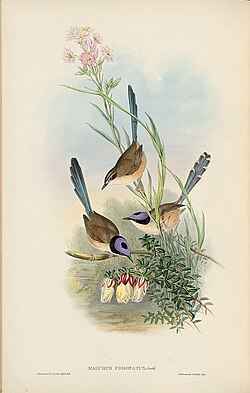
The purple-crowned fairywren (Malurus coronatus) is a small, striking passerine bird endemic to the wet-dry tropics of northern Australia. Known for its vivid coloration and highly specific habitat requirements, this species serves as a critical indicator of the health of Australia's northern river systems. First described by ornithologist John Gould in 1858, the bird is named after the Latin word cǒrōna, meaning crown.
These birds are sexually dimorphic, meaning males and females exhibit distinct physical differences in appearance. While they are currently listed as Least Concern by the IUCN, their populations have faced significant declines due to habitat loss and environmental changes.
Key Facts
- Scientific Name: Malurus coronatus
- Habitat: Dense riparian vegetation along permanent freshwater creeks and rivers.
- Size: Approximately 14 cm in length; weight between 9–13 g.
- Distribution: Spans over 1,500 km across Western Australia, Northern Territory, and Queensland.
- Conservation Status: Least Concern (IUCN 3.1), though local populations are declining.
- Key Feature: Distinctive cheek patches and deep blue tails.
Taxonomy and Subspecies
The purple-crowned fairywren belongs to the family Maluridae. While it was once placed in the monotypic genus Rosina, protein evidence has confirmed its placement within the genus Malurus. There are two recognized subspecies, separated by a geographic barrier of roughly 300 km of unsuitable habitat:
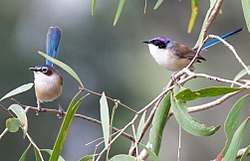
- M. c. coronatus (Western purple-crowned fairywren): The nominate subspecies found in north-western Australia. It is slightly larger with a browner back and a buff-colored breast and belly.
- M. c. macgillivrayi: Found in the eastern regions. This subspecies features a bluer crown and nape, with weak blue-grey shading on the mantle and upper back.
Physical Description
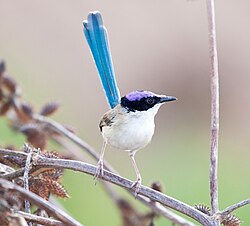
Measuring about 14 cm in length with a 16 cm wingspan, the purple-crowned fairywren is a lightweight bird. Its overall plumage is brown, with greyish-brown wings and a cream-buff belly. The most striking features are the long, upright blue tail—where most feathers are tipped with white—and the vivid crown of the male.
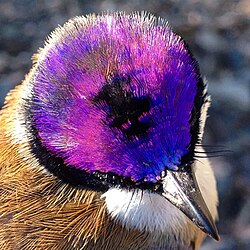
The bill is black, while the legs and feet are brownish-grey. These characteristics, combined with their unique cheek patches, allow researchers to differentiate them from other fairywren species in Northern Australia.
Distribution and Specialized Habitat
The species is a riparian habitat specialist, meaning it relies exclusively on the vegetation lining riverbanks. Its range extends from the Kimberley region of Western Australia through the Victoria River region of the Northern Territory to the Gulf of Carpentaria in Queensland.
Their preferred environment consists of a dense mid-storey of shrubs, such as Pandanus aquaticus or the freshwater mangrove Barringtonia acutangula. In the Victoria River District, they favor thickets of river grass (Chionachne cyanthopoda). To survive flooding events that submerge these shrubs, the birds utilize a high canopy of emergent trees, including Eucalyptus camaldulensis and various Ficus species.
Behavior and Ecology
Territoriality and Breeding
Purple-crowned fairywrens maintain group territories year-round. The shape of these territories depends on the vegetation: in Pandanus areas, territories are linear (50–300 m of river length), while in river-grass areas, they form a mosaic pattern.
Genetic Health and Mating
The species faces significant fitness costs from inbreeding depression, which can reduce egg hatchability by more than 30%. To combat this, females paired with related males often engage in extra-pair copulations (mating outside the social pair bond). Approximately 43% of broods from incestuously paired females contain extra-pair young, a strategy used to ensure the genetic viability of their offspring.
Dispersal Patterns
Dispersal typically occurs along waterways. While the average natal dispersal is less than 3 km, some individuals have traveled up to 70 km. This process is sex-biased: subordinate males often stay in or near their natal territory, whereas females disperse further and are capable of moving between different river catchments.
Survival and Population Status
The time to maturity for both sexes is one year. Based on data from related species, the estimated generation time is 8.3 years, with a maximum wild longevity of 17 years (though the oldest confirmed record is 12 years).
| Subspecies | Estimated Population | Primary Threats | Range |
|---|---|---|---|
| M. c. coronatus | Possibly as low as 10,000 | Cattle grazing, invasive weeds | North-western Australia |
| M. c. macgillivrayi | ~10,000 (single subpopulation) | Habitat degradation | Eastern Northern Australia |
Despite their status, the species has suffered severe declines. They disappeared from the lower Fitzroy River in the 1920s due to sheep and cattle grazing, which replaced native plants with weeds. Similarly, the construction of the Ord River Dam led to the loss of populations through flooding. Intensive cattle grazing continues to threaten river frontages in the Victoria River region.
Frequently Asked Questions
What makes the purple-crowned fairywren different from other fairywrens?
They can be distinguished by their deep blue tails and the presence of specific cheek patches, as well as their strict reliance on riparian (river-fringing) habitats.
Why do female purple-crowned fairywrens mate with males outside their pair?
This behavior helps avoid inbreeding depression. Because incestuous matings significantly reduce the hatchability of eggs, extra-pair matings increase the genetic fitness of the offspring.
How has human activity affected this species?
Livestock grazing has destroyed native riparian vegetation and introduced invasive weeds, while infrastructure projects like the Ord River Dam have flooded essential habitats, leading to localized extinctions.
What is the difference between the two subspecies?
The western subspecies (M. c. coronatus) is slightly larger with a browner back and buff-colored underparts. The eastern subspecies (M. c. macgillivrayi) has a bluer crown and nape with blue-grey shading on its back.