Restless Flycatcher
The Restless Flycatcher (Myiagra inquieta), also known as the restless myiagra, is a captivating passerine bird belonging to the Monarchidae family. Native to eastern and southern Australia, this bird is perhaps most famous for its unique vocalizations, which have earned it several colorful colloquial names, including the razor grinder, scissors grinder, dishlicker, and dishwasher.
While it shares some visual similarities with the willie wagtail, the Restless Flycatcher is a distinct species with its own unique behaviors and ecological niche. Once grouped with populations in New Guinea and northern Australia, it is now recognized as a separate species from the paperbark flycatcher (Myiagra nana), though the two together form a superspecies.
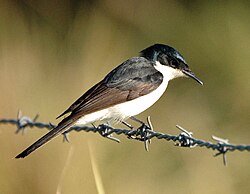
Key Facts
- Scientific Name: Myiagra inquieta
- Common Aliases: Razor grinder, scissors grinder, dishlicker.
- Distribution: East, south-east, and south-west Australia.
- Diet: Insectivorous, focusing on insects, spiders, and centipedes.
- Conservation Status: Least Concern (IUCN 3.1), though populations are decreasing.
- Distinctive Feature: A glossy dark blue crest and a characteristic "grinding" call.
Taxonomy and Identification
First described by ornithologist John Latham in 1801 as Turdus inquietus, the bird's specific epithet is derived from the Latin word inquietus, meaning "restless." This name reflects the bird's active nature.
Physical Characteristics
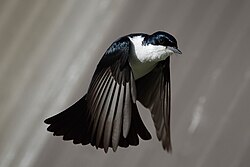
The Restless Flycatcher is a small to medium-sized bird, measuring approximately 20 cm (8 in) in length. Its plumage consists of a grey-blue back, white underparts, and a striking glossy dark blue crest. To distinguish it from the similar-looking willie wagtail, observers should look for the absence of a black throat, the presence of a head crest, a white eyebrow, and a generally more slender body shape.
Distribution and Habitat
This species is widely distributed across Australia, ranging from Cairns in Far North Queensland, through New South Wales and Victoria, into southern South Australia and the south-west of Western Australia. Many populations in the south and south-east are migratory, moving further north during the winter months.
Their preferred habitats include:
- Open and wooded forests.
- River red gum forests near water sources.
- Inland and coastal scrubs.
- Certain semi-urban environments.
Behavior and Ecology
Feeding Habits
The Restless Flycatcher is an insectivore that hunts insects, spiders, and centipedes. It typically hunts from the mid-canopy and rarely descends to the ground. A characteristic hunting behavior involves hovering with its head and tail pointed downwards to pluck insects directly from leaves. They may forage alone or in pairs.
Breeding and Nesting
The breeding process involves the construction of a cup-shaped nest made from shredded bark and grasses, which are bound together using spider-webbing. The interior is lined with soft bark, hair, feathers, or grasses. To camouflage the nest, the birds often decorate the exterior with lichen, strips of bark, or spiders' egg sacs.
Nests are typically placed in the fork of a well-foliaged tree, often overhanging or near water, and can be positioned as high as twenty meters above the ground. A typical clutch consists of three glossy, light-grey to white eggs featuring brown or dark spots at the larger end.
Species Summary
| Feature | Details |
|---|---|
| Average Length | 20 cm (8 in) |
| Primary Diet | Insects and Invertebrates |
| Key Habitat | Wooded forests and coastal scrubs |
| Nesting Material | Bark, grass, and spider-webbing |
| IUCN Status | Least Concern (Decreasing) |
Frequently Asked Questions
Why is it called the "razor grinder"?
The bird is known as the razor grinder or scissors grinder because of its distinctive, metallic-sounding call that mimics the sound of sharpening tools.
How is the Restless Flycatcher different from the Willie Wagtail?
Unlike the willie wagtail, the Restless Flycatcher has a crest on its head, a white eyebrow, a slenderer body, and lacks a black throat.
Where can the Restless Flycatcher be found in Australia?
It is found throughout east, south-east, and south-west Australia, from Cairns in Queensland down through New South Wales, Victoria, South Australia, and Western Australia.
What do Restless Flycatchers eat?
They primarily feed on insects and other invertebrates, such as centipedes and spiders, which they typically hunt from the mid-canopy of trees.
Is the Restless Flycatcher an endangered species?
The IUCN classifies the species as Least Concern; however, it is noted that their population is currently decreasing, although the exact number of individuals is unknown.