Exploring Botany: The Comprehensive Science of Plant Life
For over 3.5 billion years, plants have shaped the trajectory of life on Earth. The study of these organisms is known as botany, or plant science. This expansive branch of natural science and biology examines how plants grow, reproduce, and evolve. From the microscopic interactions of biochemistry to the vast complexities of global ecology, botany provides the essential framework for understanding the green world around us.
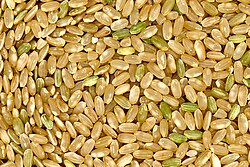
The food we eat comes directly or indirectly from plants, such as rice, making this science fundamental to human survival.
The Scope and Diversity of Plant Life
Botany is a multi-layered discipline. Scientists can analyze plants at various scales, including molecular biology (the study of biological activity at the molecular level), genetics, and cell biology. On a larger scale, botanists study anatomy (internal structure), morphology (physical form), and taxonomy (the science of classification).
The sheer diversity of the plant kingdom is staggering. There are approximately 410,000 species of land plants. Within this group, about 391,000 are vascular plants—those possessing specialized tissues for conducting water and minerals. This group is further divided into roughly 369,000 flowering plants and 20,000 bryophytes, which are non-vascular plants such as mosses.
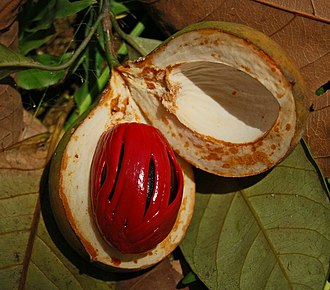
A prime example of botanical diversity is Myristica fragrans, a species native to Indonesia that provides two distinct spices: the red aril, known as mace, and the dark brown nutmeg.
The Evolution of Botanical Study
Botany began as prehistoric herbalism, driven by the human need to identify plants that were edible, medicinal, or poisonous. This early investigation evolved into the creation of medieval physic gardens, often managed by monasteries to cultivate plants with perceived healing properties.
By the 1540s, these gardens transitioned into academic botanical gardens attached to universities, such as the Padua botanical garden. These institutions allowed for the systematic study and cataloging of plant species.

The Birth of Modern Taxonomy
The effort to organize plant collections led to the development of plant taxonomy. In 1753, Carl Linnaeus introduced the binomial system of nomenclature, a method of naming species using two parts (typically the genus and specific epithet). This system remains the global standard for naming all biological species today.

Botany relies heavily on Latin names for precise identification. For example, in the species Echeveria glauca, the specific name glauca means blue.

Pioneers of Plant Science
The field was advanced by several key figures. Leonhart Fuchs, Otto Brunfels, and Hieronymus Bock are recognized as the "three German fathers of botany." Fuchs and Brunfels were notable for moving away from simply copying ancient texts, instead relying on their own original observations. Bock further contributed by creating his own system of plant classification.
In the 19th and 20th centuries, the science shifted toward heredity and structure. Building on Gregor Mendel's gene-chromosome theory, August Weismann proved that inheritance occurs exclusively through gametes. Later, Katherine Esau's groundbreaking work on plant anatomy became a cornerstone of structural biology, providing the foundation for modern textbooks on seed plants.
Modern Techniques and Specializations
The 19th and 20th centuries introduced powerful tools that revolutionized botany. Optical microscopy and live cell imaging allowed scientists to see the inner workings of plants for the first time.
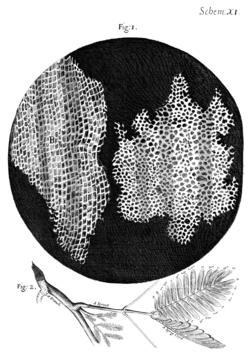
As technology progressed, botanists adopted electron microscopy, the analysis of chromosome numbers, and the study of enzyme structures. In the last two decades of the 20th century, the field embraced genomics (the study of an organism's entire genome) and proteomics (the large-scale study of proteins) to classify plants with unprecedented accuracy.
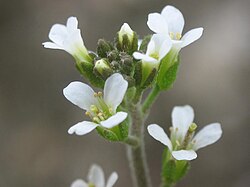
One of the most significant milestones in this era was the sequencing of the genome of Arabidopsis thaliana (thale cress), which remains the most important model organism for plant research.
Modern botany also utilizes micropropagation—the practice of rapidly multiplying stock plant material to produce many progeny—often used with transgenic plants.
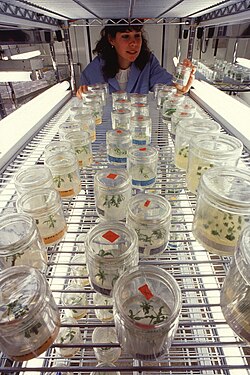
Key Areas of Botanical Research
Plant Physiology and Chemistry
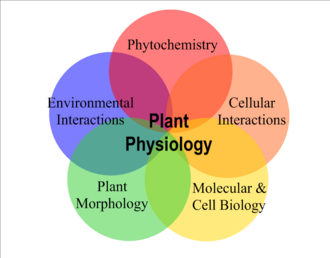
Plant physiology examines how plants function, focusing on areas such as metabolism and nutrient transport.
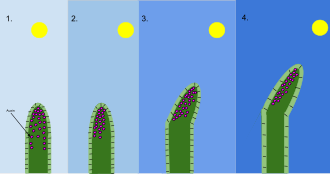
A critical part of this is the study of plant hormones. For instance, auxin is a hormone that regulates growth; when sunlight hits a shoot from an angle, auxin redistributes to the shaded side, stimulating cell elongation and causing the plant to bend toward the light.
Botanists also study plant chemistry through methods like paper chromatography, which can separate pigments in chloroplasts, such as yellowish xanthophylls and greenish chlorophylls.

Anatomy, Morphology, and Evolution
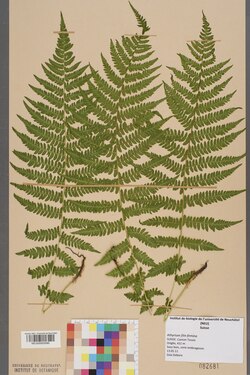
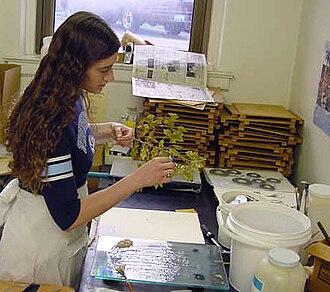
The study of plant form involves detailed recording and description. This often includes creating herbarium specimens—preserved plant samples used for scientific study.
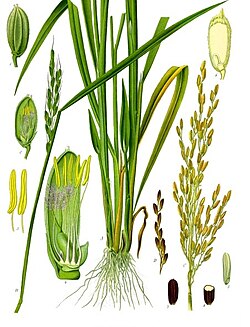
Morphology looks at the external structure of plants, such as the roots, stems, and flowers of the rice plant Oryza sativa.
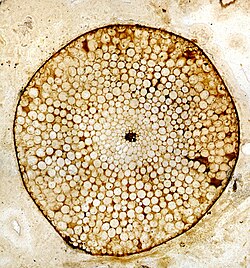
Evolutionary botany uses fossils to trace plant history. For example, transverse sections of fossil stems from the Devonian vascular plant Rhynia gwynne-vaughani provide clues about early plant life.
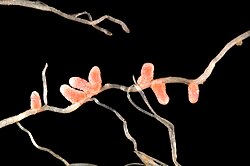
Finally, botany explores symbiotic relationships, such as the nodules of Medicago italica, which house Ensifer meliloti bacteria. The plant provides nutrients and an anaerobic environment, while the bacteria fix nitrogen for the plant.
Key Facts
- Timeline: Botany studies plant life spanning 3.5 billion years.
- Species Count: There are approximately 410,000 land plant species.
- Vascular Plants: About 391,000 species, including 369,000 flowering plants.
- Non-Vascular Plants: Approximately 20,000 species of bryophytes.
- Standard Naming: The binomial system of nomenclature was established by Carl Linnaeus in 1753.
- Model Organism: Arabidopsis thaliana was the first plant to have its genome sequenced.
Botany Summary Table
| Category | Details / Figures | Significance |
|---|---|---|
| Land Plants | ~410,000 species | Total estimated diversity of terrestrial flora |
| Vascular Plants | ~391,000 species | Plants with specialized transport tissues |
| Bryophytes | ~20,000 species | Non-vascular plants (e.g., mosses) |
| Carl Linnaeus | 1753 | Introduced the binomial nomenclature system |
| Katherine Esau | 20th Century | Founded modern plant structural biology/anatomy |
Frequently Asked Questions
What is the difference between vascular plants and bryophytes?
Vascular plants possess specialized tissues (xylem and phloem) for transporting water and nutrients throughout the plant. Bryophytes are non-vascular plants, meaning they lack these specialized tissues and generally remain small and low to the ground.
Who created the system we use to name plants today?
Carl Linnaeus created the binomial system of nomenclature in 1753. This system assigns every species a two-part Latin name, consisting of the genus and a specific epithet, ensuring a universal standard for scientists worldwide.
What is a model organism in botany?
A model organism is a species that is extensively studied to understand particular biological processes, which can then be applied to other plants. Arabidopsis thaliana (thale cress) is the primary model organism in botany because it was the first plant to have its genome sequenced.
How did botany evolve from herbalism?
Botany began as prehistoric herbalism to identify edible and medicinal plants. This evolved into medieval physic gardens for medicine, and eventually into university-affiliated botanical gardens in the 1540s, which shifted the focus toward academic and systematic study.
What role does auxin play in plant growth?
Auxin is a plant hormone that regulates cell elongation. When a plant is exposed to directional light, auxin moves to the shaded side of the shoot, causing those cells to grow faster and bending the plant toward the light source.