Species Description: The Science of Naming New Life
Every time a scientist encounters an organism that does not fit into any known category, they embark on the formal process of a species description. This is a rigorous scientific publication that officially introduces a new species to the world, detailing its unique characteristics and explaining how it differs from its closest relatives. Without this standardized process, the global catalog of life would be a chaotic collection of regional nicknames rather than a precise scientific record.
To date, approximately 1.9 million species have been identified and described. However, this is only a fraction of the estimated 8.7 million species that may exist on Earth. The scale of life's history is even more vast, with over five billion species having gone extinct over the eons.
Key Facts
- Standardization: Descriptions must follow strict codes: ICZN (animals), ICN (plants, algae, fungi), and ICTV (viruses).
- Validity: A name only becomes official upon the date of publication in a scientific manuscript or book.
- Type Specimens: Most descriptions require the selection of at least one physical type specimen for reference.
- Historical Root: Carl Linnaeus standardized modern taxonomy with Systema Naturae in 1735.
- Naming Trends: New species descriptions are currently at an all-time peak.
The Formal Naming Process
The journey from discovery to a valid scientific name involves meticulous research. Once a scientist determines an organism is indeed new, they summarize their findings in a manuscript. This document must fulfill specific criteria set by nomenclature codes to ensure the name is unambiguous. For instance, the International Code of Zoological Nomenclature (ICZN) advises that names should be compact, memorable, and appropriate.
Species names are written using the 26 letters of the Latin alphabet. While many are derived from other languages, they are always Latinized to maintain a universal scientific language.
Once a name is approved and published, it generally cannot be changed unless a significant error is found. This permanence leads to some historical curiosities. For example, the beetle Anophthalmus hitleri, named in 1933, remains in use despite the controversial nature of its namesake.
Creative and Humorous Naming
While most names are descriptive, some are whimsical. The extinct dinosaur genus Borogovia is named after a character from Lewis Carroll's poetry, and the plant Macrocarpaea apparata references the "apparating" magic of the Harry Potter series. In a more mischievous instance, Sir Peter Scott proposed Nessiteras rhombopteryx for the Loch Ness Monster—a name that is actually an anagram for "monster hoax by Sir Peter S."
Funding and Benefactors in Taxonomy
Naming rights are sometimes used to support the very science that discovers new life. Scientists often name species after benefactors or public figures. The genus Victoria (a waterplant) honors Queen Victoria, while the lemur Avahi cleesei recognizes actor John Cleese for his advocacy for Madagascan wildlife.
Some non-profit organizations, such as BIOPAT – Patrons for Biodiversity, allow sponsors to name species in exchange for financial contributions. This model has raised over $450,000 for conservation. A notable example is Plecturocebus aureipalatii, named after the Golden Palace casino following a $650,000 donation to Bolivia's Madidi National Park in 2005.
However, not all codes encourage this. The International Code of Nomenclature for algae, fungi, and plants (ICN) recommends that genera should not be dedicated to individuals who have no connection to natural science.
A History of Cataloging Life
The drive to catalog all living things is ancient. Aristotle's History of Animals (c. 343 BC) was one of the first large catalogs, though it included mythological creatures like the manticore. Pliny the Elder followed in 77 AD with his Natural History, and the 12th-century Old Norse work Konungs skuggsjá described the sea monsters of Iceland, including the fictitious hafgufu.
The turning point for modern science came in 1735 with Carl Linnaeus.
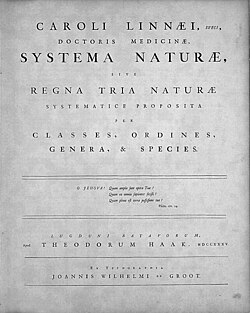
Linnaeus introduced a standardized system of taxonomy that replaced bulky, all-encompassing volumes with a more efficient structure. As the number of known species grew, scientists shifted from writing massive catalogs to publishing focused papers on single species, allowing specialists to describe organisms within their specific field of expertise.
Modern Methodology and Statistics
Today, species descriptions are more precise than ever. Scientists may use a diagnosis—a specific statement of the traits that distinguish the new species from others—which may be based on genetics rather than just morphology (physical form). A point of modern controversy is the description of species without voucher specimens (physical samples preserved in a museum).
Current data shows that the rate of new species descriptions is increasing, reaching an all-time peak in recent years.
| Year | Total New Species | Animals | Plants | Fungi | Bacteria | Cumulative Total |
|---|---|---|---|---|---|---|
| 1920 | 9,685 | 6,693 | 2,086 | 855 | 8 | 229,280 |
| 1970 | 10,578 | 8,458 | 1,132 | 802 | 14 | 353,006 |
| 2000 | 13,301 | 10,184 | 1,653 | 1,135 | 68 | 448,350 |
| 2020 | 17,044 | 10,936 | 2,714 | 3,127 | 16 | 540,440 |
Frequently Asked Questions
What makes a species description valid?
A description is valid if it is published in a scientific venue and adheres to the guidelines of the relevant nomenclature code (ICZN, ICN, or ICTV), typically including the designation of a type specimen.
Can a scientific name be changed once it is published?
Generally, once a name is assigned and approved, it cannot be changed except in cases where a significant error has been made.
What is the difference between a description and a diagnosis?
A description is a detailed account of the organism, while a diagnosis specifically highlights the characteristics that distinguish the new species from previously described related species.
Who is considered the father of modern taxonomy?
Carl Linnaeus is the earliest recognized species authority, having standardized the modern system with the publication of Systema Naturae in 1735.
Is it legal to sell the naming rights of a new species?
While some nomenclature codes discourage naming genera after people unrelated to science, some non-profit organizations allow benefactors to name species in exchange for financial support for conservation and research.