Beirut Souks: A Fusion of Ancient Heritage and Modern Commerce
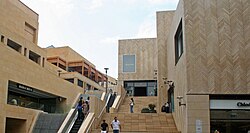
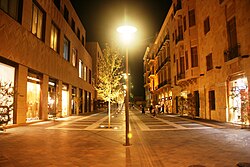
Located in the heart of the Beirut Central District, the Beirut Souks serve as a vibrant commercial hub where ancient history meets contemporary luxury. This expansive district is more than just a shopping destination; it is a meticulously planned urban space that blends high-end retail with public piazzas, landscaped pedestrian zones, and cultural landmarks.
The complex spans approximately 128,000 square metres of built-up area. It features over 200 retail outlets, 25 restaurants and cafés, an entertainment center, and a 14-screen cinema complex. By integrating modern infrastructure with a layout inspired by antiquity, the Beirut Souks have reclaimed their role as the commercial center of the city.
Key Facts
- Total Area: Approximately 128,000 square metres of built-up space.
- Retail Capacity: Over 200 shops, including global luxury brands.
- Design Basis: Reconstructed following the ancient Roman-Greek (Hellenistic) street grid.
- Opening Date: October 2, 2009.
- Key Developers: Managed and implemented by Solidere.
- Architectural Style: A low-rise complex consisting of North and South Souks.
A History of Resilience and Destruction
Historically, the souks were the beating heart of Beirut's trade. During the Romano-Byzantine era, the area flourished with villas and shopping colonnades until a devastating earthquake struck in 551 A.D. Centuries later, the district remained a premier destination; Souk al-Tawileh and Souk al-Jamil were renowned for haute-couture and fashionable boutiques, while Souk al-Franj served as the nation's largest market for flowers, fruits, and vegetables.
This prosperity was shattered during the Lebanese Civil War. By October 1975, the central district became a sniper-patrolled "no man's land." Fierce fighting led to shops being burned and blown up, affecting merchants of all backgrounds. A significant cultural loss occurred in the spring of 1983 when the Antoun Bey Khan, a historic caravanserai (a roadside inn where travelers could rest), was demolished to open the view toward the sea.
The Path to Reconstruction
Following the end of hostilities in 1990, the Lebanese Council for Development and Reconstruction commissioned Dar Al-Handasah to create a master plan. Initial proposals suggested a complete demolition of the historical center to make way for modern buildings. However, this sparked intense intellectual opposition, leading to a revised strategy focused on preservation and renovation.
In September 1994, the Lebanese government created Solidere, a private share-holding company, to manage the rehabilitation. While many medieval buildings were too damaged to save, Solidere aimed to restore the area's mercantile identity. An international competition won by Adam Drisin and Evelyn McFarlane ensured the new design adhered to the original Hellenistic street grid.
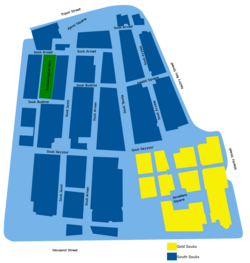
The project involved several specialized architects: José Rafael Moneo Vallés designed the southern souk, and Kevin Dash designed the Gold Souks. Despite an estimated reconstruction cost of 100 million dollars and a planned opening in 2000, political instability and licensing delays pushed the official opening to 2009.
Architecture and Layout
The modern Beirut Souks are divided into two primary components: the North Souks and the South Souks. The total floor space reaches 163,010 square metres, complemented by 17,307 square metres of pedestrian areas.
The South Souks
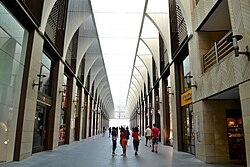
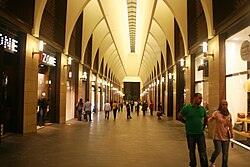
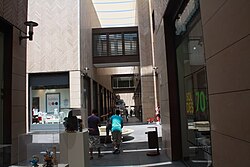
Designed by Rafael Moneo and Samir Khairallah, the South Souks are characterized by interconnected open spaces and vaulted shopping alleys. The Gold Souk, designed by Kevin Dash and Rafic Khoury, houses 49 of the district's shops. To honor the past, the new alleys retain their historic names, including:
- Souk al Tawila (The Long Souk)
- Souk Arwam
- Souk Jamil
- Souk Ayyass
- Souk Sayyour
- Souk Bustros
- Souk Arwad
Conservation and Heritage
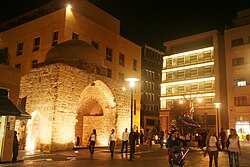
Beyond commerce, the site is an archaeological treasure. Solidere's plan preserved findings from the Phoenician era through the French mandate. Key restored landmarks include the ancient Phoenician commercial quarter, a Medieval moat, the Byzantine mosaics, and the Mameluk Koranic madrassa of Ibn Iraq Al Dimashqi.
Commercial Profile and Recognition
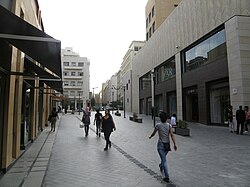
The district hosts a wide array of international luxury and high-street brands, ranging from fashion houses like Louis Vuitton, Armani, and Yves Saint Laurent to athletic brands like Nike and Adidas, and specialty stores like Virgin and Samsung.
| Feature | Details |
|---|---|
| Total Retail Outlets | 200+ |
| Dining & Cafés | Approximately 25 |
| Key Architects | Rafael Moneo, Kevin Dash, Adam Drisin, Evelyn McFarlane |
| Major Award | Capital Issues Award for Architectural Excellence (2009) |
| Boundaries | Mir Majid Arslan Ave (N), Rue Weygand (S), Patriarch Howayek (W), Allenby St (E) |
Frequently Asked Questions
When did the Beirut Souks officially open?
The Beirut Souks opened to the public on October 2, 2009, following a ten-year delay caused by political instability.
What is the significance of the Hellenistic street grid?
The Hellenistic street grid refers to the ancient Greek-style orthogonal (grid-like) street plan. The reconstruction used this layout to maintain a connection to the city's Roman and Greek roots.
Who was responsible for the reconstruction of the district?
The reconstruction was managed by Solidere, a private share-holding company created by the Lebanese government.
What historic landmarks were preserved in the area?
Preserved sites include the Phoenician commercial quarter, the Mameluk Koranic madrassa of Ibn Iraq Al Dimashqi, Byzantine mosaics, and a Medieval moat.
Are there any recent incidents reported at the Souks?
On September 15, 2020, a fire broke out in a Zaha Hadid building within the Beirut Souks, though it was quickly extinguished.