Beirut Castle: The Lost Crusader Fortress of Lebanon
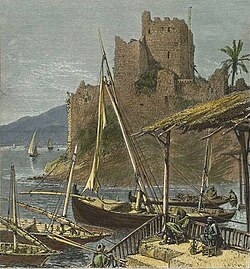
Once a dominant feature of the Lebanese coastline, Beirut Castle was a major Crusader fortification located in the heart of downtown Beirut. For centuries, this stronghold served as a strategic military asset, witnessing the rise and fall of empires. However, unlike many of the region's surviving medieval sites, the castle was entirely demolished in the late 19th century to make way for the modernization of the city's infrastructure.
Key Facts
- Location: Downtown Beirut, Lebanon, situated on a sea promontory.
- Primary Era: Built and expanded during the Crusades (12th and 13th centuries).
- Key Figures: Associated with Raymond III of Tripoli, Saladin, and John of Ibelin.
- Fate: Demolished between 1889 and 1895 for the expansion of the Port of Beirut.
- Modern Status: Basement remains were uncovered during 1995 excavations in the Beirut Central District.
The Rise and Fall of the Fortress
The military history of Beirut began with its city walls, which were noted by William of Tyre during the first Crusader conquest in 1110. The actual city castle was likely constructed between 1183 and 1185, following a failed siege by Saladin (the founder of the Ayyubid dynasty). This construction is attributed to the leadership of Raymond III of Tripoli.
By 1187, the castle was well-documented by chroniclers when Saladin successfully captured the city. The Crusaders regained control in 1197, and by 1198, the fortress came under the rule of John of Ibelin. Following extensive refurbishments by Ibelin, the castle was described in detail by Wilbrand of Oldenburg in 1212.
Mamluk and Ottoman Transitions
The tide turned in 1291 when Mamluk troops captured Beirut, leading to the partial demolition of the fortifications. However, the site remained strategically important; the Mamluk Sultan Barquq erected a new tower there in the late 14th century. In the 1770s, Jazzar Pasha destroyed portions of the castle but subsequently rebuilt the tower.
The 19th century brought further instability. During the Egyptian–Ottoman War of 1840, a British fleet bombed the site, causing significant damage. By this era, the complex was divided into two distinct parts: the "land castle" and the "sea castle," the latter being a tower situated on a small islet.
Architectural Layout and Demolition
The castle was strategically positioned on a promontory extending into the sea, north of the ancient Tell of Beirut. To protect the fortress from land-based attacks, a moat (a deep, wide ditch) measuring 6 meters wide separated the southwestern tower from the lower city.
A separate fortification, known as Burj al-Musallah, was located on a nearby islet. This layout ensured that the defenders had a commanding view of both the harbor and the city approach.
The Path to Oblivion
In the late 19th century, Beirut experienced rapid economic growth fueled by silk exports and trade liberalization. To accommodate this growth, the Municipality of Beirut received authorization from the Ottoman Empire in 1887 to modernize the Port of Beirut.
Between 1889 and 1895, the castle structures and the promontories they sat upon were completely flattened. This land was used to build a road and railway—now known as Avenue Charles Helou. The area at the foot of the former promontory evolved into the Souk Mal-al-Qabban, a bustling market for bulk goods such as coffee, tea, rice, sugar, and grains.
| Period/Year | Event | Key Figure/Entity |
|---|---|---|
| 1110 | First Crusader conquest; city walls mentioned | William of Tyre |
| 1183–1185 | Construction of the city castle | Raymond III of Tripoli |
| 1198 | Castle rule and refurbishment | John of Ibelin |
| 1291 | Capture and partial demolition | Mamluk Troops |
| 1840 | Bombardment and damage | British Fleet |
| 1889–1895 | Complete demolition for port expansion | Municipality of Beirut |
| 1995 | Discovery of basement remains | Beirut Central District Development |
Frequently Asked Questions
Where exactly was Beirut Castle located?
The castle was situated on a sea promontory in downtown Beirut, north of the ancient Tell of Beirut and west of the current intersection of Al-Shuhada Street and Avenue Charles Helou.
Why was the castle demolished?
It was demolished between 1889 and 1895 to allow for the enlargement and modernization of the Port of Beirut, specifically to make room for a new road and railway.
What happened to the Burj al-Musallah?
The Burj al-Musallah was a separate fortification built on an islet near the intersection of Foch Street and Avenue Charles Helou; it was also removed during the port expansion works.
Are there any remains of the castle today?
While the visible structures were flattened, excavations conducted in 1995 during the development of the Beirut Central District uncovered the remains of the Land Castle's basement.
Who were the primary builders of the castle?
The castle was primarily built and expanded by the Crusaders, with significant contributions from Raymond III of Tripoli and later refurbishments by John of Ibelin.