Battle of Clachnaharry: The Clan Munro and Clan Mackintosh Conflict
The Battle of Clachnaharry stands as a vivid example of the volatile nature of the Scottish clan wars. Fought in 1454 on the south bank of the Beauly Firth on the outskirts of Inverness, this clash pitted the Clan Munro against the Clan Mackintosh (part of the Chattan Confederation). What began as a dispute over traditional Highland customs escalated into a bloody confrontation that left a lasting mark on the genealogy and history of the region.
Key Facts
- Date: 1454 (though some sources suggest an earlier date).
- Location: Clachnaharry, near Inverness, Scotland.
- Outcome: Victory for Clan Munro.
- Primary Cause: A dispute over "road collop" (passage money) following a cattle raid.
- Notable Figure: John Munro, known as John Baclamhach due to a mutilated hand.
- Casualties: Estimates vary, with some accounts citing 200 Mackintoshes killed.
The Spark of Conflict: Cattle and Customs
The origins of the battle lie in a cycle of revenge and the strict social codes of the Scottish Highlands. According to various accounts, John Munro, the Tutor of Foulis, was traveling home from the south of Scotland after a cattle raid in Perthshire. During his journey, he encountered the Clan Mackintosh.
At the time, it was customary for a chief to demand a road collop (also referred to as Staoig Ratliaid or Staoig Crtich)—a form of passage money or a share of the booty—when a party drove plundered cattle through another gentleman's land. While John Munro offered a portion of the spoils, the Mackintosh side rejected the offer, demanding a significantly higher share (some sources say half, others one-third). When Munro refused to yield, the Mackintoshes pursued him, leading to the confrontation at Clachnaharry.
Conflicting Historical Accounts
Because the battle was recorded in manuscripts written decades or centuries later, historians face conflicting narratives regarding the leadership and casualties of the fight.
The Gordon and Wardlaw Perspectives
Sir Robert Gordon, writing in 1630, and James Fraser in the 1674 Wardlaw Manuscript, both suggest that the chief of Clan Mackintosh was present and killed during the battle. Fraser's account adds a specific detail: the conflict was preceded by an insult where the tails of John Munro's horses were cut off while he rested in Strathardle, prompting Munro to return with 350 men to ravage the area before the final clash at Clachnaharry.
The Mackintosh of Kinrara Account
A different narrative emerges from the 1679 Mackintosh of Kinrara manuscript. This account claims that the chief of Mackintosh was not present. Instead, the pursuit was led by the chief's grandson, also named Malcolm Mackintosh, who acted without the chief's concurrence. According to this version, the younger Malcolm did not even arrive until the battle had concluded, leaving him "sorrowful" over the outcome caused by his hastiness.
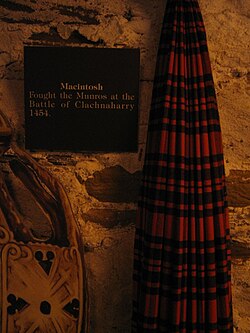
The Aftermath and Legacy
Despite the differing accounts of who died, most sources agree that the Munros held a tactical advantage by utilizing the rocky terrain to shield themselves and harass the Mackintoshes with arrows. The battle resulted in a Munro victory, though John Munro himself was severely wounded and left for dead on the field.
John Munro was rescued and cared for by Lord Lovat. Due to the mutilation of his hand during the fight, he became known as John Baclamhach (or John Bach-klawach). This act of kindness by the Frasers of Lovat is said to have established a long-standing bond of friendship between the Fraser and Munro clans.
The Clachnaharry Battle Monument
The site of the clash is marked by the Clachnaharry Battle Monument, erected in 1821 by Major Hugh Robert Duff. The monument originally featured a column 40 to 50 feet high, which collapsed during gales in 1951. Today, the monument remains as a symbolic marker, with one side facing the Munro territory and the other facing the Chattan territory.
Battle Summary
| Feature | Details |
|---|---|
| Belligerents | Clan Munro vs. Clan Mackintosh (Clan Chattan) |
| Primary Leader (Munro) | John Munro (Tutor of Foulis) |
| Primary Leader (Mackintosh) | Mackintosh of Mackintosh / Malcolm Mackintosh |
| Tactical Advantage | Munros utilized rocky terrain for cover and archery |
| Key Outcome | Munro victory; John Munro wounded (John Baclamhach) |
Frequently Asked Questions
What was a "road collop"?
A road collop was a traditional Highland custom where a chief demanded a portion of plundered cattle or goods as payment for allowing a party to travel through his ancestral lands.
Who won the Battle of Clachnaharry?
The Battle of Clachnaharry was a victory for Clan Munro, although they suffered casualties and their leader, John Munro, was seriously wounded.
Why was John Munro called "Baclamhach"?
He earned the name John Baclamhach (or Bach-klawach) because his hand or arm was mutilated during the battle, leaving him permanently disabled.
Is the Mackintosh chief's death confirmed?
No. While early accounts by Sir Robert Gordon and James Fraser state the chief was killed, the Mackintosh of Kinrara manuscript asserts that the chief was not present and that it was his grandson who led the pursuit.
What happened to the Clachnaharry monument?
The monument, built in 1821, originally had a tall column that fell over during severe gales in 1951. The base remains, marking the territories of the two clans.