Army and Ground Forces: Evolution, Structure, and History
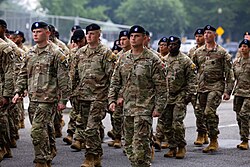
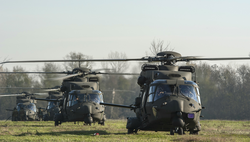
An army, also referred to as a ground force or land force, is an armed military organization designed to fight primarily on land. In its broadest sense, it represents the land-based service branch of a nation's military. While focused on terrestrial combat, modern armies often integrate aviation assets through specialized army aviation components to provide air support and troop transport.
Within a national military framework, the term "army" can refer to the entire land service or specifically to a field army—a large-scale operational formation capable of independent action.
Key Facts
- Primary Role: Conducting warfare and security operations on land.
- Core Components: Typically includes infantry, armored corps, artillery, signal corps, special forces, military police, and medical corps.
- Historical Shift: Transitioned from aristocratic and mercenary forces to national armies based on conscription and patriotism.
- Organization: Generally structured hierarchically from small squads up to massive field armies.
The Structure of Modern Armies
While organization varies by nation, most armies utilize a standardized hierarchy to manage command and control. This structure allows for the efficient movement of troops and resources during conflict.
Common Specialized Corps
To maintain operational efficiency, armies are divided into specialized functional groups:
- Infantry: The primary ground combat force.
- Armoured Corps: Units utilizing tanks and armored vehicles.
- Artillery Corps: Long-range weapon systems for fire support.
- Signal Corps: Responsible for communications and information technology.
- Special Forces: Highly trained units for unconventional warfare.
- Military Police and Medical Corps: Providing law enforcement and healthcare services.
Hierarchical Formations
In North America and Europe, the chain of command typically follows this progression:
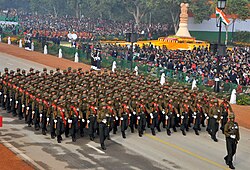
- Field Army: A massive formation commanded by a general or lieutenant general, consisting of a headquarters, army troops, and typically three to four corps and divisions.
- Corps: A large unit consisting of two or more divisions, usually commanded by a lieutenant general.
- Battalion: A mid-sized unit of 500 to 750 soldiers commanded by a colonel or lieutenant colonel. It comprises 3–5 companies (or batteries for artillery and squadrons for armor).
- Company, Platoon, and Squad: The smallest building blocks of the army, allowing for granular tactical control.
Historical Evolution of Land Forces
Ancient Civilizations
Ancient Egypt established one of the world's first professional standing armies. During the Old Kingdom (2700–2200 BCE), the military focused on internal stability and territorial defense. By the Middle and New Kingdoms (circa 2000–1500 BCE), Egypt developed specialized divisions, standardized weaponry, and war chariots to build a vast empire.
In India, the Maurya and Nanda Empires fielded some of the largest forces in history, peaking at over 600,000 infantry, 30,000 cavalry, 8,000 war-chariots, and 9,000 war elephants. Later, during the Gupta age, longbowmen were recruited to counter horse archers.
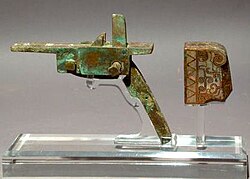
Ancient China's military power was deeply tied to political stability. During the Warring States period, the perfection of the crossbow—featuring bronze bolts capable of piercing armor—became a critical military secret. This era led to the consolidation of power under Qin Shi Huang by 221 BCE, who famously commissioned the Terracotta Army to guard his tomb.
Sparta created one of the earliest professional armies through a rigorous state-sponsored training system. Boys entered barracks at age seven or eight, remaining there until age thirty. These hoplites (heavily armed foot soldiers) were equipped with standardized round shields, spears, and helmets, wearing scarlet uniforms.
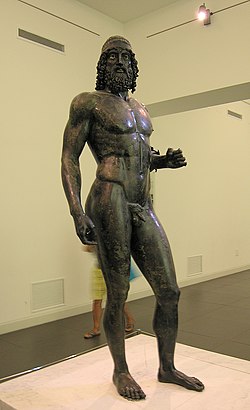
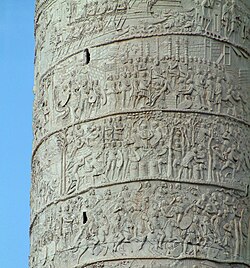
The Roman Army evolved from a citizen-based conscription model during the Republic to a professional organization where citizens served continuous 25-year terms.
Medieval and Renaissance Warfare
Medieval European armies often relied on noble knights serving their suzerains and hired footsoldiers. In England, while every man had a theoretical 40-day service obligation, the system of scutage allowed citizens to pay a fee to avoid service, which the crown used to hire professional soldiers.
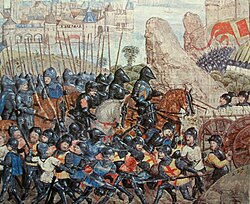
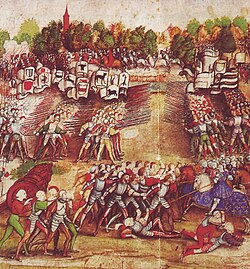
By the Renaissance, mercenaries became the backbone of many armies. In 1439, France began transitioning toward a royal standing army through the taille tax, creating the compagnies d'ordonnance to replace independent mercenary companies.
The Early Modern Era to the Nation-State
The 18th century saw the rise of "lace wars," characterized by disciplined, professional troops and aristocratic officer corps. However, the French Revolutionary Wars introduced the levée en masse (mass conscription), shifting the paradigm toward national armies fueled by patriotism rather than pay.
![The colonels of the French Guards and British guards politely discussing who should fire first at the Battle of Fontenoy (1745).[21] An example of "lace war".](/images/8e/e9/8ee9689553c8c39fdaf9a4bc26c736a193625d54b6ed6e491413579d0b7f09c6.jpg)
The Battle of the Nations in 1813 marked a pivotal transition where masses replaced hired professionals, signaling the dawn of total war.
![The battle of the Nations (1813), marked the transition between aristocratic armies and national armies.[24] Masses replace hired professionals and national hatred overrides dynastic conflicts. An early example of total wars.](/images/5e/3a/5e3af890e3fb0d586fb2ebff6aebd02b7b1ea61d0b5231f01e6b929b4fb4413d.jpg)
Different nations adopted unique recruitment models: Prussia used regimental cantons to balance agrarian needs with military service; Russia transitioned from unreliable streltsy (musketeer corps) to a German-style regular army under Peter I; and the Ottoman Empire utilized the devşirme system to recruit Christian youths.
Summary of Military Evolution
| Era/Culture | Primary Recruitment | Key Characteristic |
|---|---|---|
| Ancient Egypt | Professional Standing | First use of specialized divisions and chariots |
| Sparta | State-Training (Agoge) | Lifelong professional hoplite soldiers |
| Ancient Rome | Conscription $\rightarrow$ Professional | Transition to 25-year professional service |
| Medieval Europe | Feudal Levies / Mercenaries | Knightly class and paid core troops |
| Modern Era | National Conscription / Volunteer | Integration of aviation and specialized corps |
Frequently Asked Questions
What is the difference between an army and a field army?
An army generally refers to the entire land-based military branch of a nation. A field army is a specific, large-scale operational formation within that branch, consisting of multiple corps and divisions commanded by a general.
What was the purpose of scutage in medieval England?
Scutage was a payment made by landholders to the crown in lieu of performing their required military service. This allowed the government to use the funds to hire professional soldiers instead of relying on short-term peasant levies.
How did the Roman Army change over time?
It began as a citizen army based on mandatory conscription during the Republic and eventually evolved into a professional organization where soldiers served for a fixed term of 25 years.
What is the levée en masse?
The levée en masse was a policy of mass conscription introduced during the French Revolutionary Wars, which shifted warfare from small professional or mercenary forces to large national armies driven by patriotism.
What are the primary components of a modern army's structure?
Modern armies are typically organized into specialized corps (such as infantry, armor, and artillery) and structured hierarchically from squads and platoons up to battalions, corps, and field armies.