Argentina 2007 Presidential Election
The 2007 Argentine general election, held on October 28, marked a significant transition in the country's political landscape. Following the presidency of Néstor Kirchner, the ruling Front for Victory (FPV)—a center-left alliance led by the Peronist Party—sought to maintain its hold on power. Despite high approval ratings, President Kirchner chose not to seek re-election, instead nominating his wife, Senator Cristina Fernández de Kirchner, to lead the ticket.
To secure a victory without a ballotage (a second-round runoff election), Argentine law requires a candidate to either obtain more than 45% of the valid votes or more than 40% with a lead of at least 10 percentage points over the runner-up. The FPV strategy included nominating Mendoza Governor Julio Cobos as the vice-presidential candidate to attract "K Radicals"—members of the Radical Civic Union (UCR) who supported the populist policies of Kirchnerism.
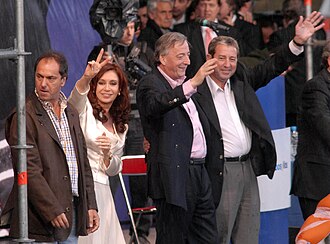
Key Facts
- Winner: Cristina Fernández de Kirchner (FPV) won with 45.28% of the popular vote.
- Turnout: Voter participation was high, with 76.20% of the 27,137,719 registered voters casting ballots.
- Legislative Control: The Front for Victory secured a majority in the Chamber of Deputies with 84 seats.
- Senate Results: The FPV won 17 seats, while the Civic Coalition saw a gain of 4 seats.
- Key Opponent: Elisa Carrió of the Civic Coalition finished second with 27.05% of the vote.
Presidential Election Results
Cristina Fernández de Kirchner secured a decisive victory, avoiding a runoff by surpassing the 45% threshold. Her campaign focused on continuing the policies of the previous administration, while her primary challenger, Elisa Carrió, positioned the Civic Coalition as the main alternative.
Other notable candidates included Roberto Lavagna of the Consensus for an Advanced Nation (UNA), who captured 17.81% of the vote, and Alberto Rodríguez Saá of the Justice, Union and Freedom Front, who received 7.64%.
| Candidate | Alliance/Party | Popular Vote | Percentage | States Carried |
|---|---|---|---|---|
| Cristina Fernández de Kirchner | Front for Victory (FPV) | 8,652,293 | 45.28% | 21 |
| Elisa Carrió | Civic Coalition | 5,168,481 | 27.05% | CABA |
| Roberto Lavagna | UNA | 3,402,981 | 17.81% | 1 |
| Alberto Rodríguez Saá | Justice, Union and Freedom Front | 1,459,174 | 7.64% | 0 |
Legislative and Provincial Outcomes
Chamber of Deputies
The legislative elections saw the Front for Victory strengthen its position, winning 84 of the 154 seats contested, a gain of 14 seats. The Civic Coalition also performed well, increasing its representation by 10 seats to reach a total of 23. In contrast, the Consensus for an Advanced Nation lost 7 seats.
The Senate
In the Senate, the Front for Victory maintained 17 seats. The Civic Coalition emerged as a significant gainer, adding 4 seats to its total. The Neuquén People's Movement also managed to secure one seat.
Gubernatorial Races
The provincial results were mixed. While the FPV and its allies won several key governorships—including Buenos Aires (Daniel Scioli) and Tucumán (José Alperovich)—other parties found success in specific regions. Notably, Mauricio Macri of the PRO won the City of Buenos Aires with 60.9% of the vote, and Hermes Binner won Santa Fe for the Progressive, Civic and Social Front.
Frequently Asked Questions
Who won the 2007 Argentine presidential election?
Cristina Fernández de Kirchner of the Front for Victory (FPV) won the election with 45.28% of the popular vote, electing Julio Cobos as Vice President.
What is a ballotage and was one needed in 2007?
A ballotage is a second-round runoff election. It was not needed in 2007 because Cristina Fernández de Kirchner exceeded the 45% threshold required for an outright victory.
How did the legislative elections affect the balance of power?
The Front for Victory increased its dominance in the Chamber of Deputies, winning 84 seats, while the Civic Coalition grew its presence in both the Chamber of Deputies and the Senate.
Which candidate won the City of Buenos Aires governorship?
Mauricio Macri of the PRO party won the governorship of the City of Buenos Aires with 60.9% of the vote.
What was the overall voter turnout for the presidential race?
The turnout was 76.20%, with over 20.6 million total votes cast (including blank and invalid ballots) out of 27,137,719 registered voters.