Animal Mobbing: The Cooperative Strategy for Predator Defense
In the natural world, survival often depends on more than just speed or strength; it requires strategy. One of the most fascinating examples of this is mobbing, an anti-predator adaptation where individuals of a prey species cooperatively attack or harass a predator. While it may seem counterintuitive for a smaller animal to approach a dangerous predator, this collective behavior is a sophisticated survival mechanism primarily used to protect offspring.
Mobbing is most frequently observed in birds, but it is a widespread phenomenon appearing in various taxa, including meerkats and certain bovines. This behavior often complements other survival strategies, such as camouflage or hiding, providing a secondary layer of defense for vulnerable young.
Key Facts
- Definition: An assemblage of individuals surrounding and harassing a potentially dangerous predator.
- Primary Purpose: To protect offspring, drive predators away, or prevent stealth attacks.
- Common Species: Widely seen in crows, jays, gulls, California ground squirrels, and humpback whales.
- Evolutionary Driver: Most common in species whose young are frequently targeted by predators.
- Communication: Specific mobbing calls are used to recruit nearby individuals to join the attack.
Mobbing Behavior in Birds
Birds are the most prolific practitioners of mobbing. Colony-breeding birds, such as gulls, frequently attack intruders, including humans. In North America, species like mockingbirds, crows, jays, chickadees, and blackbirds are known for this behavior. Their tactics include dive-bombing, loud squawking, flying in circles around the intruder, and even defecating on the predator.
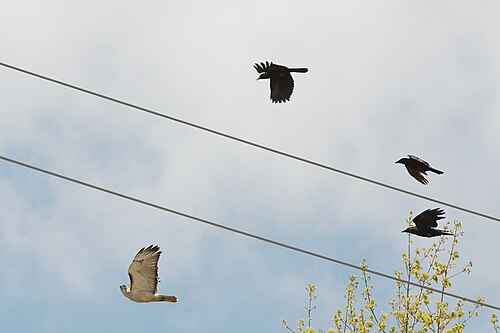
Beyond defense, some birds use mobbing to secure food. By harassing larger birds or mammals, a flock can drive a competitor away from a food source or distract a bird holding food so others can steal it. Scavenging gulls often employ this technique against humans.
Research by Hans Kruuk on black-headed gulls demonstrated that mobbing intensity decreases as the distance from the nest increases, which directly correlates with higher predation success. By attacking the predator, birds create a distraction that makes it difficult for the predator to locate nests.
The Role of Cultural Learning
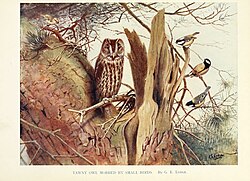
Mobbing serves a critical educational purpose. It draws attention to a predator, stripping it of the element of surprise and allowing younger generations to learn how to identify local threats. This is why species reintroduction programs often fail; captive-bred animals lack the cultural knowledge to recognize local predators, a gap scientists are now attempting to bridge through pre-release training.
Hypotheses on Why Birds Mob
Biologist Eberhard Curio suggested several adaptationist hypotheses for this risky behavior, including:
- Advertising physical fitness (showing the predator the prey is too fit to be caught).
- Luring predators away from offspring.
- Directly injuring the predator.
- Attracting a "mightier" secondary predator to remove the primary threat.
The "attract the mightier" hypothesis was tested by Fang et al. using light-vented bulbuls, who used different calls depending on whether they were mobbing a collared scops owl or a superior predator, the crested goshawk.
Mobbing in Other Animals
The appearance of mobbing across unrelated species is a prime example of convergent evolution—where different species evolve similar traits due to similar environmental pressures.
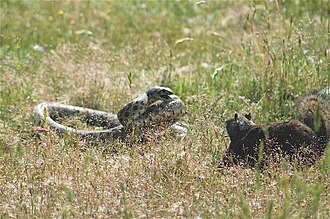
For instance, the California ground squirrel protects its nest burrows by kicking sand into the faces of rattlesnakes and gopher snakes, disrupting their sensory organs (including the heat-detecting loreal pits of crotaline snakes). In the ocean, bluegills may attack snapping turtles, and humpback whales have been observed mobbing killer whales to protect other cetaceans, seals, or fish.
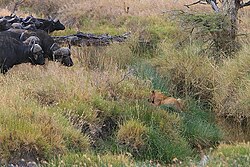
It is important to distinguish mobbing from the fight-or-flight response. While fight-or-flight is an individual's reaction to immediate danger, mobbing is a social strategy relying on group dynamics to manage risk.
The Science of Mobbing Calls
Mobbing calls are distinct from alarm calls. While alarm calls are designed to help others escape quickly, mobbing calls are used to recruit allies for a counter-attack. For example, the great tit uses a 4.5 kHz call to summon others to harass a perched owl. In contrast, when in flight, they use a 7–8 kHz alarm signal that is harder for predators to locate.
The acoustic adaptation hypothesis suggests that these calls evolve based on the environment. Research by Billings (2018) found that birds in urban or closed habitats produce calls with lower energy and lower low-frequencies compared to those in open areas.
Evolutionary Perspectives
From a game theory perspective, mobbing is analyzed through evolutionarily stable strategies. The risks to the individual are offset by the benefits to the group, particularly when members are genetically related. This is viewed through inclusive fitness—the survival of one's genes through family members.
The dilution effect, proposed by W. D. Hamilton, explains that by attacking in a large group, the individual risk to each member is reduced. Some theorists also suggest the handicap principle, where a bird demonstrates its superior health and status by daring to risk itself, making it more attractive to potential mates.
| Feature | Mobbing Call | Alarm Call |
|---|---|---|
| Primary Goal | Recruit others to attack/harass | Warn others to flee/hide |
| Frequency (e.g., Great Tit) | Lower (~4.5 kHz) | Higher (7–8 kHz) |
| Range | Long distance | Short distance |
| Predator Detection | Easier for predator to hear | Difficult for predator to locate |
Frequently Asked Questions
What is the main difference between mobbing and a fight-or-flight response?
Mobbing is a cooperative social behavior involving group dynamics to harass a predator, whereas the fight-or-flight response is an individual physiological reaction to a perceived threat.
Why do some species, like the kittiwake, not exhibit mobbing behavior?
This is an example of divergent evolution. Kittiwakes nest on sheer cliffs that are largely inaccessible to predators, meaning their young are not at risk, removing the evolutionary pressure to develop mobbing behaviors.
How does the environment affect mobbing?
Environmental structure plays a role; for example, birds in pine forests are more likely to respond to mobbing calls when there is a denser understory, as the cover provides a safer environment to engage in the behavior.
Can mobbing be used for something other than defense?
Yes, some birds use mobbing as a foraging strategy to drive larger animals away from food sources or to distract a competitor while others steal food.
What is the "attract the mightier" hypothesis?
It is the theory that prey species use specific mobbing calls to attract a larger, more powerful secondary predator to the area, which may then attack or drive away the primary predator.