Burhinus: The Fascinating World of Thick-knees and Stone-curlews
The genus Burhinus comprises a group of medium-sized, terrestrial waders known by several names, including thick-knees, stone-curlews, and dikkops. These birds are masters of camouflage, typically inhabiting semi-arid to arid open landscapes. While most are not closely tied to water, their physical adaptations make them highly efficient survivors in diverse environments across the globe, with the exception of Antarctica.
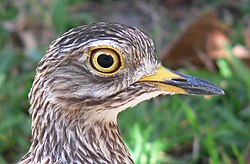
Ranging in size from 32 cm to 59 cm, these birds are instantly recognizable by their long legs, large eyes, and strong, thick bills. The name Burhinus is derived from the Greek words bous (ox) and rhis (nose), a nod to the sturdy nature of their bills.
Key Facts
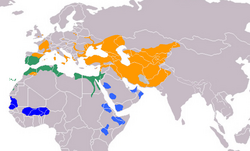
- Global Presence: Found worldwide except in Antarctica, with the highest diversity in the Old World.
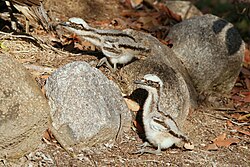
- Physical Traits: Characterized by cryptic sandy-brown plumage, long legs, and a broad, domed crown.
- Diet: Primarily insectivorous, though they also consume mollusks, reptiles, and small mammals.
- Behavior: Primarily terrestrial and often nocturnal, known for eerie calls and a tendency to freeze when alarmed.
- Conservation: Currently, no species within the genus are listed as threatened or extinct since 1600.
Taxonomy and Systematics
Established by German zoologist Johann Karl Wilhelm Illiger in 1811, the genus Burhinus belongs to the family Burhinidae. Modern multi-locus analysis suggests that this family is most closely related to the Charadriidae (plovers), rather than the Scolopacidae (sandpipers).
Taxonomic classification has seen significant refinement. For instance, the double-striped thick-knees were recently moved to the genus Hesperoburhinus. There has also been historical confusion regarding the bush stone-curlew (B. grallarius), which was previously misidentified under other names. Some phenotypic studies suggest a further split between "greater thick-knees" (including Esacus) and "lesser thick-knees" (the remainder of Burhinus) based on skeletal and skin analysis.
Physical Characteristics
The most striking feature of the Burhinus genus is its cryptic plumage—sandy browns with streaks and mottles of cream, buff, and black that allow them to blend seamlessly into their environment.
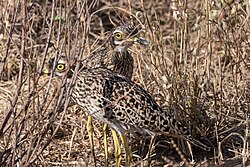
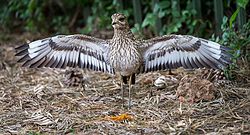
Their heads feature a broad, domed crown, which earned them the Afrikaans name dikkop ("thick head"). While they appear muted on the ground, their flight reveals a more striking pattern, including black primary feathers with white patches. Their wings are long and held straight during flight, often with their legs extending beyond the tail.
The genus undergoes a complete post-breeding moult lasting four to five months. Interestingly, the Eurasian and Senegal thick-knees may pause this process in winter, potentially to maximize their chances of re-nesting in the spring.
Distribution and Species
There are six recognized species of Burhinus, distributed across Africa, Asia, and Australia. In addition to living species, three fossil species have been identified from the Miocene and Pleistocene epochs in Nebraska, Kansas, and the Bahamas.
| Common Name | Binomial Name | Primary Distribution |
|---|---|---|
| Eurasian stone-curlew | Burhinus oedicnemus | Europe, Asia, North Africa |
| Indian stone-curlew | Burhinus indicus | South and South-eastern Asia |
| Senegal thick-knee | Burhinus senegalensis | Africa (Sahara to Equator) |
| Water thick-knee | Burhinus vermiculatus | Africa |
| Spotted thick-knee | Burhinus capensis | Africa |
| Bush stone-curlew | Burhinus grallarius | Australia |
Behavior and Ecology
Social Structure and Movement
While often solitary during breeding, Burhinus can be quite sociable outside of the breeding season. Non-breeding flocks can range from dozens to hundreds of individuals; for example, groups of over 300 Eurasian stone-curlews have been recorded in Europe.
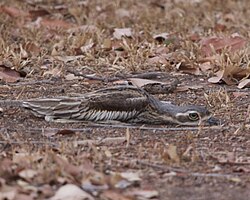
When threatened, these birds exhibit a unique defense mechanism: they will bob their heads and then either freeze in place to utilize their camouflage or walk away slowly to avoid detection.
Diet and Foraging
Their diet is remarkably consistent across species. They primarily eat insects such as beetles, crickets, and grasshoppers, but will also consume crustaceans, mollusks, worms, spiders, small mammals, reptiles, and frogs. Some species, like the Eurasian and Bush stone-curlews, may eat small amounts of seeds and vegetation.
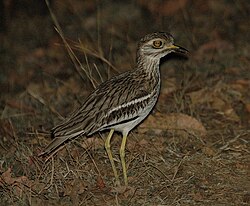
Foraging typically occurs on dry open ground, saltpans, or riverbeds. They move slowly, pausing and tilting their heads similarly to plovers. They use their bills to pick food from the surface, probe soft soil, or lunge at active prey.
Breeding and Life Cycle
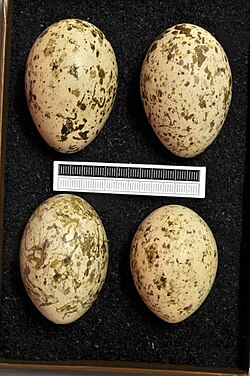
Breeding is a shared responsibility, with both parents incubating the eggs for 24 to 27 days and defending the offspring. A typical clutch consists of two eggs, rarely three, which are laid at two-day intervals. These eggs are rounded ovals with a glossy, buffish appearance and brown mottles, perfectly matching the nest substrate for maximum crypsis.
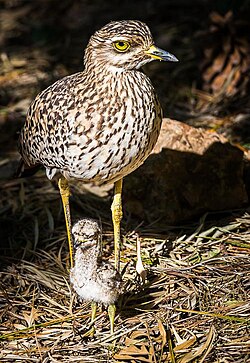
Chicks are partially independent by four weeks and fully independent by two to three months. In cases where a second clutch is laid, the parents may push the older offspring away to focus on the new brood.
Frequently Asked Questions
What does the name "Burhinus" mean?
The name comes from the Ancient Greek words bous, meaning "ox," and rhis, meaning "nose," referring to the bird's short, thick, and strong bill.
How do thick-knees protect themselves from predators?
They rely heavily on cryptic plumage to blend into sandy or arid environments. If they sense danger, they often bob their heads and freeze or walk away rather than taking flight immediately.
What is the difference between the Eurasian and Indian stone-curlew?
The Indian stone-curlew was split from the Eurasian species primarily because it does not migrate.
What is the diet of a thick-knee?
They are generalist carnivores that eat insects (beetles, grasshoppers), worms, spiders, mollusks, crustaceans, and occasionally small reptiles, frogs, or other birds' eggs.
Are any species of Burhinus currently endangered?
No, according to current records, no species in the genus Burhinus are threatened, and none have become extinct since 1600.