Mute Swan: The Elegant Giant of the Waterfowl World
The mute swan (Cygnus olor) is a striking member of the family Anatidae, known for its grace, size, and distinctive appearance. Native to much of Europe and parts of Asia, this large waterfowl has become a global icon of beauty, though its presence in non-native regions has sparked significant ecological debate. Its name, "mute," reflects the fact that it is considerably less vocal than other swan species.
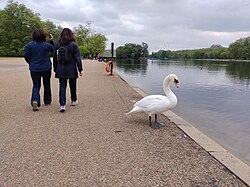
Recognizable by its pure white plumage and bright orange beak, the mute swan is a powerhouse of the avian world, combining immense physical strength with a complex social structure.
Key Facts
- Scientific Name: Cygnus olor
- Average Length: 140 to 160 cm (55 to 63 in)
- Weight: Males (cobs) average 10.6–11.87 kg; females (pens) average 8.5–9.67 kg
- Conservation Status: Least Concern (IUCN 3.1)
- Distinctive Feature: A pronounced knob atop the orange beak, larger in males
- National Symbol: The national bird of Denmark since 1984
Physical Characteristics and Taxonomy
First formally named by German naturalist Johann Friedrich Gmelin in 1789 as Anas olor, the species was later moved to the genus Cygnus in 1803. Both terms derive from the Latin word for "swan."
Adults typically measure between 140 and 160 cm in length, with a massive wingspan ranging from 200 to 240 cm. While the plumage is entirely white and the legs are dark grey, the most defining feature is the orange bill bordered with black. The cob (male) is generally larger than the pen (female) and possesses a more prominent basal knob on the bill.
The mute swan is among the heaviest flying birds in existence. While most cobs weigh up to 15 kg, one recorded "Polish swan"—a color morph expressing a recessive gene for leucism (a condition resulting in partial loss of pigmentation)—weighed nearly 23 kg, the highest verified weight for any flying bird.
Behavior and Social Structure
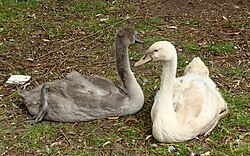
Mute swans are strongly territorial. Typically, a single pair will claim a small lake, though they can be colonial in areas with abundant food. Some colonies, such as those at Abbotsbury Swannery in England or the Ottenby Preserve in the Baltic Sea, can exceed 100 pairs with nests spaced as close as 2 meters apart.
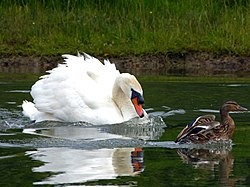
Juveniles that have not yet mated often form large flocks, sometimes numbering in the hundreds. Once paired, adults maintain their territories and may coexist with gulls and ducks, as the swans' ability to reach deep-water vegetation often brings food to the surface for other birds.
Courtship and Mating
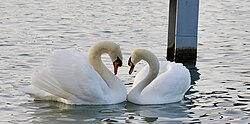
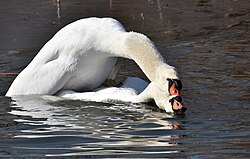
The mating process involves intricate courtship displays before the pair establishes a nesting site during the spring.
Breeding and Life Cycle
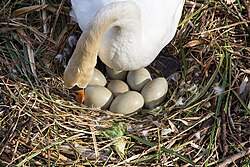
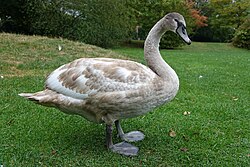
Nesting typically occurs in the spring. A clutch usually consists of 5 to 8 eggs, which the female broods for approximately 36 days. The resulting cygnets (young swans) hatch between May and July.
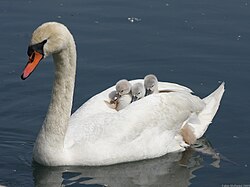
Young cygnets exhibit a unique behavior where they climb onto their parents' backs to rest or shelter beneath their wings during heavy rain to stay warm and dry.
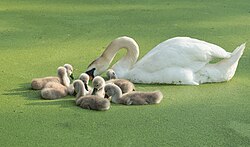
Cygnets are capable of flight 60 to 65 days after hatching, though full fledging (the point at which they are ready to leave the nest) occurs between 120 and 150 days. At this stage, they have reached about 70–75% of their adult mass.
Global Distribution and Conservation
The native population of mute swans is estimated at 500,000, with the highest concentration in Russia, particularly the Volga Delta. In the United Kingdom, the population is approximately 22,000 birds.
| Region | Status | Notes |
|---|---|---|
| Europe & Asia | Native | Largest populations in Russia (up to 350,000) |
| North America | Introduced | Considered an invasive species; high impact on vegetation |
| Australasia | Introduced | Small populations in Australia and New Zealand |
| Southern Africa | Introduced | Small introduced population (approx. 120 birds) |
The Invasive Challenge in North America
Introduced in the late 19th century, mute swans have expanded rapidly in North America. They are viewed as an invasive species because they severely reduce the density of submerged aquatic vegetation, which disrupts native ecosystems. This led the U.S. Department of the Interior to declare them a non-native, unprotected species in 2005 to allow for population management.
Cultural Significance
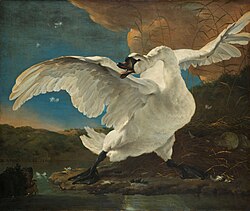
Beyond biology, the mute swan has a long history in art and national identity. It has been the national bird of Denmark since 1984 and has appeared in classical art for centuries.
Frequently Asked Questions
Why are they called "mute" swans?
They are called mute swans because they are significantly less vocal than other species of swans.
Are mute swans aggressive?
They are strongly territorial, especially during breeding season, and will attack other birds or animals to defend their space.
What is a "Polish swan"?
A Polish swan is a color morph of the mute swan that expresses a recessive gene for leucism, resulting in a different plumage appearance.
How do cygnets stay warm?
Young cygnets often shelter beneath their parents' wings during heavy rain or cold periods to maintain body heat and stay dry.
Why are they considered invasive in North America?
They are considered invasive because their rapid population growth and feeding habits severely deplete submerged aquatic vegetation, harming native waterfowl and ecosystems.