Animal Migration: The Science of Life on the Move
In the natural world, movement is often a matter of survival. Animal migration refers to the relatively long-distance movement of individual animals, typically occurring on a seasonal basis. As the most common form of migration in ecology, it is a phenomenon observed across all major animal groups, including birds, mammals, fish, reptiles, amphibians, insects, and crustaceans.
To distinguish true migration from simple local dispersal or irregular population spikes known as irruptions, scientists look for patterns that are annual, seasonal, or represent a major habitat change essential to the animal's life cycle. Whether driven by local climate, food availability, seasonal shifts, or the need to mate, these journeys are fundamental to the biological rhythms of our planet.
![Goose migration is an iconic phenomenon in the Northern Hemisphere.[1]](/images/59/8f/598f88c1c7066a7c49d2c1cdc842a433b7eb2c0bf983cb03a45e5a585ccc154a.jpg)
Goose migration is an iconic phenomenon in the Northern Hemisphere.[1]
Key Facts
- Migration is found in all major animal groups, from insects to mammals.
- Common drivers include seasonal changes, food availability, and mating requirements.
- The Arctic tern holds the record for the longest bird migration, traveling at least 19,000 km annually.
- Some insects, like the globe skimmer dragonfly, perform massive ocean crossings.
- Migration can occur on different scales, from annual seasonal shifts to daily vertical movements in water.
Types of Migratory Patterns
Migration is not a one-size-fits-all behavior. Depending on the species and the environment, movements can be categorized by their timing and frequency.
Seasonal and Life-Cycle Movements
Seasonal migration involves species moving between habitats as resource availability fluctuates throughout the year. For example, many birds migrate to warmer climates to escape harsh winter conditions. Some species, such as Pacific salmon, undergo a major habitat change to reproduce, swimming from the ocean to freshwater rivers to spawn.
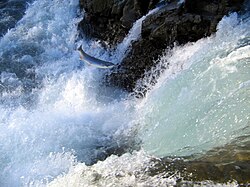
Many species of salmon migrate up rivers to spawn
Daily and Tidal Cycles
Not all migrations take months to complete. Some aquatic animals engage in diel vertical migration, moving hundreds of meters up and down the water column within a single day. Other species, such as certain jellyfish, perform daily horizontal migrations, while others respond to the rhythmic rise and fall of the tides.
Migration Across Animal Groups
Birds: The Masters of Distance
Approximately 1,800 of the world's 10,000 bird species are migratory. While many follow north-south routes to exploit summer breeding grounds and winter feeding areas, some undertake extraordinary journeys. The Arctic tern, for instance, travels from the Arctic to the Antarctic and back every year, effectively experiencing two summers annually.
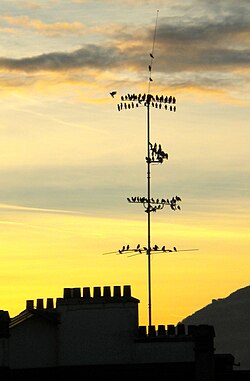
Flocks of birds assembling before migration southwards
Fish: Navigating Salt and Fresh Water
While most fish remain in specific geographical areas, a few hundred species are long-distance travelers. About 120 species are diadromous, meaning they migrate between saltwater and freshwater environments to complete their life cycles.
Insects: Small Travelers, Big Journeys
Winged insects can cover immense distances. The Pantala flavescens, or globe skimmer dragonfly, is known for making the longest ocean crossing of any insect between India and Africa. In some butterfly species, such as the monarch, the migration is multi-generational; no single individual completes the entire journey, but successive generations continue the cycle.
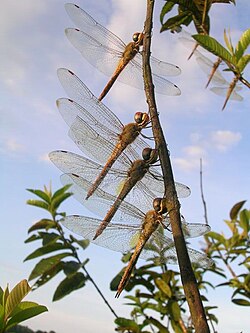
An aggregation of migratory Pantala flavescens dragonflies, known as globe skimmers, in Coorg, India
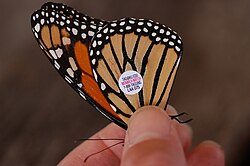
A migratory butterfly, a monarch, tagged for identification
Mammals: Terrestrial Giants and Mass Movements
Mammals exhibit both individual and mass migrations. Reindeer undertake one of the longest terrestrial migrations, covering up to 4,868 km per year. In contrast, the grey wolf is known for high cumulative annual movement, with one individual recorded traveling 7,247 km in a year.
Mass migrations involve huge numbers of animals moving together. The Serengeti 'great migration' is a famous example, involving roughly 1.7 million wildebeest and hundreds of thousands of other animals like zebras and gazelles. In human contexts, transhumance—the seasonal movement of herders and livestock between mountains and valleys—represents a traditional migratory pattern.
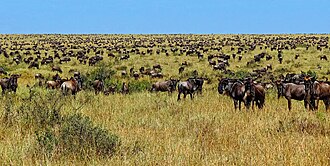
Wildebeest on the Serengeti 'great migration'
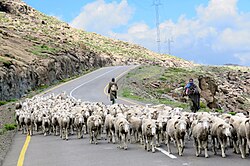
High-mountain shepherds in Lesotho practice transhumance with their flocks.
Summary of Migratory Characteristics
| Animal Group | Common Migration Type | Key Example |
|---|---|---|
| Birds | Seasonal (North-South) | Arctic tern |
| Fish | Diadromous (Salt/Freshwater) | Salmon |
| Insects | Multi-generational / Long-distance | Monarch butterfly |
| Mammals | Mass migration / Terrestrial | Wildebeest |
| Aquatic Life | Diel Vertical | Zooplankton/Jellyfish |
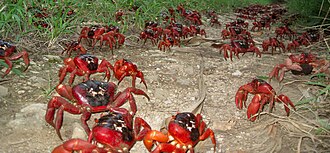
Christmas Island red crabs on annual migration
Frequently Asked Questions
What is the difference between migration and irruption?
Migration is a regular, often seasonal, movement of animals between habitats. An irruption is a rapid, irregular change in population size or movement that does not follow a predictable annual pattern.
How do scientists track migratory animals?
Researchers use various methods, including traditional identification tags like bird rings and modern electronic tracking devices to monitor movement patterns directly.
Why do animals migrate?
The primary drivers for migration include seasonal changes in climate, the availability of food resources, and the necessity to find suitable locations for mating and reproduction.
Do all migratory animals complete the journey themselves?
Not necessarily. In some species, such as certain migratory butterflies, the migration is completed by successive generations rather than a single individual.
What is transhumance?
Transhumance is a traditional form of human migration where herders move their livestock seasonally between different elevations, such as between mountains and valleys.