Aerodynamics: The Science of Air Motion and Flight
Derived from the Ancient Greek words aḗr (air) and dunamikḗ (dynamics), aerodynamics is the study of how air moves, particularly when it interacts with solid objects like airplane wings. This field is a vital branch of aeronautics and falls under the broader umbrella of fluid dynamics—the study of how liquids and gases move. While often used interchangeably with gas dynamics, the latter is a more inclusive term that applies to the motion of all gases, not just air.
From the early observations of drag to modern computational simulations, the study of aerodynamics has provided the rational foundation necessary to move from theoretical concepts to the reality of heavier-than-air flight.
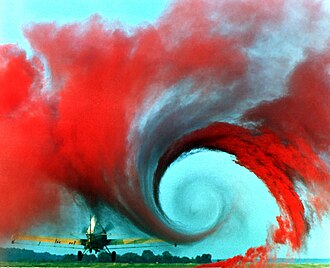
Key Facts
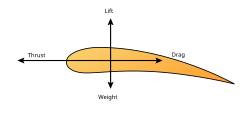
- Core Forces: Flight is governed by four primary forces: weight, lift, drag, and thrust.
- Bernoulli's Principle: A fundamental relationship between pressure, density, and flow velocity used to calculate lift.
- Mach Number: The ratio of an object's speed to the speed of sound.
- Compressibility: Airflow is considered compressible when the Mach number exceeds 0.3, causing significant changes in density.
- Historical Milestone: The Wright brothers achieved the first powered, controlled flight in 1903.
The Evolution of Aerodynamic Theory
While humans have harnessed aerodynamic forces for millennia through sailboats and windmills, modern scientific study began to take shape in the 17th and 18th centuries. Early thinkers like Aristotle and Archimedes touched upon concepts of pressure gradients and drag, but the mathematical framework was built by later pioneers.
Foundational Mathematical Principles
In 1726, Sir Isaac Newton developed an early theory of air resistance. This was followed in 1738 by Daniel Bernoulli, whose work Hydrodynamica introduced Bernoulli's principle. This principle describes how pressure, density, and velocity relate in incompressible flow, offering a method to calculate aerodynamic lift.
Leonhard Euler expanded these ideas in 1757 with the Euler equations, which apply to both compressible and incompressible flows. Later, in the 19th century, these were extended to include viscosity (the "thickness" or internal friction of a fluid), resulting in the Navier–Stokes equations. These equations are the most general governing equations for fluid flow, though they are notoriously difficult to solve for complex shapes.
The Path to Powered Flight
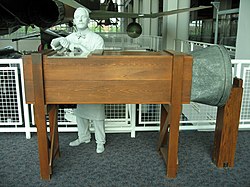
Sir George Cayley revolutionized the field in 1799 by identifying the four aerodynamic forces: weight, lift, drag, and thrust. His work outlined the trajectory for aviation for the next century. By 1871, Francis Herbert Wenham had constructed the first wind tunnel, a device used to create controlled airflow to measure aerodynamic forces precisely.
The late 19th and early 20th centuries saw rapid progress. Otto Lilienthal successfully demonstrated glider flights using thin, curved airfoils to maximize lift. Building on these empirical and mathematical foundations, the Wright brothers successfully flew the first powered airplane on December 17, 1903.

Flow Classification and Speed Regimes
As aircraft technology advanced, engineers had to account for how air behaves at different speeds. A critical concept here is the continuum assumption, which treats air as a continuous medium rather than individual molecules. This assumption works well for most aircraft but fails at extremely high altitudes or in space, where statistical mechanics must be used instead.
Incompressible vs. Compressible Flow
In incompressible aerodynamics, we assume the density of the air remains constant. This is a valid simplification for low-speed flight, specifically when the Mach number is below 0.3 (approximately 228 mph or 366 km/h at 60°F). Once speeds exceed this threshold, compressible aerodynamics must be used because the air's density begins to change significantly along its path.
Transonic, Supersonic, and Hypersonic Speeds
As aircraft approach and exceed the speed of sound, they enter different aerodynamic regimes:
- Transonic Flow: Occurs at speeds typically between Mach 0.8 and 1.2. In this range, some parts of the airflow over the aircraft are supersonic while others are not.
- Supersonic Flow: Occurs when the airflow is entirely faster than the speed of sound. This regime introduces shock waves and increased drag.
- Hypersonic Flow: A subset of supersonic flow, generally referring to speeds of Mach 5 and above. This regime is characterized by extremely high temperatures and chemical changes in the air.
Modern Computational Aerodynamics
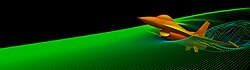
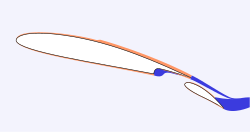
Today, the field has become increasingly digital. While wind tunnels remain essential, computational modelling allows engineers to simulate complex airflow patterns over jets and other vehicles with incredible precision. This helps in studying turbulence (chaotic air movement) and boundary layers (the thin layer of air directly adjacent to a surface) before a physical prototype is ever built.
| Regime | Mach Number Range | Key Characteristics |
|---|---|---|
| Subsonic (Incompressible) | Below 0.3 | Constant air density |
| Subsonic (Compressible) | 0.3 to ~0.8 | Density changes occur |
| Transonic | 0.8 to 1.2 | Mixed subsonic and supersonic flow |
| Supersonic | Above 1.2 | Shock waves and high drag |
| Hypersonic | Mach 5+ | High temperatures and chemical dissociation |
Frequently Asked Questions
What are the four forces of flight?
The four forces are weight (gravity pulling the aircraft down), lift (the upward force created by the wings), drag (air resistance pulling the aircraft back), and thrust (the forward force produced by the engine).
What is the difference between aerodynamics and gas dynamics?
Aerodynamics is the study of air motion specifically, often in the context of aeronautics. Gas dynamics is a broader field that studies the motion of all gases, not just air.
Why does the Mach number matter?
The Mach number tells us how fast an object is moving relative to the speed of sound. This is crucial because as an object approaches the speed of sound, the air behaves differently, creating shock waves and changing the way lift and drag are calculated.
What is the continuum assumption?
The continuum assumption is the idea that air can be treated as a continuous fluid rather than a collection of individual molecules. This is accurate for most flight conditions but becomes invalid in the extremely low-density environments of high orbit.
What is a wind tunnel used for?
A wind tunnel is a tool used to simulate airflow around an object, such as a wing or a car, allowing engineers to measure aerodynamic forces and observe flow patterns in a controlled environment.