Zumba Crater: A Pristine Window into Martian Impact Processes
Located within the lava-filled plains of Daedalia Planum, Zumba is a remarkable geological feature on Mars. Unlike many of the planet's ancient landscapes, Zumba is an exceptionally fresh impact crater, offering scientists a rare, undisturbed look at the physics of planetary collisions. Because it has not yet been worn down by eons of erosion, it serves as a primary case study for how simple craters form and evolve on the Red Planet.
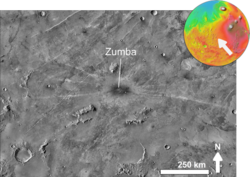
The Anatomy of a Simple Crater
Zumba is classified as a simple crater. In Martian geology, a simple crater is typically defined as one with a diameter of less than 6–9 km (3.7–5.6 mi). These craters are characterized by a conical-bowl shape, minimal wall collapse, and the absence of a complex central feature, such as a central peak.
The dimensions of Zumba further highlight its youth. The crater reaches a depth of approximately 620 metres (2,030 ft), while its rim rises about 200 metres (660 ft) above the surrounding plains. Notably, Zumba is roughly 25% deeper than the average Martian crater of its size, a disparity that strongly suggests it is a very recent addition to the Martian surface.
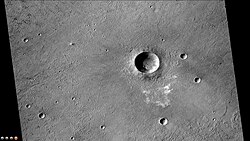
Unique Geological Features
Zumba is of particular interest to the scientific community because it preserves features that are usually buried or eroded away in older Martian craters. In fact, Zumba contains details that are not even visible in the freshest terrestrial craters, such as the famous Meteor Crater in Arizona. High-resolution imagery from HiRISE (High Resolution Imaging Science Experiment) has allowed researchers to observe these nuances in unprecedented detail.
The Mystery of Pitted Deposits
One of the most intriguing aspects of Zumba is its relatively flat floor, which is covered in a pitted deposit. These crater-fill deposits generally consist of impact melts—rock that was liquefied by the extreme temperatures of the impact—and rock fragments that suffered varying degrees of damage during the event.
The presence of pits within these deposits is a phenomenon unique to the freshest and best-preserved Martian craters; they have not been observed in terrestrial or lunar craters. Scientists hypothesize that these pits may be the result of hot impact deposits interacting with subsurface water or water-ice present before the impact occurred.
There are currently two primary theories regarding the formation of these pits:
- Explosive Formation: Similar to terrestrial volcanic pits created when hot lava interacts with wet sediments.
- Collapse Formation: Caused by the drainage of volatiles or impact melts from beneath the surface.
Key Facts
- Location: Daedalia Planum, Mars.
- Depth: Approximately 620 metres (2,030 ft).
- Rim Height: Approximately 200 metres (660 ft).
- Classification: Simple crater (conical-bowl shape, no central peak).
- Distinctive Feature: Pitted crater-fill deposits, likely linked to subsurface ice/water interactions.
- Age Indicator: 25% deeper than average craters of similar size, indicating it is very fresh.
| Feature | Measurement/Detail |
|---|---|
| Depth | ~620 m (2,030 ft) |
| Rim Height | ~200 m (660 ft) |
| Crater Type | Simple (Conical) |
| Location | Daedalia Planum |
| Unique Feature | Pitted floor deposits |
Frequently Asked Questions
Why is Zumba considered a "fresh" crater?
Zumba is considered fresh because it is approximately 25% deeper than the average Martian crater of its size, indicating that erosion and sediment infill have not yet significantly altered its original structure.
What is a simple crater on Mars?
A simple crater is a small impact site, generally under 6–9 km in diameter, that maintains a bowl-like shape without a central peak or significant wall collapse.
What are the pitted deposits on the crater floor?
These are deposits made of impact melts and damaged rock fragments. They contain unique pits that are only found in the youngest, best-preserved Martian craters.
How did the pits in Zumba likely form?
Scientists believe they formed from the interaction of hot impact materials with subsurface water or ice, either through explosive reactions or the collapse of draining melts and volatiles.
How does Zumba compare to Meteor Crater in Arizona?
Zumba preserves certain impact-related features that are not present even in Meteor Crater, making it a superior example for studying the immediate aftermath of an impact event.