Zunil Crater: A Window into Martian Impact History
Zunil is a relatively young impact crater on Mars that provides scientists with a rare glimpse into the planet's recent geological activity. Because it formed only a few million years ago, the crater remains in a pristine form, meaning it has not been significantly eroded or altered by the Martian environment. Unlike many craters formed by high-velocity comet impacts, Zunil likely resulted from a lower-velocity collision.
The geological context of Zunil is particularly significant. If current interpretations are correct, the crater was blasted into basalt—a dark, volcanic rock—that was originally deposited between 165 and 177 million years ago.
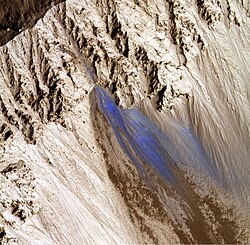
Key Facts
- Age: Formed within the last few million years.
- Composition: Located in basalt deposited 165–177 million years ago.
- Ray System: Infrared-visible rays extend up to 1,600 km from the center.
- Secondary Craters: Produced hundreds of millions of smaller craters, some reaching 3,500 km away.
- Meteorite Link: Potentially the source of basaltic shergottite meteorites found on Earth.
The Impact and Its Aftermath
The energy released during the formation of Zunil created a massive ray system—linear streaks of ejecta (debris) radiating from the center—that is visible in the infrared spectrum and extends 1,600 km (990 mi). The impact was so powerful that it launched billions of rock fragments into the atmosphere and space.
Secondary Crater Distribution
One of the most striking features of the Zunil event is the creation of secondary craters, which are smaller craters formed by the fallback of debris from the primary impact. These secondaries range from 10 to 100 meters in diameter. Interestingly, very few of these are found within 80 km of the main crater.
The scale of this distribution is immense. Approximately 80% of the craters located in the Athabasca Valles region are actually Zunil secondaries. This discovery is critical for planetary scientists because it suggests that crater counting—a standard technique used to date the age of planetary surfaces—may be less accurate for young features if a single impact can create so many deceptive secondary craters.
Ejecta and Earth Connections
Simulations indicate that the Zunil impact ejected roughly 30 cubic kilometers of material, including ten billion rock fragments larger than 10 centimeters in diameter. These fragments created roughly one billion 10-meter secondary craters across a distance of up to 3,500 km (2,200 mi). Some of these fragments may have escaped Mars' gravity entirely, landing on Earth as shergottites, a specific class of Martian meteorites.
Thermal Interactions and Ice
Research published in the journal Icarus has highlighted unique features within the Zunil Crater: specialized pits caused by the interaction of heat and ice. When hot ejecta fell onto ground containing subsurface ice, the resulting heat created steam. This steam rushed out from groups of pits simultaneously, blowing away the surrounding debris and leaving distinct pits behind.
| Feature | Detail/Measurement |
|---|---|
| Estimated Age | A few million years |
| Ray System Reach | 1,600 km |
| Secondary Crater Range | 10 to 100 meters in diameter |
| Total Ejecta Volume | 30 cubic kilometers |
| Max Secondary Distance | 3,500 km |
Frequently Asked Questions
How old is the Zunil Crater?
The crater formed no more than a few million years ago, which is why it is still in a relatively pristine state.
What are shergottites?
Shergottites are a type of Martian meteorite found on Earth. It is hypothesized that Zunil may be the source of these basaltic meteorites.
How does Zunil affect the way scientists date Mars?
Because Zunil produced so many secondary craters (including 80% of those in Athabasca Valles), it suggests that crater counting may not be a fully accurate dating method for young Martian surfaces.
What caused the pits found inside the crater?
The pits were formed when hot ejecta hit ice-bearing ground, creating steam that erupted and cleared away the surrounding material.
Was Zunil formed by a comet?
It is unlikely; evidence suggests it was not produced by a high-velocity impact typical of comets.