XXI Corps: The British Army's Strategic Force in the Sinai and Palestine Campaign
The XXI Corps was a pivotal Army Corps of the British Army during World War I, operating as a primary component of the Egyptian Expeditionary Force (EEF). Formed in the heat of the Sinai and Palestine Campaign, the corps became renowned for its tactical precision and its role in some of the most decisive victories of the Middle Eastern theater.
From its inception in August 1917 to the Armistice of Mudros in 1918, the XXI Corps evolved from a defensive line-holding force into a highly mobile offensive machine. Its operations are often cited by military historians as precursors to modern combined-arms warfare, specifically the Blitzkrieg (lightning war) tactics used in later conflicts.
Key Facts
- Active Period: 12 August 1917 – 1919.
- Primary Theater: Sinai and Palestine Campaign.
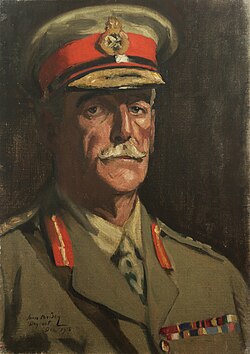
- Notable Commander: Lieutenant-General Sir Edward Bulfin.
- Defining Victory: The Battle of Sharon, described as one of the war's most successful operations.
- Final Achievement: A rapid advance along the coast to secure Beirut and Tripoli.
Origin and Formation
The XXI Corps was established on August 12, 1917, at Deir al-Balah. Its creation was part of a comprehensive reorganization of the Egyptian Expeditionary Force led by General Sir Edmund Allenby. The corps was tasked with managing the left section of the EEF line facing Gaza City.
Under the command of Lieutenant-General Edward Bulfin, the corps initially integrated the 52nd (Lowland), 54th (East Anglian), and 75th Divisions, supported by three brigades of heavy artillery. To ensure operational flexibility, the corps was equipped with its own signal company and the XXI Corps Cavalry Regiment, the latter formed from three divisional cavalry squadrons.
The Invasion of Palestine
The corps played a critical role in the Third Battle of Gaza. While other forces focused on Beersheba, the XXI Corps conducted a heavy bombardment of Gaza's defenses starting October 27, followed by holding attacks in early November. As Turkish forces evacuated Gaza due to pressure from the east, the XXI Corps pursued them vigorously to secure Wadi el Hesi.
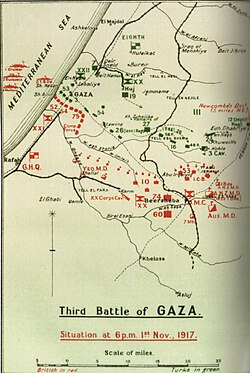
Following the breakthrough at Gaza, the corps engaged in a series of rapid actions to push the Ottoman forces northward. These included the Battle of Mughar Ridge, the occupation of Junction Station, and the defense of Jerusalem. By December 1917, the corps was involved in the Battle of Jaffa and the crossing of the Nahr el Auja.
Order of Battle (October 1917)
| Component | Units/Commanders |
|---|---|
| Command | Lt-Gen Edward Bulfin (GOC) |
| Infantry Divisions | 52nd (Lowland), 54th (East Anglian), 75th Division |
| Cavalry | XXI Corps Cavalry Regiment |
| Artillery | XCVII, C, and CII Heavy Artillery Groups (RGA) |
| Support | Royal Engineers, Signal Company, Machine Gun Corps |
The Final Offensive: Battle of Megiddo
By September 1918, the XXI Corps had been reorganized. Due to the German Spring Offensive on the Western Front, many British units were replaced by Indian Army formations, a process known as "Indianisation." The only infantry division to remain purely British was the 54th (East Anglian).
During the Battle of Megiddo, launched on September 19, the XXI Corps faced Turkish trench lines up to five miles deep. Utilizing overwhelming artillery superiority and clever deception—such as the strategic use of pontoon bridges on the Nahr el Auja—the corps achieved a massive breakthrough during the Battle of Sharon.
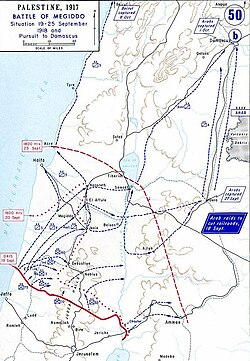
The success was so absolute that the Official History labeled it one of the most successful operations of the entire war. After capturing Nablus on September 21, the corps shifted its focus to securing the Syrian coast.
The March to Beirut and Tripoli
The 7th (Indian) Division undertook a remarkable march along the coast road toward Beirut. A significant obstacle was the "Ladder of Tyre," a narrow cliff-side track. Under Bulfin's orders, engineers worked for two and a half days to make the path passable for 60-pounder guns.
The advance continued with impressive speed: the XXI Corps Cavalry Regiment entered Tyre on October 4, secured Sidon on October 6, and established Corps HQ at the Deutscherhof Hotel in Beirut on October 8. The final push saw Column A occupy Tripoli by October 13, with the leading troops having covered 270 miles in just 40 days.
Frequently Asked Questions
Who commanded the XXI Corps?
The corps was primarily commanded by Lieutenant-General Sir Edward Bulfin, though Major-General Sir Vere Fane and Major-General Reginald Hoskins served as acting commanders during the summer of 1918.
What was the significance of the Battle of Sharon?
The Battle of Sharon is regarded as a precursor to the modern Blitzkrieg due to its overwhelming success, speed, and the effective integration of artillery and infantry to break deep enemy defenses.
What does "Indianisation" mean in the context of the EEF?
Indianisation refers to the replacement of British infantry units with Indian Army divisions to compensate for the loss of troops sent to the Western Front during the German Spring Offensive of 1918.
How did the XXI Corps overcome the Ladder of Tyre?
The corps utilized extensive engineering work over two and a half days to modify a narrow ancient cliff track, allowing heavy 60-pounder guns to pass through to Beirut.
When did the XXI Corps cease hostilities?
The corps' operations ended on October 31, 1918, coinciding with the Armistice of Mudros.