3rd (Lahore) Division
The 3rd (Lahore) Division was a distinguished infantry formation of the British Indian Army with a history spanning from the mid-19th century through the First World War. Originally organized in 1852, the division evolved from an administrative regional command into a combat-ready field force that fought across three major theaters of war: the Western Front in France, the deserts of Mesopotamia, and the hills of Palestine.
Key Facts
- Established: 1852, originally as part of the Bengal Army.
- Headquarters: Historically based at Mian Mir (Lahore).
- Major Conflicts: Indian Mutiny (1857), World War I.
- WWI Theaters: France and Belgium, Mesopotamia (Iraq), and Palestine.
- Notable Commanders: Sir Hugh Henry Gough (VC), Frederick Walter Kitchener, and Sir Arthur Hoskins.
Early Origins and the Bengal Army
The division first appeared in the Indian Army List in 1852. It was created when the Cis-Jhelum Division was renamed, following a lineage that traced back to the Saugor Division of the Bengal Army (the army of the Bengal Presidency). During this era, divisions functioned primarily as administrative bodies managing brigades and stations rather than as mobile field units.
The division absorbed the Lahore Field Force and established its presence in the region following the British annexation of Lahore in 1849. In 1852, a military cantonment—a permanent military quarters—was established at Mian Mir outside the city of Lahore.
The Indian Mutiny of 1857
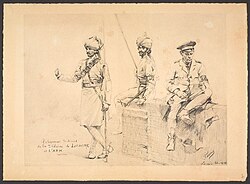
During the Indian Mutiny (also known as the First War of Independence), the division faced internal strife. While some regiments at the Mian Mir cantonments plotted to revolt, they were successfully disarmed by British horse artillery and infantry to prevent the seizure of Lahore Fort. However, the 26th Bengal Native Infantry did mutiny, killing several officers before escaping during a dust storm. Despite this, Lahore remained under the control of British and loyal Indian troops.
Evolution Toward World War I
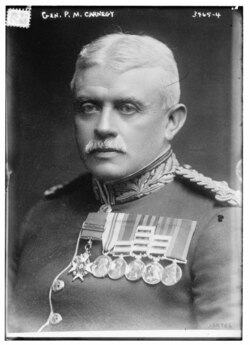
In the late 19th and early 20th centuries, the division underwent several structural changes. Under the reforms of Lord Roberts in 1890, divisions were briefly renamed 1st Class Districts. Later, Lord Kitchener reintroduced numbered divisions with territorial titles. The designation 3rd (Lahore) Division officially reappeared in the Army List by late 1904 as part of the Northern Command.
By 1914, the division's headquarters were located at Dalhousie, overseeing the Ferozepore, Jullundur, and Sirhind infantry brigades, as well as the Ambala cavalry brigade.
World War I: The Western Front (1914–1915)
At the outbreak of World War I, the 3rd (Lahore) Division was deployed as part of Indian Expeditionary Force A to reinforce the British Expeditionary Force (BEF) in France. To avoid confusion with the 3rd British Division, they were referred to simply as the "Lahore Division."
The deployment was fraught with delays caused by German raiders in the Indian Ocean and slow transport. Upon arrival in Marseille in September 1914, troops had to be re-armed with modern rifles and improvised supply trains were created using local vans.
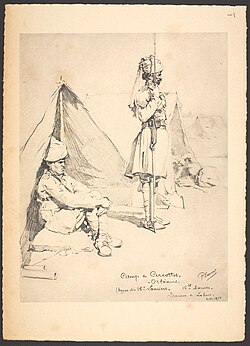
The division entered combat piecemeal during October and November 1914, participating in the Battles of La Bassee, the First Battle of Messines, and the Battle of Armentieres. The chaos of the early deployment was noted by Lt-Gen Sir James Willcocks, who observed that the division's brigades were often split up and attached to various British units.
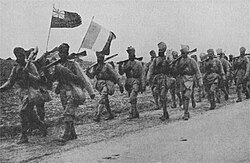
Throughout 1915, the division endured harsh winter conditions and fought in several major engagements, including the Battles of Neuve Chapelle, Second Ypres, Aubers Ridge, Festubert, and Loos.
Middle Eastern Campaigns: Mesopotamia and Palestine
By August 1915, the Indian battalions had been severely weakened by casualties and the brutal European winter. Consequently, the 3rd (Lahore) Division was ordered to leave France for Mesopotamia (modern-day Iraq) to support the advance on Baghdad. They arrived in April 1916, joining the Tigris Corps.
In March 1918, the division was transferred again, this time to Egypt to join Sir Edmund Allenby's Egyptian Expeditionary Force. The division played a key role in the Palestine Campaign, most notably during the Battle of Megiddo in September 1918, where it served on the right flank of the XXI Corps.
| Theater | Period | Key Engagements |
|---|---|---|
| Western Front | 1914–1915 | La Bassee, Neuve Chapelle, Second Ypres, Loos |
| Mesopotamia | 1916–1918 | Advance on Baghdad, Tigris Corps operations |
| Palestine | 1918 | Battle of Megiddo |
Frequently Asked Questions
Why was the division renamed from the Cis-Jhelum Division?
The renaming occurred in 1852 as part of a broader reorganization of the Indian Army's administrative divisions to better align with regional headquarters, such as Lahore.
Why was the division moved from France to Mesopotamia?
The move was prompted by heavy casualties and the inability of the supply system to provide enough drafts to replace losses, combined with a desire to withdraw Indian troops before another harsh European winter.
What was the role of the 3rd Lahore Divisional Area?
Formed in late 1914, this area took over the garrison duties in India that the 3rd Division had previously performed before it deployed to France.
Which notable commanders led the 3rd (Lahore) Division?
Notable leaders included Sir Hugh Henry Gough, a Victoria Cross recipient, Frederick Walter Kitchener, and Sir Arthur Hoskins.
What happened to the division's artillery when it left France?
When the division embarked for Mesopotamia, it left behind its attached Territorial Force and Special Reserve battalions, as well as its three Royal Field Artillery (RFA) brigades of 18-pounder guns.