WQXR History: The Evolution of New York City's Classical Music Authority
For nearly a century, WQXR has served as a cornerstone of classical music broadcasting in New York City. From its origins as an experimental television station to its current status as a non-commercial powerhouse, the station's journey reflects the broader technological and regulatory shifts of the American radio industry.
The Early Years and Experimental Beginnings
The roots of WQXR trace back to March 26, 1929, when John V. L. Hogan and Elliott Sanger launched W2XR. Originally designed as a mechanical television station, W2XR frequently broadcast classical music alongside its visual transmissions. By 1936, the operation transitioned into a standard AM broadcast station at 1560 kHz, officially adopting the call letters WQXR.
The station's growth was intertwined with the birth of wide band FM (Frequency Modulation). Edwin Howard Armstrong, the inventor of FM, initially rebroadcast WQXR programming on his own experimental station, W2XMN. However, by 1939, Hogan and Sanger established their own FM presence with W2XQR at 42.3 MHz. The station's physical footprint also evolved, transmitting from the Chanin Building starting in 1941 before moving to the iconic Empire State Building in 1965.
The New York Times Era (1944–2009)
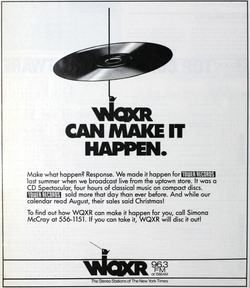
In 1944, the New York Times Company acquired the Interstate Broadcasting Company, the holding company for WQXR. This acquisition began a long era of association between the prestigious newspaper and the radio station. As the FCC shifted the FM band to its current 88–108 MHz range in 1945, the station moved to 97.7 MHz, eventually settling at 96.3 MHz in 1948 under the call letters WQXR-FM.
Innovation in Stereo Sound
WQXR was a pioneer in audio fidelity, becoming the first AM station in New York to experiment with stereo broadcasting in 1952. This was achieved using a clever dual-microphone setup: one microphone fed the AM signal and another fed the FM signal. Listeners could experience a stereo effect by placing two separate radios—one tuned to 1560 AM and the other to 96.3 FM—six feet apart.
Programming Shifts and Corporate Changes
Throughout the 1950s, WQXR-FM expanded its reach via the Rural Radio Network into Upstate New York. However, regulatory changes in 1965 forced a split in programming; the FCC required AM and FM stations in large markets to offer distinct content. Consequently, WQXR-FM focused on longer classical compositions, while the AM side aired lighter music and talk programs produced with The New York Times.
The landscape shifted again in 1992 when the AM station transitioned to popular standards and became WQEW. By 2007, after a lease and eventual sale to ABC for Radio Disney, WQXR-FM remained the sole broadcasting property of the New York Times Company.
The Transition to 105.9 MHz
The frequency 105.9 MHz has a turbulent history. It began in 1962 as WCOM (later WHBI), but the station faced severe FCC scrutiny in the 1970s. Due to a lack of licensee control and various rule violations—including false advertising and improper logging—the FCC recommended against license renewal in 1976. After years of interim operations by the Global Broadcasting Group and Multicultural Radio Broadcasting, the frequency cycled through several call signs, including WNWK and WCAA.
The 2009 Frequency Swap and Public Radio
A landmark transition occurred on October 8, 2009. The New York Times Company transferred the 96.3 FM license to Univision Radio in exchange for the 105.9 MHz license. This complex deal involved WNYC Radio, which took over 105.9 FM as a non-commercial entity. Univision paid $33.5 million for 96.3 MHz, while WNYC Radio paid $11.5 million for the 105.9 FM license, equipment, and the WQXR brand assets.

The transition was marked by a symbolic musical handoff: the final piece on 96.3 MHz was Leonard Bernstein's "Mambo" from West Side Story, while the first broadcast on 105.9 MHz was Igor Stravinsky's Dumbarton Oaks.
Technical Impact of the Move
While WQXR-FM continues to transmit from the Empire State Building, the move to 105.9 MHz resulted in a significant reduction in signal strength. The Effective Radiated Power (ERP)—the energy concentrated toward the horizon—dropped from 6,000 watts to 610 watts. This reduced the coverage area from approximately 17.1 million people (at a 50-mile range) to 14.5 million people (at a 30-mile range). Additionally, signal interference occurs where WQXR overlaps with Hartford's WHCN, which also broadcasts on 105.9 MHz.
| Era/Year | Frequency | Call Sign | Primary Owner |
|---|---|---|---|
| 1929–1936 | Experimental | W2XR | Hogan & Sanger |
| 1936–1992 | 1560 AM | WQXR | NY Times Co. (from 1944) |
| 1948–2009 | 96.3 FM | WQXR-FM | NY Times Co. |
| 2009–Present | 105.9 FM | WQXR-FM | New York Public Radio |
Key Facts
- Founded: March 26, 1929, as experimental station W2XR.
- Stereo Pioneer: First NYC AM station to experiment with stereo in 1952 using dual-frequency listening.
- Ownership: Owned by the New York Times Company from 1944 until 2009.
- Current Status: Operated by New York Public Radio as a non-commercial station.
- Signal Change: Moved from 96.3 MHz to 105.9 MHz in 2009, reducing ERP from 6,000 to 610 watts.
Frequently Asked Questions
Why did WQXR move from 96.3 FM to 105.9 FM?
The move was part of a commercial exchange in 2009 where the New York Times Company traded the 96.3 FM license to Univision Radio in exchange for the 105.9 MHz license, which was then transitioned to WNYC Radio as a non-commercial station.
How did WQXR achieve stereo sound in 1952?
The station used two microphones placed six feet apart; one fed the AM signal and the other fed the FM signal. Listeners could create a stereo effect by tuning two separate radios to these different frequencies and placing them six feet apart.
What happened to the WQXR AM station?
The AM side changed its format from classical to popular standards in 1992 and became WQEW. It was later leased and eventually sold to ABC for Radio Disney in 2007.
Does the move to 105.9 FM affect the listening range?
Yes. The signal strength was reduced from 6,000 watts to 610 watts ERP, decreasing the coverage range from 50 miles to 30 miles and reducing the potential audience from 17.1 million to 14.5 million people.
Who currently operates WQXR?
WQXR is currently operated by New York Public Radio as a non-commercial classical music station.