Windham Bay: The Versatile Escort Carrier of WWII and the Korean War
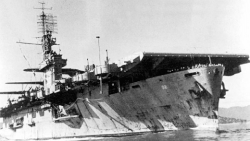
The Windham Bay was a Casablanca-class escort carrier that served as a vital logistical artery for the United States Navy across two major conflicts. Rather than engaging in primary combat strikes, the Windham Bay specialized in the transport and replenishment of aircraft, personnel, and supplies, ensuring that frontline fleet carriers remained operational during the most intense campaigns of the Pacific Theater.
Key Facts
- Primary Role: Aircraft transport and replenishment carrier.
- WWII Honors: Awarded three battle stars for service.
- Major Incidents: Suffered severe structural damage during Typhoon Connie in June 1945.
- Korean War Service: Reclassified as an aircraft transport (T-CVE-92) and later a utility carrier (CVU-92).
- Final Fate: Decommissioned in 1959 and scrapped in Japan in 1961.
World War II Service: Logistics and Resilience
Following her commissioning, the Windham Bay began her career with a series of transport missions. After shakedown cruises and trials off the California coast, she moved aircraft and personnel through Hawaii to the Marshall Islands, specifically Majuro and Kwajalein Atolls. One of her early notable missions involved transporting Marine Night Fighter Squadron 532 (VMF(N)-532) to Saipan.
Throughout 1944, the ship operated as a shuttle, moving aircraft to the Admiralty Islands, the New Hebrides, and the Solomon Islands. She also played a humanitarian role, transporting approximately 350 casualties from the Palau campaign back to San Diego in November 1944.
The Iwo Jima and Okinawa Campaigns
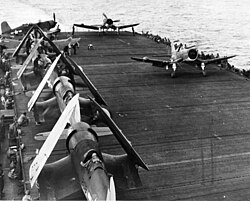
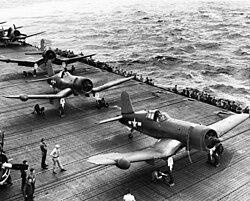
By early 1945, the Windham Bay transitioned into a replenishment carrier. As part of Task Group 50.8 (the Logistics Support Group), she provided essential replacement aircraft, parts, and crews to the Fast Carrier Task Force of the Third Fleet. During the invasion of Iwo Jima, she and three sister ships delivered a total of 254 aircraft and 65 crews to fleet carriers.
During the Okinawa campaign, she utilized the captured Kerama Islands to quickly replenish bombs and ammunition, reducing the time she spent away from the frontline carriers she supported.
Survival of Typhoon Connie
In June 1945, the Windham Bay encountered Typhoon Connie. Despite warnings from Rear Admiral Donald B. Beary, the fleet sailed into the storm's eyewall. The ship faced winds estimated at 127 knots (146 mph) and waves reaching 75 feet.
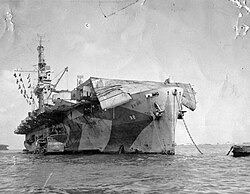
The storm caused catastrophic damage: the forward 20 feet of the flight deck collapsed onto the forecastle, and two 40 mm Bofors guns and the forward lookout platform were swept overboard. Water flooded the elevator well, rendering the forward aircraft elevator inoperable.
Post-War Repatriation
After extensive repairs in San Diego, the Windham Bay joined Operation Magic Carpet, the massive effort to repatriate U.S. servicemen from the Pacific. She conducted multiple runs between the Philippines, Hawaii, and the U.S. West Coast before being decommissioned and mothballed in August 1946.
The Korean War and Final Years
The outbreak of the Korean War in 1950 necessitated the ship's return to service. Recommissioned on October 28, 1950, she was reclassified as an aircraft transport (T-CVE-92) and operated by the Military Sea Transportation Service (MSTS) with a civilian crew under military command.
Her missions during this era were primarily transpacific resupply voyages between the U.S. West Coast and Japan. Notably, she became the first large vessel to enter the Long Gam River in Saigon since 1925. While docked in Saigon, the ship was targeted by Vietnamese rebels who threw seventeen hand grenades at the vessel, though none exploded.
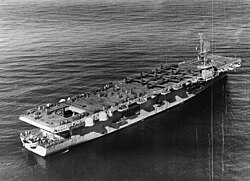
In 1955, she was reclassified as a utility carrier (CVU-92). After a severe fire in Alameda in 1956 and continued service in the Western Pacific, the Navy determined that the Casablanca-class carriers were less economical than the older Bogue-class for transport duties. The Windham Bay was decommissioned for the final time in January 1959 and scrapped in Japan in 1961.
Service Summary
| Period | Classification | Primary Role | Key Locations |
|---|---|---|---|
| 1944–1946 | CVE (Escort Carrier) | Aircraft Transport / Replenishment | Marshall Islands, Iwo Jima, Okinawa |
| 1950–1955 | T-CVE (Aircraft Transport) | Logistics Resupply | Japan, Korea, Saigon, Philippines |
| 1955–1959 | CVU (Utility Carrier) | Logistics Resupply | West Coast US, Japan, Vietnam |
Frequently Asked Questions
What was the primary purpose of the Windham Bay?
The Windham Bay served primarily as a transport and replenishment carrier, moving aircraft, crews, and supplies to frontline fleet carriers and transporting personnel and casualties across the Pacific.
How did Typhoon Connie affect the ship?
The typhoon caused severe structural damage, including the collapse of the forward 20 feet of the flight deck and the loss of two 40 mm Bofors guns and the forward lookout platform.
What was the ship's role in the Korean War?
She operated as an aircraft transport under the Military Sea Transportation Service, conducting nine round-trip resupply voyages between the U.S. West Coast and Japan, with additional stops in Taiwan, Thailand, and Vietnam.
What happened during the ship's visit to Saigon?
While docked in Saigon, Vietnamese rebels threw seventeen hand grenades at the carrier, although none of the grenades exploded.
Why was the Windham Bay eventually scrapped?
The U.S. Navy evaluated the Casablanca-class escort carriers as being less economical and desirable for transport duties compared to the older Bogue-class carriers.