Syngman Rhee: The Architect and Controversial First President of South Korea
Syngman Rhee stands as one of the most consequential and polarizing figures in modern Asian history. As the first president of the Republic of Korea, his life spanned the transition from the Joseon dynasty through Japanese colonial rule to the establishment of a sovereign South Korean state. His journey from an independence activist in exile to the leader of a new nation is a complex saga of diplomacy, political struggle, and authoritarian rule.

Key Facts
- First President: Served as the inaugural president of the Republic of Korea from 1948 to 1960.
- Independence Activist: Led the Korean Provisional Government in exile during the Japanese occupation.
- Academic Background: Earned degrees from George Washington University, Harvard University, and Princeton University.
- Political Affiliation: Primarily associated with the Liberal Party.
- Legacy: A figure of deep division, credited with establishing the state but criticized for authoritarianism.
Early Life and the Fight for Independence
Born Rhee Syngryong in 1875 in Pyongsan County, Hwanghae, Rhee’s early life was shaped by his conversion to Christianity at a local Methodist school. His political awakening led to his imprisonment in 1899 for independence activities. Following his release in 1904, he moved to the United States, a move that would define his future political strategy.
In the United States, Rhee became a highly educated advocate for Korean sovereignty. He sought to influence global powers, even meeting with U.S. President Theodore Roosevelt in 1905 to discuss the preservation of Korean independence. His academic pursuits at prestigious institutions like Harvard and Princeton provided him with the intellectual tools to lobby international leaders for his country's freedom.

During the Japanese occupation, Rhee played a pivotal role in the Korean Provisional Government. He served as its president from 1919 to 1925 and later held leadership roles in various capacities. His efforts included establishing the Korean Commission in Washington, D.C., to garner support from America and Europe for the cause of independence.
The Rise to the Presidency
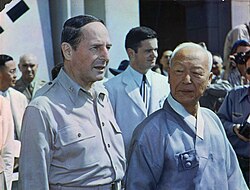
Following the end of World War II, Rhee returned to a Korea transitioning from US and Soviet oversight. He was a staunch anti-communist, a stance that aligned with the burgeoning Truman Doctrine of containment. In 1948, the National Assembly elected him as the first president of the Republic of Korea, winning 92.3% of the vote.

His early presidency was marked by the formal establishment of the Republic of Korea on August 15, 1948. However, this period also saw the beginning of political tensions, including his complex relationship with the chinilpa—elites who had collaborated with the Japanese during the colonial era. To maintain stability, Rhee reached understandings that allowed many former colonial-era officials to retain their positions, including many in the national police force.
The Korean War and Political Repression
The outbreak of the Korean War on June 25, 1950, fundamentally altered Rhee's presidency. As North Korean forces invaded, the South Korean military was overwhelmed. The conflict was characterized by extreme violence and political instability. During this time, Rhee's administration engaged in significant political repression, with thousands of suspected communists held in jails or enrolled in the Bodo League, a re-education movement.
![Prisoners lie on the ground before execution by South Korean troops near Daejon, South Korea, July 1950. Photo by US Army Maj. Abbott.[39]](/images/da/d0/dad00158300f4676ae2ba4c7369c9173c8cc6ee80570c153d6dc23acc9605510.jpg)
![South Korean soldiers walk among bodies of South Korean political prisoners shot near Daejon, South Korea, July 1950. Photo by US Army Major Abbott.[39]](/images/56/ca/56ca90a4b272c0a8203a9d4cbe74abebdbad1e0686647c0e4370ebb6c9ffc3f4.jpg)
Despite the devastation, Rhee used the war to solidify South Korea's alliance with the United States. Although he refused to sign the 1953 Korean Armistice Agreement, his leadership helped secure the Korea-U.S. Mutual Defense Treaty, ensuring long-term American military support for the South.

Authoritarianism and Resignation
In the post-war years, Rhee's administration faced the monumental task of rebuilding a devastated nation. While the country remained heavily dependent on U.S. aid, Rhee's political grip tightened. He successfully lobbied the legislature to amend the constitution, removing term limits to allow himself to run for an unlimited number of terms.
By 1960, Rhee's rule had become increasingly authoritarian. Following a controversial fourth term election in March 1960, public opposition reached a breaking point. The growing political instability and public outcry eventually led to his resignation in April 1960, ending his twelve-year tenure as president.

Summary of Syngman Rhee's Political Career
| Office | Period | Context |
|---|---|---|
| President, Korean Provisional Government | 1919–1925 | Exile government during Japanese occupation |
| President, People's Republic of Korea | 1945–1946 | Post-WWII transitional period |
| Speaker, National Assembly | May–July 1948 | Founding of the South Korean legislature |
| President, Republic of Korea | 1948–1960 | First President of the First Republic |
Frequently Asked Questions
What was Syngman Rhee's educational background?
Rhee was highly educated in the United States, earning a BA from George Washington University, an MA from Harvard University, and a PhD from Princeton University.
How did Rhee influence the relationship between South Korea and the U.S.?
Rhee was a staunch anti-communist who leveraged his connections in the U.S. to secure support. His refusal to sign the Korean Armistice Agreement eventually led to the Korea-U.S. Mutual Defense Treaty in 1953.
Why is Syngman Rhee considered a controversial figure?
While credited with helping establish the Republic of Korea, he is criticized for his authoritarian leadership, political repression of suspected communists, and efforts to bypass constitutional term limits.
What happened to Rhee after he resigned?
Following his resignation in 1960, Rhee lived in exile. He passed away on July 19, 1965, at the age of 90.
What is the current public perception of Rhee in South Korea?
Public opinion is mixed. A 2023 survey indicated that 30% of respondents believe he did many good things, while 40% believe he did many wrong things.