Second Battle of Seoul: The Recapture of the South Korean Capital
The Second Battle of Seoul was a pivotal engagement of the Korean War, taking place from September 20 to 28, 1950. Following the successful Inchon landing, United Nations (UN) forces sought to reclaim the South Korean capital from North Korean control. The operation involved a complex series of river crossings, urban combat, and strategic hill seizures to isolate the city and force a North Korean withdrawal.
The campaign was characterized by intense fighting in the outskirts and the heart of the city, requiring close coordination between the U.S. Marine Corps, the U.S. Army, and the Republic of Korea (ROK) forces.

Key Facts
- Date: September 20–28, 1950.
- Outcome: United Nations victory and the restoration of the South Korean government.
- Primary UN Forces: 1st Marine Division, 7th Infantry Division, ROK Marine Corps, and the ROK 17th Regiment.
- Opposing Forces: North Korean 9th and 18th Divisions.
- Casualties: UN forces suffered 313 killed; North Korean forces suffered approximately 14,000 killed and 7,000 captured.
The Advance and the Han River Crossing
The operation began with a push toward the Han River. On September 21, the 5th Marines advanced southeast along rail and road lines, capturing strategic heights such as Hill 104 and Hill 296. Simultaneously, the 1st Battalion secured lower hills south of the rail lines, positioning themselves within three miles of Seoul's main railroad station.

The Struggle for Yongdungp'o
To the south, the 1st Marine Regiment targeted Yongdungp'o. The fighting here was brutal, involving a series of seesaw battles for Hills 80, 85, and 118. The North Korean People's Army (KPA) launched fierce counterattacks across rice paddies and the Kal-ch'on Creek, causing significant Marine casualties. By September 22, the KPA abandoned the city, allowing the 1st Marines to occupy Yongdungp'o and reach the destroyed bridges over the Han River.
Securing the Southern Flank
While the Marines pushed toward the city, the 7th Infantry Division protected the right flank. This advance was hampered by extensive minefields near Anyang-ni, which damaged tanks and nearly killed the regimental commander, Colonel Beauchamp. Despite these obstacles, the 32nd Infantry Regiment successfully seized Copper Mine Hill and Hill 290, dominating the southern approaches to Seoul.
The Assault on Western Seoul
Between September 22 and 25, the 5th Marines focused on the western edge of the city. The attack targeted a series of key heights, including Hill 296 and Hill 105. Although the KPA put up stiff resistance with artillery and mortar fire, the UN forces eventually broke the defenses on September 25.

By September 24, the 1st Marines had crossed the Han River from Yongdungp'o to join the 5th Marines. Meanwhile, the 7th Marines moved to the northern edge of the city to block escape routes, and the 3rd Battalion of the 187th Airborne Regiment secured Kimpo Airfield.

The Final Push: 32nd Infantry and the Battle of the Barricades
On September 25, the 32nd Infantry, supported by the ROK 17th Regiment, crossed the Han River. Their primary objectives were Namsan and Hill 348. By September 26, the ROK 17th Regiment had captured the high ground east of the city, effectively sealing the perimeter.

The climax of the battle, known as the Battle of the Barricades, occurred between September 26 and 28. As the North Korean 18th Division attempted to retreat northward toward Ch'orwon, they launched desperate delaying actions. The 5th Marines fought through the city center, eventually using a flame-throwing tank to break the final organized resistance at the Kwang Who Moon Circle.
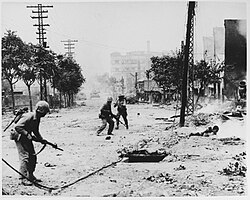
Simultaneously, the 1st Battalion, 5th Marines, captured Hill 338, a dominant feature overlooking the Seoul-Pyongyang highway. By the night of September 27, most North Korean defenders had withdrawn from the city.

Aftermath and Restoration
On September 28, the 1st Marines completed the occupation of the northeast corner of Seoul. The following day, General Douglas MacArthur arrived at Kimpo Airfield and entered the city to a cheering crowd of South Koreans. A formal ceremony was held to restore the Capitol to the Republic of Korea.


While the city was secured, fighting continued on the outskirts. On September 29, the 2nd Battalion, 17th Infantry Regiment, engaged KPA forces southeast of Seoul in a heavy firefight, resulting in over 400 North Korean casualties.
| Category | United Nations Forces | North Korean Forces (KPA) |
|---|---|---|
| Key Units | 1st Marine Div, 7th Infantry Div, ROK 17th Reg | 9th Division, 18th Division |
| Commanders | Douglas MacArthur, Edward M. Almond | Choi Yong-kun, Wol Ki Chan |
| Casualties (Killed) | 363 (Combined) | ~14,000 |
| Prisoners | Negligible | ~7,000 |
| Strategic Result | Recapture of Seoul | Forced withdrawal to the north |
Frequently Asked Questions
What was the primary objective of the Second Battle of Seoul?
The primary objective was to recapture the South Korean capital, Seoul, from North Korean forces and restore the legitimate government of the Republic of Korea.
What was the "Battle of the Barricades"?
The Battle of the Barricades refers to the final phase of urban combat within Seoul, where UN forces, specifically the 5th Marines, fought through North Korean street defenses and barricades to secure the city center and the Capitol.
How did the UN forces cross the Han River?
UN forces utilized various crossing points, including the Yongdungp'o area, using LVTs (Landing Vehicle Tracked) and pontoon bridges to move troops and equipment north of the river.
Which units were involved in the recapture of the city?
The operation was a joint effort involving the U.S. 1st Marine Division, the U.S. 7th Infantry Division, the Republic of Korea (ROK) Marine Corps, and the ROK 17th Regiment.
What happened to the North Korean forces after the battle?
The North Korean 18th Division and other remnants retreated northward via the Uijongbu road toward Ch'orwon, though thousands were killed or captured during the withdrawal.