Willowdale History: From Taggarts Crossroads to Modern Suburban Boundary
Nestled in Chester County, the area now known as Willowdale serves as a fascinating intersection of Pennsylvania's rural heritage and suburban growth. Originally known as Taggarts Crossroads, this location has evolved from a quiet colonial outpost into a commercial hub, all while preserving remnants of its deep historical roots.
Key Facts
- Original Name: Taggarts Crossroads, named after the family who owned a stone inn built in 1730.
- Military Significance: Site of a British flanking maneuver by Lord Cornwallis on September 11, 1777.
- Industrial Roots: Growth was fueled by the nearby Du Pont Factory's need for willow trees to produce black powder.
- Longest Running Business: The Rakestraw-Pyle Company (now R-P Nurseries), established in 1866.
- Transit History: A trolley line operated by the West Chester Street Rail Company served the area from 1904 to 1929.
Colonial Beginnings and the Revolutionary War
The origins of the community date back to the 1700s. The crossroads was named for the Taggart family, who established a stone inn in 1730 that remains standing today on the northwestern corner. Another historic fieldstone house on the northeastern section was once cited as the oldest house west of the Brandywine; while later dating proved this inaccurate, it remains a significant historic structure.
The area played a strategic role during the American Revolution. On the morning of September 11, 1777, British forces led by Lord Charles Cornwallis marched through the crossroads. This flanking maneuver allowed Cornwallis to bypass George Washington's main force at Chadds Ford.
During this movement, Cornwallis encountered a picket line—a preliminary line of troops deployed to warn of enemy approach—commanded by Lieutenant Colonel James Ross of the 8th Pennsylvania Regiment. After firing three shots, Ross retreated and followed the British rearguard along the Great Valley Road to report the maneuver to Washington.
19th Century Growth and Industrialization
The 1800s brought economic expansion to the crossroads, largely driven by the nearby Du Pont Factory. The factory manufactured black powder, a propellant consisting of 15% charcoal. Because willow trees from the local area were ideal for burning to produce this charcoal, the community grew in tandem with the factory's needs.
This growth led to the establishment of essential village services, including a post office, general store, blacksmith, wheelwright shop, and a church.
In 1866, Josiah Pyle and William Rakestraw founded the Rakestraw-Pyle Company. This plant nursery, located near the present-day Willowdale Church, featured gardens, a greenhouse, and a water tower. Today, the business continues to operate in the same location as R-P Nurseries.
The Era of the Trolley and 20th Century Evolution
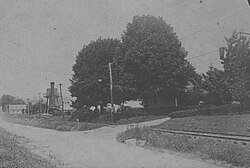
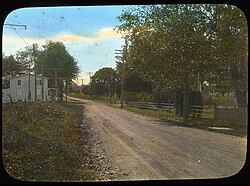
The early 1900s saw a surge in connectivity. In 1906, the West Chester Street Rail Company introduced a trolley line running from Kennett Square along Unionville Road. The trolley stopped at the general store near the Willowdale crossroads, with service running ten minutes before and after every hour.
To manage traffic, a trolley switch was installed between the station and the chapel, allowing cars traveling in opposite directions to pass one another. This service operated until 1929, when it was replaced by a bus route. Traces of the original line are still visible today on the stone wall along the southern stretch of Unionville Road.
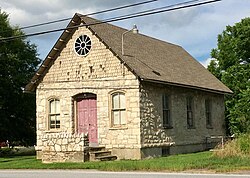
As the community grew, the local church expanded, constructing a larger building directly across from the original structure. This congregation remains active today, holding services every Sunday.
Modern Development
In the latter half of the 20th century, Chester County experienced significant suburbanization. This led to the redevelopment of the northeastern side of the crossroads, resulting in the demolition of the original general store and several outbuildings. A historic barn and stone house were repurposed into office spaces.
Currently, the area hosts various commercial services, including health, finance, food, and state government offices. Despite this, the intersection remains a distinct boundary: the land to the west remains primarily farmland, while the land to the east is characterized by housing developments.
Willowdale Historical Summary
| Era/Year | Key Event/Development | Significance |
|---|---|---|
| 1730 | Taggart Inn built | Established the original Taggarts Crossroads |
| 1777 | Cornwallis Flanking Maneuver | Strategic British movement during the Revolutionary War |
| 1800s | Du Pont Factory Expansion | Willow trees used for black powder charcoal production |
| 1866 | Rakestraw-Pyle Company founded | Start of a multi-generational family nursery business |
| 1906–1929 | West Chester Street Rail service | Provided trolley transit between Willowdale and Kennett Square |
| Late 1900s | Suburbanization | Transition to commercial offices and residential developments |
Frequently Asked Questions
What was the original name of Willowdale?
The area was originally called Taggarts Crossroads, named after the Taggart family who owned a stone inn built in 1730.
How did the Du Pont Factory influence the town's growth?
The factory produced black powder, which required charcoal. The willow trees in the area were among the best for burning to create this charcoal, driving the growth of the local community.
Who was the British commander that passed through the crossroads in 1777?
Lord Charles Cornwallis led the British forces through the crossroads during a flanking maneuver to avoid Washington's main force at Chadds Ford.
What happened to the trolley line that served the area?
The trolley line, operated by the West Chester Street Rail Company, ran from 1904 until 1929, at which point it was replaced by a bus route.
Is the Rakestraw-Pyle Company still in business?
Yes, the business is still owned and operated by the same family in the same location, though it is now known as R-P Nurseries.