Waders and Shorebirds: Biology, Taxonomy, and Migration
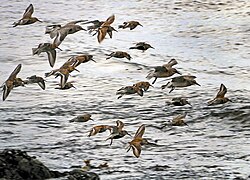
Across the world's coastlines and mudflats, a diverse group of birds known as waders (in Europe) or shorebirds (in North America) play a vital role in wetland ecosystems. These birds, belonging to the order Charadriiformes, are specialized for life in transitional environments, where they forage for small arthropods, aquatic insects, and crustaceans burrowed in the sand or mud.
While the term "wader" is standard in Europe, North Americans often use it specifically for long-legged birds like herons and storks, preferring "shorebird" for the Charadriiformes group. From the tiny least sandpiper to the imposing Far Eastern curlew, these birds exhibit extraordinary adaptations for survival and travel.
Key Facts
- Species Diversity: There are approximately 255 species of waders globally.
- Extreme Migration: The bar-tailed godwit holds the record for the longest non-stop flight, traveling over 13,000 km from Alaska to New Zealand.
- Size Range: Weights vary from the least sandpiper (15.5 g) to the beach thick-knee (approx. 1 kg).
- Feeding Specialization: Many species possess sensitive nerve endings in their bills to detect hidden prey.
- Temporal Range: The group has existed since the Late Oligocene.
Taxonomy and Classification
Historically, waders were grouped into a single suborder called Charadrii. However, modern research has revealed this to be a wastebasket taxon—a term used for a group where unrelated species are placed together for convenience rather than evolutionary accuracy. Recent genetic studies have redefined these relationships, splitting the group into more accurate monophyletic lineages (groups consisting of a common ancestor and all its descendants).
Suborder Classifications
Waders are traditionally divided into two primary suborders, with a third often included in broader discussions:
- Suborder Charadrii (or Eucharadrii): Includes plovers, lapwings, oystercatchers, stilts, and avocets.
- Suborder Scolopaci: Includes sandpipers, snipes, jacanas, and the plains-wanderer.
- Suborder Lari: Includes gulls and terns; while not always classified as waders, families like the crab-plover and buttonquail are sometimes associated with the group.
| Metric/Category | Details | Example Species |
|---|---|---|
| Smallest Species | 13 cm / 15.5 g | Least sandpiper |
| Longest Species | 63 cm / 860 g | Far Eastern curlew |
| Heaviest Species | Approx. 1 kg | Beach thick-knee |
| Total Species | ~255 | Various |
Physical Characteristics and Adaptations
The most striking feature of waders is their long legs, which allow them to navigate shallow waters and mudflats without swimming. Their wing lengths are often optimized for long-distance migration, supported by highly efficient metabolisms that provide energy during grueling journeys between breeding and non-breeding grounds.
Feeding strategies are highly specialized to reduce competition. Different bill lengths allow multiple species to coexist in the same habitat by targeting prey at different depths. Many waders utilize tactile foraging, using sensitive nerve endings in their bills to "feel" prey in the soil without needing to see it.
Evolutionary Drivers: Selection and Dimorphism
Waders exhibit varying degrees of sexual dimorphism—physical differences between males and females. These differences can manifest in size, color, or agility.
Sexual Selection
In many species, sexual selection drives the evolution of larger males, who compete for access to females. However, some species exhibit gender role reversal. In the Jacana species, females are larger and compete for territories and access to males, who are primarily responsible for childcare.
Natural Selection
Natural selection focuses on traits that increase overall fitness within a specific niche (the specific role and environment a species occupies). For example, if a specific bill size is more efficient for gathering available food, that trait will become dominant in the population. This can lead to monomorphism, where males and females look nearly identical, unless sexual selection pushes the traits in a different direction.
Frequently Asked Questions
What is the difference between a wader and a shorebird?
The terms are largely regional. "Wader" is the preferred term in Europe, while "shorebird" is used in North America. In North America, "wader" may specifically refer to larger birds like herons.
Which wader travels the furthest?
The bar-tailed godwit holds the global record for the longest non-stop flight, covering more than 13,000 km from Alaska to New Zealand.
Why do different shorebirds have different bill shapes?
Different bill lengths and shapes allow various species to forage for food at different depths in the mud or sand, reducing direct competition for the same food sources.
Do all waders migrate?
No. While many species from Arctic and temperate regions are strongly migratory, tropical waders are often resident or move only in response to local rainfall patterns.
What is a "wastebasket taxon" in wader taxonomy?
It refers to the former classification of the suborder Charadrii, which grouped together several unrelated lineages simply because they shared similar characteristics, rather than a close evolutionary ancestor.