Victory in Europe Day
Victory in Europe Day, commonly known as VE Day, marks the formal end of World War II in Europe. Observed annually on 8 May, this international occasion commemorates the unconditional surrender of Nazi Germany, bringing a close to one of the most devastating conflicts in human history.
The celebrations of VE Day vary across the globe, reflecting the diverse experiences of the nations involved. While many European states recognize 8 May, other countries—most notably Russia and several former Soviet states—celebrate on 9 May. This discrepancy is due to the time difference; the surrender took effect at 23:01 Central European Summer Time on 8 May, which was 00:01 on 9 May in Moscow.
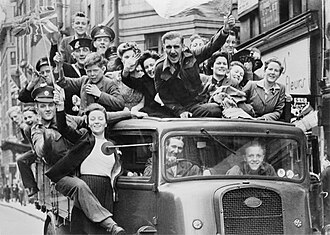
Key Facts
- Date: 8 May (observed by most European states); 9 May (observed by Russia and former Soviet states).
- Significance: Marks the end of World War II in Europe.
- First Observed: 8 May 1945.
- Key Figures: Winston Churchill (UK), Harry S. Truman (USA), and Karl Dönitz (Germany).
- Legal Basis: The German Instrument of Surrender signed in Reims and Berlin.
The History of the Surrender
The path to peace began with the fall of the Nazi regime. Following the suicide of Adolf Hitler on 30 April 1945 during the Battle of Berlin, his successor, Reichspräsident Karl Dönitz, authorized the surrender. The administration under Dönitz became known as the Flensburg Government.
The military surrender occurred in two stages. The first act was signed at 02:41 on 7 May at the Supreme Headquarters of Allied Expeditionary Forces (SHAEF) in Reims. This was followed by the definitive German Instrument of Surrender, signed on 8 May 1945 in Karlshorst, Berlin, at 22:43 local time. This document ordered all German military, naval, and air forces to cease active operations by 23:01 Central European time.
Global Reactions and Leadership
In the United States, the victory coincided with President Harry S. Truman's 61st birthday. Truman dedicated the triumph to Franklin D. Roosevelt, who had passed away from a cerebral hemorrhage on 12 April, just weeks before the end of the war. While American cities like New York's Times Square erupted in celebration, flags remained at half-staff for a 30-day mourning period for Roosevelt.
Despite the jubilation, leaders remained cautious. Both Winston Churchill and President Truman reminded their citizens that the war was not yet fully over, as Japan remained unsubdued. Churchill described the moment as a "brief period of rejoicing," while Truman referred to it as a "victory only half won."
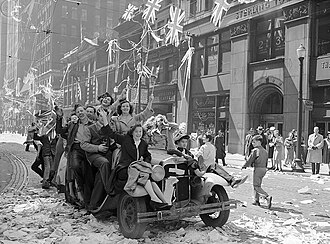
National Observances and Traditions
Different nations have integrated VE Day into their national identities in various ways:
- France: 8 May is a national public holiday. The date is so deeply embedded in the culture that over 500 streets across French communes are named "Rue (du) 8-Mai-1945."
- Germany: Berlin holds events on 8 May to honor the German Resistance and those who died fighting Nazism. East Germany previously celebrated this as Liberation Day (Tag der Befreiung).
- Poland: Officially recognized as National Victory Day (Narodowy Dzień Zwycięstwa) on 8 May since 2015. Previously, Poland followed the Russian tradition of celebrating on 9 May.
- United Kingdom: While a major historical event, it is not a permanent annual public holiday. However, the government has moved bank holidays to 8 May for major anniversaries, such as the 50th and 75th.
- United States: It is not a federal holiday, though President Donald Trump issued a proclamation in 2025 designating 8 May as "Victory Day for World War II."
Other Regional Commemorations
In the Baltic states (Estonia, Latvia, and Lithuania), 8 May is commemorated, but 9 May is avoided as it is associated with the Soviet occupation of 1944. In Belgium, the end of WWII is commemorated as part of the Armistice of 11 November, featuring a ceremony at the Tomb of the Unknown Soldier in Brussels.
Summary of Associated Holidays
| Country | Holiday Name | Date | Type |
|---|---|---|---|
| Russia | Victory Day | 9 May | National Public |
| France | 8 mai 1945 | 8 May | National Public |
| Czech Republic | Victory Day / Liberation Day | 8 May | National Public |
| Norway | Liberation Day | 8 May | National Commemorative |
| Poland | National Victory Day | 8 May | National Commemorative |
| Ukraine | Day of Remembrance and Victory over Nazism | 8 May | National Public |
| Netherlands | Liberation Day | 5 May | National Commemorative |
| Italy | Liberation Day | 25 April | National Public |
Frequently Asked Questions
Why do some countries celebrate on 8 May and others on 9 May?
The difference is due to time zones. The German surrender took effect at 23:01 Central European Summer Time on 8 May 1945, which was already 00:01 on 9 May in Moscow. Consequently, Russia and other former Soviet states celebrate on the 9th.
Who signed the final surrender documents?
The surrender was authorized by Reichspräsident Karl Dönitz. The definitive German Instrument of Surrender was signed on 8 May 1945 in Karlshorst, Berlin.
Was VE Day the end of all fighting in World War II?
No. While it ended the war in Europe, the war in the Pacific continued. Both Winston Churchill and Harry S. Truman noted at the time that the victory was only partial until Japan was defeated.
Is VE Day a public holiday in the UK and USA?
No, it is not a standard annual public holiday in either country. In the UK, bank holidays are occasionally moved to coincide with major anniversaries, and in the US, it has been recognized via presidential proclamation but is not a federal holiday.