States' Rights Democratic Party: The Rise and Fall of the Dixiecrats
The States' Rights Democratic Party, commonly known as the Dixiecrats, was a short-lived but influential far-right splinter group that emerged in 1948. Born from a fracture within the Democratic Party, the movement represented a desperate attempt by Southern white conservatives to maintain racial segregation and white supremacy in the face of a shifting national political landscape.
While the party existed as a formal entity for only a few months, its emergence signaled the beginning of the end for the "Solid South"—the era when the Democratic Party held nearly absolute control over the Southern United States.
Key Facts
- Founded: July 17, 1948; dissolved in November 1948.
- Primary Leader: Senator Strom Thurmond of South Carolina.
- Core Ideology: Segregationism, white supremacy, and states' rights.
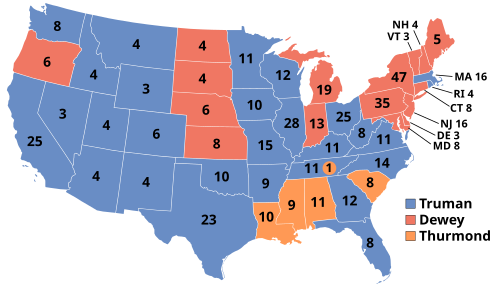
- 1948 Performance: Won 39 electoral votes and carried four states (Alabama, Louisiana, Mississippi, and South Carolina).
- Long-term Impact: Initiated the political realignment of the South from Democratic to Republican.
The Foundation of the Solid South (1865–1948)
Following the Reconstruction era, white voters in the South overwhelmingly supported the Democratic Party. This dominance created the Solid South, a political monolith where Democrats controlled nearly every congressional seat and state legislature. This power was maintained through systemic violence, fraud, and the disenfranchisement of Black voters and poor whites between 1890 and 1908.
Central to this social order were Jim Crow laws—a system of legal and informal segregation that relegated African Americans to second-class citizenship. While the national Democratic Party began to shift, Southern Democrats used their seniority and power in Congress to block civil rights legislation for decades.
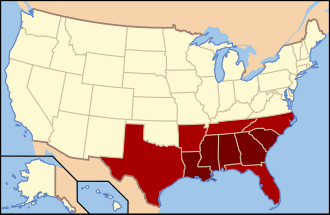
By the 1930s, President Franklin D. Roosevelt's New Deal brought significant economic intervention to the region. However, the New Deal largely avoided civil rights issues to maintain the support of Southern Democrats. This uneasy alliance began to crumble after Roosevelt's death when his successor, Harry S. Truman, took a more active stance on racial equality.
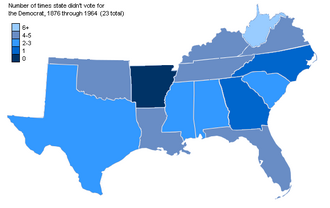
The 1948 Schism and Presidential Election
The tension reached a breaking point in 1948. President Truman established the President's Committee on Civil Rights and issued Executive Order 9981 to desegregate the U.S. military. These moves alienated Southern governors and senators, including Strom Thurmond and Fielding L. Wright.
At the 1948 Democratic National Convention, Northern liberals led by Hubert Humphrey successfully pushed for a civil rights plank in the party platform. In protest, 35 Southern delegates walked out of the convention. These defectors formed the States' Rights Democratic Party to challenge Truman's nomination.
The Dixiecrats held a massive convention in Oklahoma City on August 14, 1948, where they adopted a platform centered on the preservation of segregation and the opposition to federal interference in state affairs.
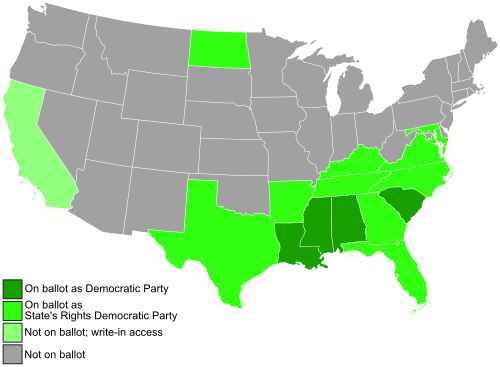
In the general election, the Thurmond-Wright ticket captured 1,169,021 popular votes. They successfully carried Alabama, Louisiana, Mississippi, and South Carolina, and secured one electoral vote in Tennessee. Despite this split in the Democratic vote, Truman managed an upset victory over Republican Thomas E. Dewey.
Opposition and Collapse
The Dixiecrat movement faced significant opposition from a coalition of African American voters, labor activists, and white Democrats who opposed segregation. These groups worked to maintain loyalty to the national Democratic Party while advocating for the protections and rights of marginalized citizens.
The party collapsed shortly after the 1948 election. Most of its leaders eventually returned to the Democratic Party, though the seeds of distrust had been sown. By the 1952 Democratic National Convention, Southern delegations were reseated after signing loyalty pledges, and the nomination of segregationist Senator John Sparkman as the vice-presidential candidate helped temporarily stabilize the party in the South.
Legacy and Political Realignment
The Dixiecrats were the first major crack in the Solid South. Their rebellion paved the way for a massive political realignment over the following decades. As the national Democratic Party embraced civil rights, white Southern conservatives began migrating toward the Republican Party.
This shift was exemplified by Strom Thurmond himself, who officially joined the Republican Party in 1964 to oppose national civil rights legislation. By the late 1960s, Republican candidates like Barry Goldwater and Richard Nixon began winning the same states that Thurmond had carried in 1948. This process eventually resulted in the modern political map, where the South is predominantly Republican and the Northeast is predominantly Democratic.
| Candidate | Vice Presidential Candidate | Popular Votes | Percentage | Electoral Votes |
|---|---|---|---|---|
| Strom Thurmond | Fielding L. Wright | 1,175,930 | 2.4% | 39 |
Frequently Asked Questions
What were the Dixiecrats?
The Dixiecrats were members of the States' Rights Democratic Party, a far-right splinter group that broke away from the Democratic Party in 1948 to oppose civil rights platforms and maintain racial segregation.
Who was the leader of the States' Rights Democratic Party?
The party's primary leader and presidential candidate was Senator Strom Thurmond of South Carolina.
Why did the Dixiecrats leave the Democratic Party?
They left because President Harry S. Truman supported civil rights initiatives, including the desegregation of the military and a pro-civil rights platform at the 1948 Democratic National Convention.
Which states did the Dixiecrats win in 1948?
The party carried Alabama, Louisiana, Mississippi, and South Carolina, and received one electoral vote in Tennessee.
What happened to the party after the 1948 election?
The party collapsed quickly. Most members returned to the Democratic Party in the short term, but the movement began a long-term shift of Southern conservatives toward the Republican Party.