World War II in Europe: The Final Days and German Surrender
The conclusion of World War II in Europe was not a single moment, but a series of collapses and formal agreements that unfolded throughout May 1945. Following the suicide of Adolf Hitler on April 30, the leadership of Nazi Germany transitioned to Grand Admiral Karl Dönitz and the Flensburg Government. As Soviet forces closed in on the capital, the Third Reich faced an inevitable end, leading to a sequence of unconditional surrenders across multiple fronts.
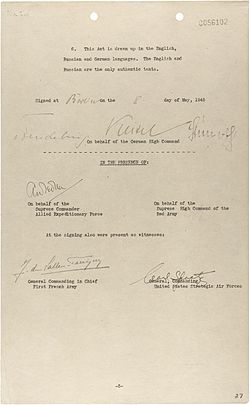
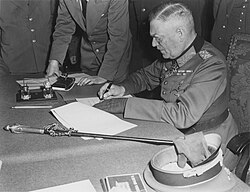
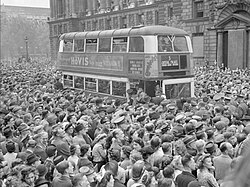
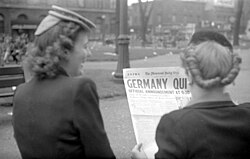
The fall of Berlin on May 2 marked the symbolic end of the regime, but the formal cessation of hostilities required a coordinated legal process. On May 8, Field Marshal Wilhelm Keitel signed the German Instrument of Surrender in Karlshorst, Berlin. This event is commemorated globally as Victory in Europe Day (V-E Day), while Russia celebrates Victory Day on May 9.
Key Facts
- Official End: Germany signed its unconditional surrender on May 8, 1945.
- Leadership Shift: Grand Admiral Karl Dönitz took power after Hitler's suicide on April 30.
- Prisoner Scale: Over 1.5 million prisoners were taken on the Western Front in April 1945 alone.
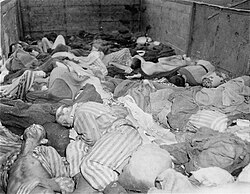
- Holocaust Discovery: The advance of Allied forces uncovered the full scale of Nazi concentration camps, including Dachau and Bergen-Belsen.
- Post-War Law: The Allied Control Council repealed Nazi laws and abolished national-socialist organizations in September and October 1945.
The Final Collapse of the Axis Powers
The Liberation of Concentration Camps
As Allied forces pushed into German territory, they discovered the horrific reality of the Holocaust. On April 15, the British 11th Armoured Division liberated Bergen-Belsen, where up to 60,000 prisoners were found. Shortly after, on April 19, the American 42nd Infantry Division liberated Dachau. The conditions were so dire that thousands of prisoners continued to die even after liberation due to starvation and disease.
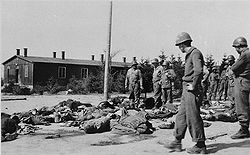
The discovery of these camps led to immediate war crime tribunals. While many SS guards were executed or sentenced to death, approximately 10,000 Nazi war criminals managed to escape Europe via routes known as ratlines.
The Fall of Fascist Italy
In Italy, the collapse occurred rapidly in late April. Italian partisans liberated Milan and Turin on April 25. Benito Mussolini was captured by partisans on April 27 and executed on April 28 in Giulino. His body, along with other captured fascists, was later displayed at the Piazzale Loreto in Milan. By May 2, nearly 1,000,000 German forces in Italy and Austria surrendered unconditionally to British Field Marshal Sir Harold Alexander.
The Sequence of Surrenders
The Battle for Berlin and Northwest Europe
The Battle of Berlin ended on May 2 when General Helmuth Weidling surrendered the city to General Vasily Chuikov of the Red Army. Simultaneously, German forces north of Berlin surrendered to the Western Allies. In Northwest Germany, Denmark, and the Netherlands, Field Marshal Bernard Montgomery accepted the surrender of 1,000,000 men on May 4.
The Final Formal Agreements
The legal end of the war occurred in two stages. First, on May 7, General Alfred Jodl signed an unconditional surrender at SHAEF (Supreme Headquarters Allied Expeditionary Force) headquarters in Reims, France. This was followed by a second, more formal ceremony in Berlin on May 8, where Field Marshal Wilhelm Keitel signed the final documents in the presence of Marshal Georgy Zhukov.
Residual Fighting
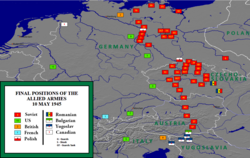
Despite the formal surrender, isolated pockets of resistance continued. The Courland Pocket in Latvia surrendered on May 10, and the Prague offensive in Czechoslovakia concluded on May 11. The Battle of Odžak in Yugoslavia did not end until May 25, 1945. Meanwhile, the war continued in the Pacific theatre until Japan's surrender on September 2.
Post-War Transition and Legal Settlement
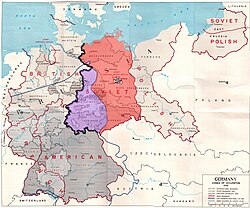
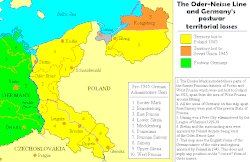
Following the surrender, the Allied Control Council took authority over Germany. They passed laws to repeal Nazi legislation and abolish all national-socialist organizations. Germany was divided into occupation zones, which eventually led to the creation of the Federal Republic of Germany (West Germany) and the German Democratic Republic (East Germany) in 1949.
The formal "state of war" remained in place for several years. Most Western Allies, including the US and UK, ended the state of war by 1951. The Soviet Union ended its state of war with Germany in early 1955. The final resolution came with the Treaty on the Final Settlement with Respect to Germany in 1990, which facilitated German reunification and the withdrawal of all occupying troops by the end of 1994.
| Date | Location/Force | Key Figure | Outcome |
|---|---|---|---|
| May 2 | Berlin | Helmuth Weidling | Unconditional surrender of the city |
| May 4 | Lüneburg Heath | Bernard Montgomery | Surrender of NW Germany, Denmark, Netherlands |
| May 7 | Reims, France | Alfred Jodl | First unconditional surrender document signed |
| May 8 | Berlin (Karlshorst) | Wilhelm Keitel | Final Instrument of Surrender signed |
Frequently Asked Questions
Why are there two different dates for Victory Day?
Victory in Europe Day is celebrated on May 8 in most Western countries, marking the signing of the surrender in Berlin. In Russia, it is celebrated on May 9 due to the time difference and the specific timing of the surrender's effectiveness.
What were "ratlines"?
Ratlines were escape routes used by Nazi war criminals to flee Europe after the war, often heading to South America to avoid prosecution by Allied war crime tribunals.
What was the difference between POWs and Disarmed Enemy Forces?
SHAEF reclassified prisoners as Disarmed Enemy Forces (DEF) rather than Prisoners of War (POW) to circumvent the legal requirements of the 1929 Geneva Convention regarding the treatment of combatants.
When did the state of war with Germany officially end?
While the fighting stopped in 1945, the legal state of war ended at different times. Most Western Allies ended it in 1951, and the Soviet Union ended it in early 1955.
How was the final reunification of Germany handled legally?
The Treaty on the Final Settlement with Respect to Germany, signed in 1990, saw the Four Powers renounce their rights in Germany and Berlin, leading to full sovereignty and the withdrawal of occupying troops by 1994.