Vertebrates: Evolution, Classification, and Diversity of the Backboned Animals
Vertebrates represent some of the most complex and diverse organisms on Earth. Defined primarily by the presence of a backbone or spinal column, these animals range from the microscopic to the gargantuan. From the depths of the oceans to the highest mountain peaks, vertebrates have adapted to nearly every environment on the planet over hundreds of millions of years.
The sheer scale of vertebrate diversity is staggering. For instance, the smallest known frog species, Brachycephalus pulex, reaches a minimum adult snout–vent length of only 6.45 millimetres (0.254 in). At the opposite end of the spectrum is the blue whale, which can grow up to 33 metres (108 ft) and weigh approximately 150 tonnes.
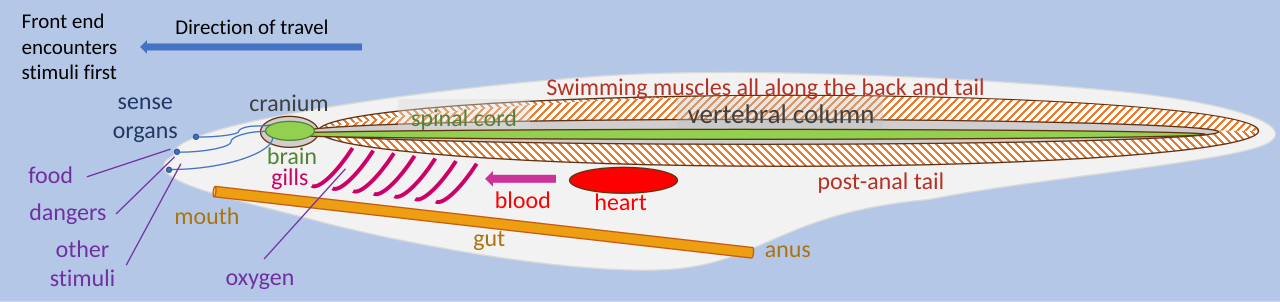
Key Facts
- Temporal Range: Vertebrates first appeared during the Cambrian Stage 3, approximately 518 million years ago.
- Defining Feature: The presence of a vertebral column (backbone) that protects the spinal cord.
- Size Range: From the tiny 6.45 mm Brachycephalus pulex to the 33 m blue whale.
- Major Groups: Divided into jawless fishes (Agnatha) and jawed vertebrates (Gnathostomata).
- Biodiversity Crisis: The Living Planet Index reports a 60% decline in vertebrate populations between 1970 and 2014.
The Evolutionary Journey of Vertebrates
The Cambrian Explosion and Early Origins
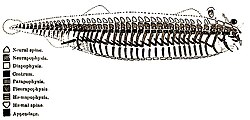
The story of vertebrates begins in the Cambrian period, roughly 518 million years ago. Early ancestors like Haikouichthys provide a glimpse into the dawn of the vertebrate body plan, marking the transition toward more complex skeletal structures.
![The Cambrian Haikouichthys, 518 mya[26]](/images/89/c5/89c5aa89c834db874876468d0ac455d988881b4f0f8df61fa6d6cf6c18f844f2.jpg)
From Water to Land
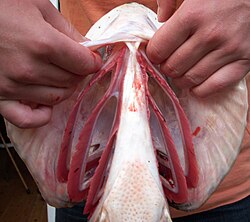
Throughout the Paleozoic era, vertebrates evolved from primitive fish to land-dwelling creatures. A critical milestone was the development of branchial arches (structures that support gills in fish), which eventually contributed to the evolution of jaws and other head structures.
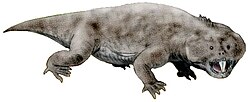
By the Devonian period, creatures like Acanthostega demonstrated the transition from fins to limbs, paving the way for the Tetrapoda—four-limbed vertebrates capable of walking on land.
![Acanthostega, a Devonian labyrinthodont, c. 365 mya[33]](/images/65/a7/65a7a12c467f2b9da2187a7801c83b046c7f2c15e86c96bb65458515285d42ab.jpg)
The Age of Dinosaurs and Mammals
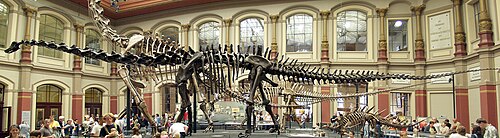
The Mesozoic era saw the rise of the diapsid reptiles, including the massive dinosaurs. An extreme example of the vertebral column's potential is seen in the Diplodocus carnegii, a tetrapod reaching 26 metres (85 ft) in length.
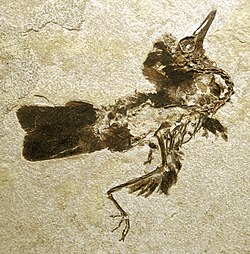
Following the end-Cretaceous mass extinction, the Cenozoic era became the Age of Mammals, allowing mammals and birds (such as the Eocene Nahmavis) to diversify and dominate various ecological niches.
Classification and Taxonomy
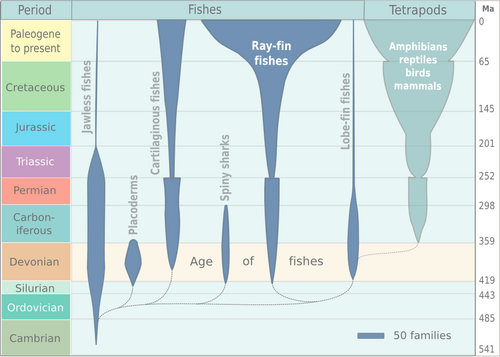
The classification of vertebrates has evolved significantly since Jean-Baptiste Lamarck first defined them as a distinct group in 1801. While early taxonomists grouped them into four simple classes (fish, reptiles, birds, and mammals), modern science uses a more nuanced phylogenetic approach.
Major Taxonomic Divisions
Vertebrates are broadly categorized based on the presence of jaws and the type of reproduction:
- Agnatha: Jawless vertebrates, including hagfish (Myxini) and lampreys (Petromyzontida).
- Gnathostomata: Jawed vertebrates, which include cartilaginous fishes (Chondrichthyes) and bony fishes (Osteichthyes).
- Tetrapods: Four-limbed vertebrates comprising amphibians, reptiles, birds, and mammals.
A key biological distinction is made between Anamniotes (which lack an amniotic membrane and must reproduce in water) and Amniotes (which possess an amniotic membrane, allowing them to reproduce on land).
Vertebrate Diversity Summary
| Category | Class/Group | Estimated Species |
|---|---|---|
| Anamniotes | Jawless Fish (Myxini, Hyperoartia) | 118 |
| Chondrichthyes | >1,100 | |
| Actinopterygii | >32,000 | |
| Amphibia | 7,302 | |
| Amniotes | Reptilia | 10,711 |
| Aves (Birds) | 10,425 | |
| Mammalia | 5,513 | |
| Total Described Species | 66,178 |
Conservation and Population Trends
Despite their success, modern vertebrates face severe threats. Data from the Living Planet Index indicates a 60% decline in populations between 1970 and 2014. The impact is most severe among freshwater species (83% decline) and tropical populations in South and Central America (89% decline).
The World Wildlife Fund (WWF) warns that these trends could lead to a sixth major extinction event. The primary drivers of this biodiversity loss include:
- Land-use change
- Overexploitation of natural resources
- Climate change
- Pollution
- Invasive species
Frequently Asked Questions
What is the primary difference between Anamniotes and Amniotes?
Anamniotes lack an amniotic membrane, meaning their eggs generally require a water environment to survive and develop. Amniotes possess this membrane, which protects the embryo and allows them to lay eggs on land or retain the embryo internally.
Who first defined vertebrates as a taxonomic group?
Jean-Baptiste Lamarck defined vertebrates as a taxonomic group in 1801, distinguishing them from invertebrates.
What are the two main infraphyla of vertebrates?
The two main divisions are the Agnatha (jawless vertebrates) and the Gnathostomata (vertebrates with jaws).
How many described vertebrate species are there?
There are approximately 66,178 described species of vertebrates, with ray-finned bony fishes (Actinopterygii) being one of the most numerous groups.
What is the smallest vertebrate known?
The smallest known vertebrate is the frog species Brachycephalus pulex, with a minimum adult snout–vent length of 6.45 millimetres.