Understanding Vegetative Reproduction: The Art and Science of Plant Cloning
Imagine a plant that can create an exact genetic copy of itself without the need for seeds or pollination. This biological phenomenon is known as vegetative reproduction (also referred to as vegetative propagation, multiplication, or cloning). It is a form of asexual reproduction where a new plant grows from a fragment, a cutting, or specialized reproductive structures called vegetative propagules.
While many plants naturally employ this strategy to expand their reach, humans have also harnessed these processes. Horticulturists use asexual propagation to replicate specific cultivars with desirable traits, though the ease of this process varies. For instance, monocotyledons—plants with a single embryonic leaf—are often more difficult to propagate because they typically lack a vascular cambium, the layer of tissue responsible for secondary growth.
The Biological Engine: How It Works
Vegetative reproduction is made possible by meristematic cells. These are undifferentiated cells capable of cellular differentiation and constant division, found primarily in the tips of stems and roots, as well as in leaves. Because these cells can transform into any type of plant tissue, they allow a fragment of a plant to regenerate into a complete organism.
Another critical mechanism is the development of adventitious roots. These are roots that arise from non-root tissues, such as stems or leaves, enabling a detached plant part to anchor itself and absorb nutrients from the soil.
The Trade-off: Advantages and Disadvantages
Vegetative reproduction is rarely a plant's only method of reproduction, as it presents a significant evolutionary trade-off.
The Benefits
- Genetic Consistency: Offspring are clones of the parent. This ensures that favorable traits are passed down perfectly, which is economically vital for commercial growers who require crop uniformity.
- Resource Efficiency: Plants avoid the energy-intensive process of creating flowers, seeds, and fruits.
- Faster Maturity: Vegetatively propagated plants often bypass the fragile seedling stage, reaching maturity more quickly.
- Survival and Expansion: In nature, this allows plants to recover quickly from disturbances like floods or fires. It is also a common characteristic of invasive species.
- Research and Conservation: Forest geneticists use these methods to maintain gene banks or clone-holding orchards to preserve specific genetic lines.
The Risks
The primary drawback is the total lack of genetic diversity. Because the plants are genetically identical, an entire crop can be wiped out by a single pathogen, virus, or fungus to which the parent plant was susceptible. Furthermore, the lack of genetic variation can lead to the accumulation of harmful mutations over time.
Natural Methods of Vegetative Reproduction
Natural propagation is most common in perennial plants. In many cases, this process is less about creating "new" individuals and more about the survival and expansion of the parent's biomass, sometimes creating a clonal colony.
Modified Stems and Roots
- Runners (Stolons): Modified stems that grow just below the soil surface. Buds along the runner produce new roots and stems. Strawberries and currants are classic examples.
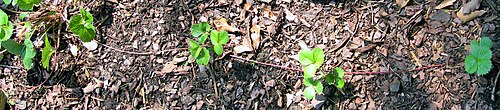
'Lipstick' hybrid strawberry (Comarum palustre × Fragaria × ananassa) using stolons to grow new plants - Bulbs: Underground inflated stems surrounded by nutrient-rich, layered leaves. Examples include tulips, lilies, and shallots.
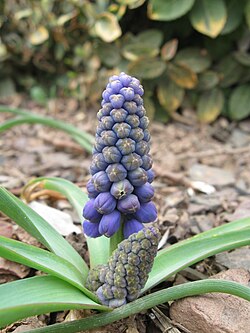
A bulb of Muscari has reproduced vegetatively underground to make two bulbs, each of which produces a flower stem. - Tubers: These can be stem tubers (swollen rhizomes or runners), such as potatoes and yams, or root tubers (modified roots), such as dahlias and sweet potatoes.
- Corms: Similar to bulbs but consisting of solid fleshy tissue rather than layered leaves. Examples include taro and gladiolus.
- Suckers: Stems that arise from buds on the roots or the base of the parent stem, common in banana, elm, and apple trees.
Specialized Structures
- Plantlets: Miniature plants that grow from the meristem at leaf margins. Once mature, they drop off to root in the soil. This is seen in Kalanchoe pinnata and Kalanchoe daigremontiana (Mother of Thousands), as well as spider plants.
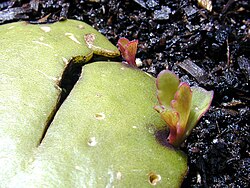
Production of new individuals along a leaf margin of the air plant, Kalanchoe pinnata. The small plant in front is about 1 cm tall. The concept of "individual" is stretched by this process. 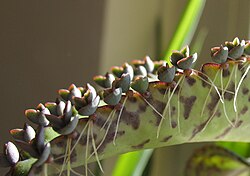
Kalanchoe daigremontiana produces plantlets along the margins of its leaves. When they are mature enough, they drop off and root in any suitable soil beneath. - Keikis: Offshoots that develop on the flower stalks or stems of certain orchids, such as Dendrobium, Epidendrum, and Phalaenopsis.
- Apomixis: A unique process where plants produce clonal seeds or plantlets without fertilization. This occurs in dandelions, hawkweed, Kentucky bluegrass, and some citrus species.
Artificial Propagation Techniques
Humans use several techniques to clone plants for agriculture and gardening:
- Cutting: A piece of stem or leaf is removed and planted, often treated with hormones to encourage adventitious root growth.
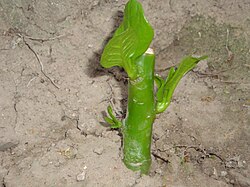
Vegetative reproduction from a stem cutting less than a week old. Some species are more conducive to this means of propagation than others. - Grafting: A scion (desired cutting) is attached to a stock (rooted plant). While the top is clonal, the whole plant is only a clone if the rootstock was also vegetatively propagated. This is common for mangoes and guavas.
- Layering: A branch is bent to the ground and covered with soil to induce rooting while still attached to the parent. Air layering involves scraping and replanting branches, often used for Bougainvillea and Jasmine.
- Suckering: Mature suckers are pruned from the parent plant and transplanted to new locations.
- Tissue Culture: Cells are grown in a sterile medium to form a callus (a mass of undifferentiated tissue), which is then treated with hormones to develop into plantlets.
- Offsets: In bamboo, the lower part of a culm with its rhizome and roots is planted to propagate the species.
Summary of Vegetative Propagation Methods
The following table summarizes the various ways plants reproduce vegetatively.
| Method | Type | Primary Structure Used | Example Plants |
|---|---|---|---|
| Runners (Stolons) | Natural | Above-ground modified stem | Strawberries, Currants |
| Bulbs | Natural | Layered underground stem | Tulips, Lilies |
| Tubers | Natural | Swollen stem or root | Potatoes, Sweet Potatoes |
| Plantlets | Natural | Leaf margins | Kalanchoe, Spider Plant |
| Cuttings | Artificial | Stem or leaf fragment | Various cultivars |
| Grafting | Artificial | Scion and Rootstock | Mango, Guava |
| Tissue Culture | Artificial | Cellular callus | Laboratory-grown clones |
Key Facts
- Cloning: Vegetative reproduction creates genetically identical offspring.
- Meristems: The process relies on undifferentiated cells that can become any plant tissue.
- Apomixis: Some plants can produce seeds without fertilization.
- Chimeras: Some plants, like thornless blackberries, are genetic mosaics; cuttings may revert to the "thorny" type if the tissue beneath the skin is genetically different.
- Vulnerability: Lack of genetic diversity makes clonal crops highly susceptible to total failure from a single disease.
Frequently Asked Questions
What is the difference between a bulb and a corm?
While both are underground storage organs, bulbs consist of a central shoot surrounded by plump, layered leaves. Corms, however, are solid enlarged stems with fleshy tissue and are surrounded by papery leaves.
Why is vegetative reproduction considered a cloning method?
Because the new plant grows from the somatic tissues of the parent rather than through the fusion of male and female gametes, the offspring inherits the exact same genetic blueprint as the parent.
Can any plant be propagated via cuttings?
Not all plants are equally conducive to this method. Monocotyledons are generally more challenging to propagate because they lack a vascular cambium. Success rates vary greatly depending on the species and the use of growth hormones.
What is a "chimera" in the context of plant propagation?
A chimera is a plant composed of two or more genetically different cell lines. For example, a thornless blackberry may have thornless epidermal layers but thorny tissue underneath; a cutting taken from the inner tissue will result in a thorny plant.
How does apomixis differ from other forms of vegetative reproduction?
Unlike runners or tubers, which use vegetative organs, apomixis produces seeds or plantlets without the process of meiosis or fertilization, effectively creating a "virgin birth" of a clonal seed.