Uruguay Electricity and Energy Transition
Uruguay has undergone a remarkable transformation in its energy landscape, evolving from a reliance on traditional hydropower and fossil fuel imports to becoming a global leader in sustainable power. Through strategic legislative reforms and aggressive investment in green technology, the country has fundamentally reshaped how it generates and consumes electricity.
Key Facts
- 98% of electricity needs were covered by renewable sources by 2025.
- Renewable growth was driven by legal reforms in 1997, 2002, and 2006.
- Wind power grew from negligible levels in 2012 to 10% of installed capacity by 2014.
- Nuclear energy for power generation is prohibited by Law 16.832 of 1997.
- Hydropower remains a cornerstone of the domestic production capacity.
The Shift to Renewable Energy
Historically, Uruguay's electricity sector relied on domestic hydropower and thermal power plants, often importing electricity from Argentina and Brazil during periods of peak demand. However, a series of modernization efforts—anchored by regulatory reforms in 1997, 2002, and 2006—opened the door for significant private and public investment.
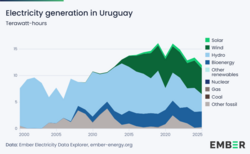
A pivotal turning point occurred with the 2006 reform, where government purchasing agreements incentivized the rapid expansion of sustainable energy. This led to a surge in wind power and the construction of several photovoltaic solar power plants. To ensure stability, the country also installed a new combined cycle power plant capable of running on either gas or oil.
Diversifying the Energy Mix
While wind and solar have seen rapid growth, other sources continue to play vital roles:
- Hydropower: This remains a primary source, with production centered on four facilities: three on the Rio Negro and the Salto Grande dam on the Uruguay River (shared with Argentina). While dependent on seasonal rainfall, these plants typically cover off-peak demand.
- Biomass: Thermal power derived from organic materials provides additional generation capacity.
- Thermal Power: Fossil fuel plants are now primarily activated only during peak demand, with their overall contribution decreasing substantially as renewables reached 98% of generation by 2025.
Furthermore, Uruguay has enhanced its energy security by improving its electrical grid interconnection with Brazil, allowing for more efficient imports and exports of electricity.
The Status of Nuclear Energy
Unlike its transition to renewables, Uruguay's path regarding nuclear energy has been one of restriction. The use of nuclear energy is currently prohibited by Law 16.832 of 1997. Despite this ban, the country maintains regulatory bodies such as the Center for Nuclear Research (Centro de Investigaciones Nucleares) and the National Regulation Authority on Radiological Protection (Autoridad Reguladora Nacional en Radioprotección).
Historical Context and Public Debate
Uruguay once operated a small research and training reactor, brought from the United States in 1964 and activated in Malvin Norte in 1978. The reactor was shut down in 1985 due to corrosion, and all fuel was removed. Following the Chernobyl and Goiânia accidents, public sentiment shifted against nuclear power.
In 1988, a proposed cooperation agreement with Canada to build a nuclear plant in Paso de los Toros sparked significant social unrest. This led to a parliamentary debate that ultimately resulted in the rejection of the agreement and the passage of the 1997 prohibition law.
The debate resurfaced briefly during an energy crisis in 2007 under President Tabaré Vázquez, who established a multiparty committee to study nuclear power. However, the 2011 Fukushima accident further complicated the political and social discourse. Although the government allocated 10 million Uruguayan pesos for a Phase 1 evaluation—including specialist consultants and public consultation—the deployment of wind and solar technologies eventually resolved the energy crisis, effectively ending the nuclear debate.
Energy Infrastructure Summary
| Energy Source | Role/Status | Key Details |
|---|---|---|
| Hydropower | Primary Base | Four main facilities; dependent on rainfall. |
| Wind & Solar | Rapid Growth | Wind reached 10% capacity by 2014; key to 98% renewable goal. |
| Thermal (Fossil) | Peak Support | Used during high demand; substantially decreased. |
| Biomass | Supplementary | Provides additional renewable capacity. |
| Nuclear | Prohibited | Banned by Law 16.832 (1997). |
Frequently Asked Questions
What percentage of Uruguay's electricity comes from renewables?
By 2025, renewable energy sources covered 98% of Uruguay's electricity needs.
Which laws govern nuclear energy in Uruguay?
Law 16.832 of 1997 prohibits the use of nuclear energy in the country.
How did wind power grow in Uruguay?
Wind power grew from negligible levels in 2012 to 10% of the installed capacity by 2014, driven by government purchasing agreements and regulatory reforms.
What are the main hydropower sites in Uruguay?
The main production comes from four facilities: three located on the Rio Negro and the Salto Grande dam on the Uruguay River, which is shared with Argentina.
Why was the nuclear energy debate eventually dropped?
The debate ended because the country successfully deployed widespread renewable energy sources, such as wind turbines and solar photovoltaics, to solve its energy crisis.