Union Station Kansas City: A History of Rail and Resilience
For over a century, the heart of Kansas City's transportation has been defined by its grand stations. From the eclectic towers of the early Union Depot to the monumental Beaux-Arts scale of the current Union Station, these landmarks have mirrored the city's growth from a regional hub into a major American metropolis. Today, the station stands not just as a transit point, but as a cultural epicenter for science, art, and community gatherings.
The Union Depot Era
The story begins on April 8, 1878, with the opening of the Union Depot. Located on a narrow triangle of land in the West Bottoms between Union Avenue and the Hannibal and St. Joseph Railroad tracks, it was only the second union station ever built in the United States, following Indianapolis Union Station.
Designed by lead architect Asa Beebe Cross, the building featured a hybrid of Second Empire (a 19th-century French style characterized by mansard roofs) and Gothic Revival architecture. The exterior was noted for its intricate towers, stone-framed arched windows, and a prominent 125-foot clock tower. Despite its grandeur, locals jokingly nicknamed it the "Jackson County Insane Asylum" due to its perceived oversized scale.
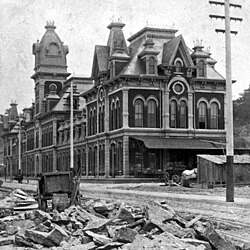
By the turn of the 20th century, the depot was a hive of activity with over 180 trains passing through daily. However, as the city's population tripled, the station became a victim of its own success. A combination of limited expansion space and a devastating flood in 1903 prompted city leaders and railroad companies to seek a more sustainable location.
The Rise of Union Station
The transition to a new facility was led by the Kansas City Terminal Railway, a joint operation involving twelve different railroads, including the Union Pacific, Missouri Pacific, and the Atchison, Topeka and Santa Fe. To avoid future flooding, the new site was chosen at 25th Street and Grand Avenue, situated in a valley above the floodplain and south of the central business district.
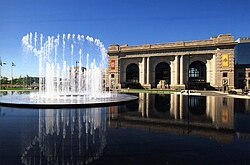
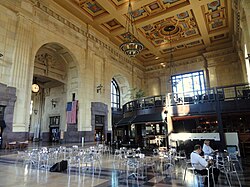
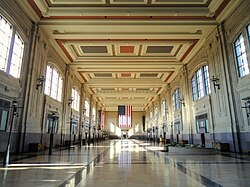
Architect Jarvis Hunt designed the station following the City Beautiful movement, which emphasized monumental grandeur and civic virtue. The resulting Beaux-Arts structure—a neoclassical style known for symmetry and ornate detail—spanned 850,000 square feet. The design featured a massive main hall for ticketing and a perpendicular waiting hall extending over the tracks.
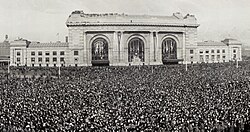
The scale of the building was immense: the Grand Hall ceiling reaches 95 feet, illuminated by three chandeliers weighing 3,500 pounds each. A massive clock face, 6 feet in diameter, serves as a focal point of the hall. When it opened on October 30, 1914, it ranked as the third-largest train station in the country.
Tragedy and the Kansas City Massacre
Union Station was the site of one of the most infamous events in American law enforcement history. On June 17, 1933, during the transfer of captured fugitive Frank Nash to a prison train, members of the Kansas City crime family launched an ambush. Using Thompson submachine guns, the gunmen murdered four lawmen, including FBI agents, in an attempt to free Nash. Nash himself was killed during the gun battle.
This event exposed the deep-seated lawlessness of the era under the Pendergast Machine and led to a pivotal change in federal policy: the arming of all FBI agents.
Decline and Deterioration
Passenger traffic reached its zenith in 1945 with 678,363 annual travelers. However, the rise of air and automobile travel in the 1950s led to a sharp decline. By 1973, annual passengers had plummeted to 32,842, with all services managed by Amtrak.
The building fell into severe decay. A failed redevelopment deal with the Trizec Corporation between 1974 and 1994 left the station largely abandoned. By 1985, Amtrak operations were moved to a smaller, temporary facility known as an "Amshack," leaving the grand station to deteriorate further until a legal settlement with Trizec was reached in 1994.
The Great Restoration
The station's salvation came in 1996 when voters in five counties approved a "bistate tax" (a 1/8 of a cent sales tax). This funding, combined with private donations and federal grants, fueled a $250 million restoration project from 1997 to 1999.
The renovation allowed Amtrak to return to the main building in 2002 and transformed the station into a non-profit cultural hub managed by Union Station Kansas City, Inc. Today, the facility is self-sustaining, funded by admissions, leases, and donations rather than public money.
Modern Attractions and Facilities
- Science City: An interactive science center with over 50 exhibits.
- Gottlieb Planetarium: The largest planetarium in the region.
- H&R Block City Stage Theater: A venue for live-action productions.
- Regnier Extreme Screen: A movie screen standing five and a half stories tall.
- Dining and Culture: Home to the Irish Museum and Cultural Center, as well as restaurants like Pierponts and Harvey's.
Additionally, the former Powerhouse building was converted into the Todd Bolender Center for Dance and Creativity, the home of the Kansas City Ballet since 2011.
Key Facts
- Opening Date: October 30, 1914.
- Architecture: Beaux-Arts style designed by Jarvis Hunt.
- Size: 850,000 square feet with a 95-foot ceiling in the Grand Hall.
- Peak Traffic: 678,363 passengers in 1945.
- Restoration Cost: $250 million (completed in 1999).
- Management: Operated by a 501(c)(3) non-profit organization.
| Feature | Union Depot (1878) | Union Station (1914) |
|---|---|---|
| Architectural Style | Second Empire / Gothic Revival | Beaux-Arts |
| Lead Architect | Asa Beebe Cross | Jarvis Hunt |
| Key Feature | 125-ft Clock Tower | 95-ft Grand Hall Ceiling |
| Location | West Bottoms (Floodplain) | 25th & Grand (Above Floodplain) |
Notable Modern Events
Union Station continues to be a focal point for major events. It served as a filming location for American Ninja Warrior in 2015 and 2017 and hosted the 2023 NFL draft. However, it was also the site of a tragedy on February 14, 2024, when a mass shooting occurred during the Super Bowl LVIII victory parade for the Kansas City Chiefs, resulting in one death and 22 injuries.
Frequently Asked Questions
Who designed the current Union Station?
The station was designed by architect Jarvis Hunt, who was influenced by the City Beautiful movement and utilized the Beaux-Arts architectural style.
What was the Kansas City massacre?
Occurring on June 17, 1933, it was a violent ambush by the Kansas City crime family that killed four lawmen and fugitive Frank Nash, leading to the arming of all FBI agents.
How is Union Station funded today?
The station receives no public funding for operations. It is funded through general admission, theater tickets, grants, corporate and private donations, facility rentals, and commercial leases.
What is Science City?
Science City is a family-friendly interactive science center located within Union Station that features more than 50 hands-on exhibits.
Why was the original Union Depot replaced?
The Union Depot was replaced due to a lack of room for expansion and a major flood in 1903, which prompted the move to a location above the floodplain.