New York Public Library: A History of Philanthropy and Knowledge
The New York Public Library (NYPL) stands as one of the world's most iconic institutions of learning, born not from a single government act, but from a unique convergence of private wealth and public vision. From its origins as a collection of exclusive reference rooms to its current status as a massive network of research and circulating libraries, the NYPL reflects the evolving intellectual landscape of New York City.
The Foundations of a Giant
The library's roots lie in three distinct philanthropic legacies. It began with the Astor Library, established in 1854 through a $400,000 bequest from John Jacob Astor. While a vital resource, it was a reference-only library, meaning books could not be checked out, leading critics to describe it as inaccessible to the general public.
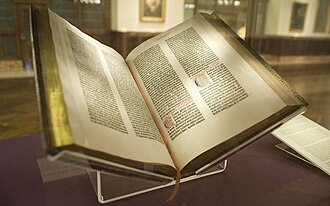
In 1877, the Lenox Library opened on Fifth Avenue, housing the vast collection of James Lenox, including the first Gutenberg Bible to arrive in the New World. Like the Astor Library, the Lenox institution initially charged admission and restricted physical access to its rare manuscripts and art.
The final piece of the puzzle arrived via Samuel J. Tilden, a former Governor of New York. Upon his death in 1886, Tilden left approximately $2.4 million to establish a free library and reading room. Trustees John Bigelow and Andrew Haswell Green envisioned using these funds to merge the struggling Astor and Lenox libraries into a single, citywide system.
On May 23, 1895, "The New York Public Library, Astor, Lenox and Tilden Foundations" was officially created. This merger was soon bolstered by the New York Free Circulating Library in 1901 and a massive $5.2 million grant from Andrew Carnegie to build 65 branch libraries across the city.

The Main Branch and Architectural Grandeur
To house its growing research collections, the library commissioned a central site on Fifth Avenue between 40th and 42nd Streets. Designed by the firm Carrère and Hastings in the Beaux-Arts style (a classical architectural style characterized by symmetry and ornate detail), the building opened on May 23, 1911.
At the time of its completion, it was the largest marble structure in the United States. Its centerpiece, the Rose Main Reading Room, was the largest of its kind globally, featuring 50-foot-high ceilings. The entrance is famously guarded by two stone lions, Patience and Fortitude, sculpted by E.C. Potter.
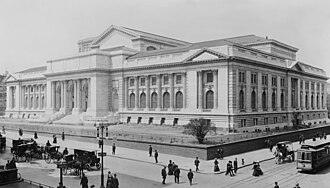
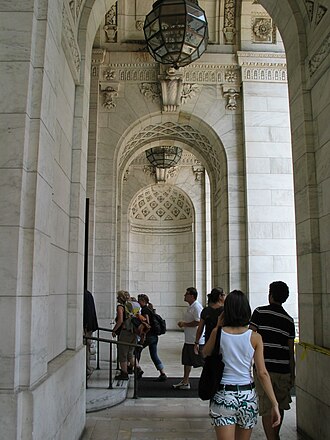

Over the decades, the building has evolved. A major restoration from 2007 to 2011 was funded by a $100 million gift from Stephen A. Schwarzman, leading to the branch's renaming. Today, it is a designated National Historic Landmark that blends historic grandeur with modern technology, including computer access and dedicated spaces for scholars.
The Research Library System
The NYPL operates a sophisticated research system that holds approximately 44 million items, contributing to a total system-wide collection of 50.6 million items. This system is divided into specialized hubs:
- Humanities and Social Sciences Library: The heart of the research system located at the 42nd Street main branch.
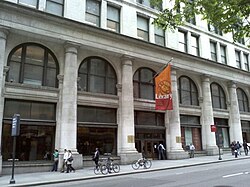
- Science, Industry and Business Library (SIBL): Opened in 1995 in the former B. Altman & Company Building, it is the largest public library in the U.S. dedicated solely to science and business.
- Schomburg Center for Research in Black Culture: A vital resource located in Harlem.
- New York Public Library for the Performing Arts: Located at Lincoln Center.
Modernization and Operational Evolution
In recent years, the NYPL has focused on efficiency and digital accessibility. In 2010, the library opened the Library Services Center in Long Island City. This facility houses the world's largest book sorter, a machine two-thirds the length of a football field that can process 7,500 items per hour, significantly reducing wait times for patrons.
To streamline technical services, the NYPL and Brooklyn Public Library merged their departments in 2013 to create BookOps. This consolidated hub handles the acquisition, cataloging, and processing of new items for both systems, saving millions of dollars in operational costs.
Digital innovation also led to the 2016 launch of SimplyE, an open-source app designed to simplify the process of borrowing e-books. Furthermore, in a move toward greater accessibility, the library officially eliminated all late fees on October 5, 2021.
Key Facts
- Founding Legacies: Formed from the merger of the Astor, Lenox, and Tilden foundations.
- Total Holdings: Approximately 50.6 million items across all branches and research libraries.
- Architectural Milestone: The Main Branch was the largest marble structure in the U.S. upon its 1911 opening.
- Digital Access: Developed the open-source SimplyE app for streamlined e-book borrowing.
- Late Fees: Completely abolished as of October 2021.
- Funding Model: Research libraries are largely privately funded, while branch libraries rely primarily on city government funds.
| Library Name | Specialization | Key Feature |
|---|---|---|
| Humanities and Social Sciences | General Research | Located in the historic Main Branch |
| SIBL | Science, Industry, Business | Largest public library of its kind in the U.S. |
| Schomburg Center | Black Culture | Located in Harlem |
| Library for the Performing Arts | Arts & Performance | Located at Lincoln Center |
Frequently Asked Questions
Does the New York Public Library still charge late fees?
No. The NYPL stopped charging late fees on October 5, 2021, and cleared existing debts from patron records.
Who are the lions at the entrance of the Main Branch?
The lions are named Patience and Fortitude. They were sculpted by E.C. Potter and carved by the Piccirilli Brothers.
What is BookOps?
BookOps is a merged technical services department between the New York and Brooklyn public libraries that handles the acquisition, cataloging, and logistics of library materials.
How is the NYPL funded?
The library uses a hybrid model: research libraries are primarily funded through private philanthropy, while the branch (circulating) libraries are funded mainly by the New York City government.
What is the SimplyE app?
SimplyE is an open-source application launched in 2016 to make it easier for patrons to explore and check out e-books from various vendors.