Edward H. Bennett: The Architect of the City Beautiful Movement
Edward H. Bennett was a pivotal figure in American urban design, transforming the landscape of several major cities through his commitment to order, grandeur, and efficiency. While often associated with the legendary Daniel Burnham, Bennett was the technical engine and creative force behind some of the most influential urban plans in North American history.
Early Life and Education
Born in Bristol, England, on May 12, 1874, Bennett moved to San Francisco as a child. His trajectory toward architecture was sparked while working for Robert White, where he was encouraged by the renowned architect Bernard Maybeck to study in France. Between 1895 and 1902, Bennett attended the École des Beaux-Arts in Paris—a prestigious institution known for its rigorous classical training—funded by the generosity of Phoebe Apperson Hearst. The friendships and technical skills he acquired in Paris became the foundation for his entire professional career.
The Partnership with Daniel Burnham
After a brief tenure in New York City with George B. Post, Bennett was sent to Chicago to assist Daniel H. Burnham with plans for the military academy at West Point. Impressed by Bennett's precision and skill, Burnham invited him to Chicago in 1903 to collaborate on a comprehensive plan for San Francisco. Although the 1906 earthquake prevented the implementation of the San Francisco plan, the partnership between the two men flourished.
Bennett became the primary co-author of the 1909 Plan of Chicago. While Burnham focused on fundraising and public visibility, Bennett was responsible for the actual layouts and detailed drawings that defined the project. This collaboration gave practical substance to the City Beautiful philosophy, an urban planning approach that emphasized monumental grandeur and beauty to inspire civic virtue.
Expanding a National Legacy
Bennett established Chicago as his professional base, serving on the Chicago Plan Commission into the 1930s. Alongside partners William E. Parsons and Harry T. Frost, he operated as a planning consultant for cities across the continent. Using the Chicago plan as a prototype, Bennett developed comprehensive urban designs for cities including Detroit, Minneapolis, and Portland, Oregon. He also extended his influence internationally by preparing the first comprehensive plan for Canada in 1915, covering Ottawa and Hull.
His firm was a pioneer in utilizing zoning ordinances (laws that regulate how land is used) and regional transportation studies as essential tools for urban design. His approach combined Beaux-Arts principles of axiality—the alignment of streets and buildings along a central axis—with a systematic ordering of functions to ensure city efficiency.
Personal Life and Architectural Works
Bennett married Catherine Jones of the prominent Lake Forest family. In 1916, he designed and built their estate, Bagatelle, in Lake Forest, Illinois. The residence was an interpretation of the Château de Bagatelle in Paris, featuring a classical garden and central fountain that mirrored the design of Chicago's Grant Park and Buckingham Fountain.
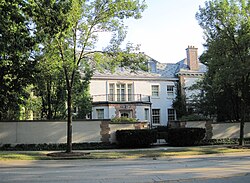
Beyond his civic work, Bennett owned Deerpath Farm, a 160-acre dairy farm and retreat which he eventually gave to his son, E. H. Bennett Jr. While primarily a classical architect, Bennett also experimented with modernism, designing a personal studio at the Bagatelle estate and a home in Tryon, North Carolina.
Later Career and Public Contributions
From his office in the Santa Fe building penthouse, Bennett oversaw the construction of Grant Park, including the original Peristyle and the iconic Buckingham Fountain. As the nature of urban planning shifted after World War I, Bennett's firm transitioned toward working for official city agencies. During the Great Depression, he contributed to the 1933 Chicago Century of Progress Exposition.
Between 1927 and 1937, Bennett served as the Chairman of the Board of Architects for the Federal Triangle in Washington, DC. This massive project created a complex of government buildings between the White House and the U.S. Capitol, including the current National Archives and Records Administration.
| Category | Key Details |
|---|---|
| Education | École des Beaux-Arts, Paris (1895–1902) |
| Major Collaborator | Daniel H. Burnham |
| Defining Work | 1909 Plan of Chicago |
| Notable Projects | Grant Park, Federal Triangle (DC), Ottawa/Hull Plan |
| Design Philosophy | City Beautiful / Beaux-Arts |
| Private Estate | Bagatelle (Lake Forest, IL) |
Key Facts
- Global Reach: Worked in nearly 20 U.S. states, Puerto Rico, and Canada.
- Technical Role: Created the actual layouts and drawings for the Plan of Chicago.
- Civic Impact: Designed Grant Park and Buckingham Fountain in Chicago.
- Government Work: Led the architectural board for the Federal Triangle in Washington, DC.
- Legacy: His personal papers and notebooks are preserved at Lake Forest College and The Art Institute of Chicago.
Frequently Asked Questions
What was Edward H. Bennett's role in the Plan of Chicago?
While Daniel Burnham provided the vision and secured funding, Bennett was the primary co-author who created the actual layouts and detailed drawings that made the plan a reality.
What is the City Beautiful philosophy?
It is an urban planning approach that emphasizes monumental grandeur, axiality, and the incorporation of public buildings and parks to create a more beautiful and inspiring civic environment.
Which other cities did Bennett help plan?
Beyond Chicago and San Francisco, Bennett developed plans for Detroit, Minneapolis, Portland (Oregon), and the first comprehensive plan for Canada (Ottawa and Hull).
What is the Federal Triangle?
The Federal Triangle is a large complex of government buildings in Washington, DC, located between the White House and the U.S. Capitol. Bennett served as Chairman of the Board of Architects for its development from 1927 to 1937.
Did Bennett design any modernist buildings?
Yes. Although he is primarily known for the Beaux-Arts tradition, he designed two modernist structures: a personal studio on his Bagatelle estate and a house in Tryon, North Carolina.