Treaty of Schönbrunn: The Aftermath of the Fifth Coalition
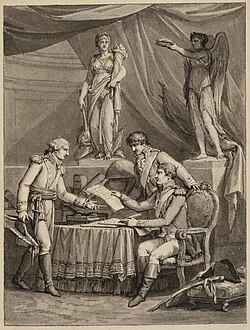
The Treaty of Schönbrunn, also referred to as the Peace of Schönbrunn or the Treaty of Vienna, was a pivotal diplomatic agreement signed on October 14, 1809. Concluded at the Schönbrunn Palace near Vienna, this treaty formally ended the Fifth Coalition during the Napoleonic Wars, following the decisive defeat of Austrian forces at the Battle of Wagram on July 5–6.
The agreement marked a period of significant territorial redistribution and political submission for the Austrian Empire, cementing Napoleon Bonaparte's dominance over Central Europe.
The Road to Peace: Prelude to the Treaty
The conflict leading to the treaty began as Austria sought to reverse the terms of the 1805 Peace of Pressburg. During the Peninsular War—the conflict involving Spanish resistance against French rule—Austria attempted to incite national uprisings in French-occupied Central European territories. A notable example was the Tyrolean Rebellion against Napoleon's Bavarian allies.
These efforts failed to shift the balance of power. By May 1809, French forces had occupied Vienna. Although Archduke Charles managed to repulse the French at the Battle of Aspern on May 21–22, Napoleon quickly regrouped and crushed the Austrian army at Wagram. This defeat forced the archduke to sign the Armistice of Znaim on July 12. In the wake of this military collapse, Austrian Foreign Minister Johann Philipp Stadion was replaced by the influential diplomat Klemens von Metternich.
Harsh Terms and Territorial Losses
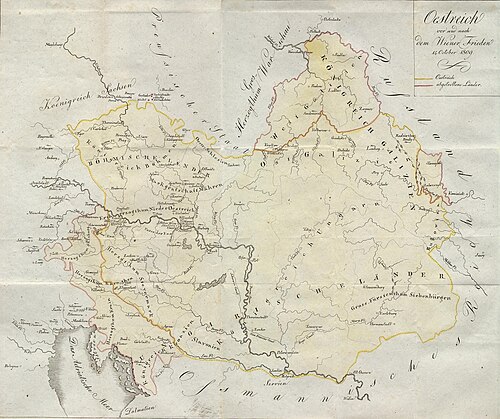
Napoleon imposed severe conditions upon the defeated Austrians, stripping the empire of strategic lands and economic autonomy. Austria was forced to cede the Duchy of Salzburg to Bavaria and relinquish its access to the Adriatic Sea. This loss included the Imperial Free City of Trieste, the Littoral territories of Gorizia and Gradisca, Carniola, the March of Istria, western ("Upper") Carinthia with East Tyrol, and Croatian lands southwest of the river Sava. These territories were incorporated into the French Empire as the Illyrian Provinces.
Further losses included West Galicia, which went to the Duchy of Warsaw, and the Tarnopol district, which was ceded to the Russian Empire.
Political and Military Concessions
Beyond land, Austria was required to recognize Napoleon's previous conquests and the legitimacy of Joseph Bonaparte as the King of Spain. The empire faced heavy financial burdens through a large indemnity and was ordered to reduce its army to 150,000 men, though this promise was not fulfilled. Additionally, the Graz Schlossberg fortress, known for its stubborn resistance against French forces, was largely demolished.
Austria was also compelled to implement the Continental System, Napoleon's large-scale economic blockade designed to paralyze Great Britain, which remained at war with France.
Key Facts
- Date Signed: October 14, 1809.
- Location: Schönbrunn Palace, near Vienna.
- Primary Conflict: Ended the Fifth Coalition of the Napoleonic Wars.
- Major Territorial Loss: Loss of Adriatic Sea access via the creation of the Illyrian Provinces.
- Military Limit: Austrian army was officially capped at 150,000 men.
- Economic Mandate: Forced adherence to the Continental System against Britain.
The Assassination Attempt of Friedrich Staps
Amidst the diplomatic tension of the negotiations, Napoleon narrowly escaped an assassination attempt on October 12. Friedrich Staps, a seventeen-year-old son of a Lutheran pastor, attempted to gain an audience with the Emperor to present a petition. After being refused by General Jean Rapp, Staps attempted to push through a crowd during a military parade to reach Napoleon.
Staps was arrested and found to be concealing a large kitchen knife within his petition papers. During interrogation, he admitted his intent to kill the Emperor, describing Napoleon as the "misfortune of his country." Even when asked if he would be grateful for a pardon, Staps replied, "I would kill you none the less."
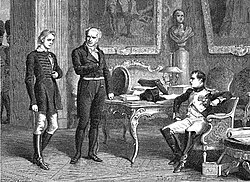
Napoleon departed Vienna on October 16. The following day, Staps was executed by Württemberg fusiliers. His final shouts of "Long live freedom! Long live Germany!" later contributed to his status as a martyr for German nationalism following the 1813 campaign.
Summary of Treaty Impact
| Category | Outcome/Loss | Recipient |
|---|---|---|
| Adriatic Territories | Trieste, Istria, Carniola, etc. | French Empire (Illyrian Provinces) |
| Central Europe | Duchy of Salzburg | Bavaria |
| Eastern Territories | West Galicia | Duchy of Warsaw |
| Eastern Territories | Tarnopol district | Russian Empire |
| Military | Army reduced to 150,000 men | N/A |
Frequently Asked Questions
What was the primary cause of the Treaty of Schönbrunn?
The treaty was the result of Austria's defeat in the Fifth Coalition, specifically following the decisive French victory at the Battle of Wagram in July 1809.
How did the treaty affect Austria's geography?
Austria suffered significant territorial losses, most notably losing its access to the Adriatic Sea and ceding lands to Bavaria, the Duchy of Warsaw, and the Russian Empire.
What was the Continental System mentioned in the treaty?
The Continental System was a French economic blockade intended to exclude British trade from the European continent to weaken the United Kingdom during the Napoleonic Wars.
Who was Friedrich Staps?
Friedrich Staps was a seventeen-year-old who attempted to assassinate Napoleon with a kitchen knife during the treaty negotiations in October 1809; he was subsequently executed and became a symbol of German nationalism.
Did Austria remain a power after the treaty?
Yes, despite being considerably weakened, Austria remained a European great power. It later attempted to stabilize relations through the marriage of Marie Louise to Napoleon in 1810.