Karl Mack von Leiberich: The Rise and Fall of an Austrian General
Karl Mack von Leiberich is a figure of profound contradiction in military history. Once a rising star of the Austrian Empire, lauded for his strategic intellect and staff work, he is now primarily remembered for one of the most catastrophic surrenders in Napoleonic history. His journey from the heights of imperial favor to the depths of a military prison serves as a cautionary tale of overconfidence and the perils of fragmented command.
Key Facts
- Full Name: Karl Freiherr Mack von Leiberich.
- Highest Rank: Feldmarschall-leutnant.
- Defining Moment: Surrendered his entire army to Napoleon at the Battle of Ulm in 1805.
- Major Awards: Recipient of the Military Order of Maria Theresa.
- Lifespan: 25 August 1752 – 22 December 1828.
Early Career and Rapid Ascent
Born in Nennslingen within the Principality of Ansbach, Mack entered the Austrian cavalry in 1770. His early career was marked by a series of strategic successes and the patronage of influential leaders. Serving under Count Kinsky and Field Marshal Count Lacy, Mack proved himself an adept staff officer, earning promotions to first lieutenant in 1778 and captain in 1783.
During the Austro-Turkish War, Mack's trajectory continued upward. He became a major in 1788 and a personal aide-de-camp to Emperor Joseph II. His bravery during the storming of Belgrade in 1789 earned him a colonelcy and the prestigious Military Order of Maria Theresa. Despite a severe head injury sustained during these campaigns—from which he never fully recovered—and a brief professional rift with Ernst Gideon von Laudon, Mack remained a respected figure in the imperial military hierarchy.
The French Revolutionary Wars
By 1793, Mack served as the quartermaster-general (the chief of staff) to Prince Josias of Saxe-Coburg in the Netherlands. His contributions were highly praised, including by the young Archduke Charles of Austria, who credited Mack for early coalition successes. Mack further distinguished himself at the Battle of Neerwinden and played a key role in diplomatic negotiations.
However, the tide turned as the coalition allies began to fail. Although these failures were largely due to political factors beyond his control, Mack became a scapegoat in certain military circles. Despite this, Emperor Francis II continued to support him, promoting him to Feldmarschall-leutnant in 1797.
Mack's career took a surreal turn when he accepted command of the Neapolitan army. Facing an undisciplined force and the threat of mutiny, Mack abandoned his post and sought refuge in the French camp. Rather than being returned home, he was taken to France as a prisoner of war by order of Napoleon Bonaparte.
Napoleon's Assessment of Mack
During Mack's captivity in Paris, Napoleon met the general and formed a scathing opinion of him. Napoleon described Mack as a man of "lowest mediocrity," characterized by conceit and a lack of genuine talent. He viewed Mack as a boaster who believed himself equal to any challenge despite being, in Napoleon's eyes, "one of the most silly men existing." This psychological assessment would prove prophetic during their next encounter on the battlefield.
The Ulm Campaign and Final Collapse
After escaping Paris in disguise, Mack returned to Austrian service in 1804. He was appointed quartermaster-general with the task of preparing the army for war against France. By 1805, he was the de facto commander of the army in Bavaria, serving under the inexperienced Archduke Ferdinand Karl Joseph of Austria-Este.
Mack's leadership was plagued by inconsistency. He implemented some of Archduke Charles' military reforms while ignoring others, and his frequent reversals of policy undermined the confidence of his staff. This instability left the Austrian forces vulnerable to Napoleon's superior maneuvering.
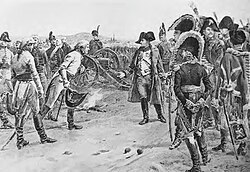
The culmination of these failures occurred in October 1805. At the Battle of Ulm, Mack surrendered his entire army to the French Grande Armée (Napoleon's primary fighting force). The capitulation was absolute: 25,000 men, 18 generals, 65 guns, and 40 standards were captured.
Aftermath and Legacy
Following the disaster at Ulm and the subsequent defeat at Austerlitz, Mack faced a court-martial. He was convicted of cowardice, stripped of his rank and honors, and imprisoned for two years. He lived in obscurity until 1819, when the general victory of the allies over Napoleon led to his reinstatement as Feldmarschall-leutnant and the return of his membership in the Order of Maria Theresa.
Mack died in St. Pölten on 22 December 1828. His historical footprint extends beyond military records, as he appears as a character in Leo Tolstoy's War and Peace.
| Period/Event | Role/Outcome | Key Result |
|---|---|---|
| Early Career (1770-1789) | Staff Officer | Distinguished service at Belgrade; Order of Maria Theresa |
| French Revolutionary Wars | Quartermaster-general | Success at Neerwinden; later prisoner of war in France |
| Ulm Campaign (1805) | De facto Commander | Surrender of 25,000 men to Napoleon |
| Post-1805 | Convicted/Reinstated | Imprisoned for cowardice; later restored to rank in 1819 |
Frequently Asked Questions
Why is Karl Mack von Leiberich famous?
He is primarily known for the catastrophic surrender of the Austrian army to Napoleon Bonaparte during the Ulm Campaign of 1805, which significantly weakened the Third Coalition.
What was Napoleon's opinion of General Mack?
Napoleon held Mack in contempt, describing him as mediocre, conceited, and lacking in talent, famously calling him one of the silliest men he had ever encountered.
Did Mack ever recover his reputation?
Yes, partially. Although he was stripped of his rank and imprisoned for cowardice after 1805, he was reinstated as a Feldmarschall-leutnant and regained the Order of Maria Theresa in 1819.
What happened to the Austrian army at the Battle of Ulm?
The army was effectively neutralized; 25,000 soldiers, 18 generals, and 65 artillery pieces were captured, removing a large portion of the Habsburg command from the subsequent campaign.
Was Mack a skilled officer before his failure at Ulm?
Yes, early in his career he was highly regarded for his staff work and strategic planning, particularly during the Turkish War and the early stages of the French Revolutionary Wars.