Teshub: The Hurrian King of the Gods and Master of Storms
In the complex pantheons of the Ancient Near East, few figures loom as large as Teshub. As the Hurrian weather god and king of the gods, Teshub embodied the raw power of the atmosphere, governing the rain and storms essential for agriculture and life. His influence extended far beyond the Hurrian people, weaving into the religious fabrics of the Hittites, Luwians, and Mesopotamians, making him one of the most significant deities of the second millennium BCE.
Key Facts
- Role: King of the gods and deity of weather phenomena.
- Symbols: Associated with the bull and the chariot.
- Family: Son of Anu and Kumarbi; spouse of Ḫepat.
- Major Cult Centers: Kumme, Arrapha, Aleppo, Kaḫat, and Kummanni.
- Equivalents: Adad (Mesopotamian), Baal (Ugaritic), Tarḫunna (Hittite), and Tarḫunz (Luwian).
Divine Identity and Iconography
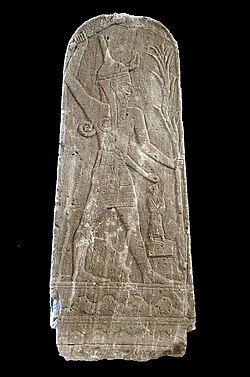
Teshub is characterized by his dominion over the skies. In artistic representations, he is often depicted with weapons that manifest weather phenomena. His divine authority is further symbolized by his mount—a chariot pulled by the bulls Šeri and Ḫurri. The bull itself served as a primary animal association, representing strength and fertility.
One of the most striking visual records of Teshub is found at the Yazılıkaya sanctuary. Here, a central relief depicts Teshub standing atop the napes of two mountain gods, surrounded by his family, including his wife Ḫepat and children Šarruma, Allanzu, and Kunzišalli. This imagery reinforces his status as the supreme ruler of the divine hierarchy.
Cross-Cultural Influence and Equivalents
The worship of Teshub was not isolated; it existed in a state of cultural exchange with neighboring civilizations. In Mesopotamia, he is closely linked to Adad. While not explicitly listed as equivalent in some early god lists, other texts identify Teshub as a foreign counterpart to Adad, specifically from the region of Subartu. This relationship is mirrored in the genealogy, where the father-son bond between Anu and Teshub reflects Mesopotamian traditions.
In the west, Teshub's identity merged with other storm deities. In Ugarit, he is associated with Baal, and in Anatolia, he is identified as Tarḫunna by the Hittites and Tarḫunz by the Luwians. This widespread reception suggests a shared cultural understanding of the storm god's role as a protector and provider.
![A hypostasis of the Luwian weather god, “Tarḫunz of the vineyard”, as depicted on the İvriz relief.[125]](/images/60/0b/600b55a2d64ee319e98a4b6da2ed4910753bb54a5189e08be523910cd2c25668.jpg)
Mythology and the Kumarbi Cycle
Teshub is the central figure in a series of dramatic narratives known as the Kumarbi Cycle. These myths often focus on the struggle for divine kingship. In the Song of Emergence (or Song of Kumarbi), Teshub's ascent to power is contested by his father, Kumarbi, who plots against him. These conflicts often involve the assistance of Ea, the King of Wisdom.
Other myths highlight Teshub's battles against chaotic forces. In the Song of Ḫedammu and other fragments, Teshub clashes with the sea and rebellious mountain gods. One narrative mentions the theft of Teshub's weapon by mountain deities, while another describes his victory over the sea. Additionally, the Ea and the Beast narrative contains prophecies regarding Teshub's birth and his eventual triumph over Kumarbi to claim the throne.
Summary of Teshub's Divine Profile
| Category | Details |
|---|---|
| Primary Domain | Weather, Storms, Kingship |
| Parents | Anu and Kumarbi |
| Spouse | Ḫepat |
| Children | Šarruma, Allanzu, Kunzišalli |
| Sacred Animals | Bulls (Šeri and Ḫurri) |
| Regional Names | Adad, Baal, Tarḫunna, Tarḫunz, Teišeba |
Frequently Asked Questions
Who were the parents of Teshub?
Teshub was the son of Anu and Kumarbi, a lineage that mirrors Mesopotamian divine traditions.
What is the significance of the bulls Šeri and Ḫurri?
Šeri and Ḫurri were the bulls that pulled Teshub's chariot, symbolizing the power and thunder of the storm god.
How does Teshub relate to the Mesopotamian god Adad?
Teshub is considered a foreign counterpart to Adad, particularly linked to the region of Subartu, and they share similar roles as weather deities.
What is the Kumarbi Cycle?
The Kumarbi Cycle is a collection of Hurrian myths detailing the succession of divine kingship, focusing on the conflicts between Kumarbi and Teshub.
Where was Teshub primarily worshipped?
His major cult centers included the cities of Kumme, Arrapha, Aleppo, Kaḫat, and Kummanni.