Swedish Heraldry: The Evolution of Provincial Arms
The rich tradition of Swedish heraldry—the system of designing and granting coats of arms—is deeply intertwined with the nation's royal history and territorial shifts. While many associate heraldry with individual nobility, Sweden developed a distinct tradition of provincial arms to represent the various regions of the realm.
The formal display of provincial arms began on a grand scale in 1560 during the funeral of King Gustav Vasa (Gustav I). For this occasion, arms for 24 provinces, including those in Finland, were displayed together for the first time. This elaborate procession was modeled by Erik XIV after the funerals of German dukes, who likely drew inspiration from the funeral of Emperor Charles V, where banners represented the Emperor's numerous titles. Because Gustav Vasa's own titles were limited to "King of Sweden, the Goths and the Wends," banners for each province were created to ensure a more visually impressive display.
The Evolution of Provincial Symbols
Not all of the original 1560 designs endured. Some early symbols were short-lived; for instance, Medelpad's beaver was changed in the 1570s, and Värmland's wolverine was replaced in 1567. Småland also saw changes to the roses on its arms, with the current version established for the coronation of John III in 1569.
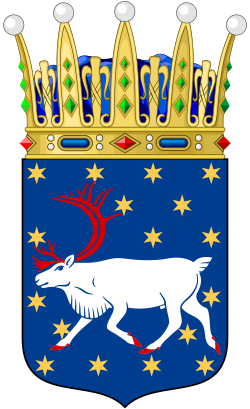
Other arms were created as the Swedish state expanded or evolved. The wild man representing Lapland was introduced for the funeral of Charles IX in 1612. When Norway ceded Jämtland to Sweden in 1635, new arms were created for the province, with Härjedalen following later. The arms for Blekinge, Bohuslän, Halland, and Skåne were established during the funeral of Charles X Gustav in 1660. The most recent addition is the arms for Norrbotten, which were created in 1995.
In some cases, provinces had multiple representations. Östergötland once used two different arms—one featuring a Västanstång dragon and another a Östanstång lion—before the current design was finalized in 1884.
Rank and Coronets in Heraldry
During the coronation of Erik XIV in 1561, a system was introduced that divided provinces into duchies (hertigdom) and counties (grevskap). Although this specific administrative system lacked lasting stability, it influenced the visual markers of the arms. In 1884, the King in Council granted all provinces the right to use a ducal coronet (a crown indicating the rank of a duke) on their coats of arms.
Interestingly, some Finnish provinces, which were separated from Sweden in 1809, still retain a count's coronet on their heraldic displays.
Regional Divisions of Sweden
Sweden is traditionally divided into three primary lands: Götaland, Svealand, and Norrland. These regions have shifted over centuries due to treaties and administrative changes.
Götaland
Located in the southern part of Sweden, Götaland comprises ten provinces. Its borders changed significantly as Sweden acquired territory from Denmark and Norway. Gotland and Halland were Danish until 1645, while Blekinge and Scania (Skåne) remained Danish until 1658. Bohuslän was part of Norway until the same period. Additionally, Värmland was considered part of Götaland until 1812.
Svealand
Svealand covers the central region of Sweden and consists of six provinces. It absorbed Värmland from Götaland in 1812.
Norrland
Norrland encompasses nine provinces in the northern and central regions. Jämtland and Härjedalen were part of Norway until 1645. A major shift occurred in 1809 when Sweden ceded Finland to the Russian Empire; this resulted in the split of Lapland into Swedish Lapland and Finnish Lapland. Simultaneously, Norrbotten was separated from Västerbotten, eventually developing its own distinct provincial identity throughout the 19th century.
Key Facts
- First Mass Display: 24 provincial arms were first shown together at King Gustav Vasa's funeral in 1560.
- Latest Addition: Norrbotten's arms are the newest, created in 1995.
- Coronet Status: Since 1884, all Swedish provinces have the right to use a ducal coronet.
- Territorial Shifts: Provinces like Skåne, Blekinge, and Halland were formerly part of Denmark.
- Regional Split: The 1809 cession of Finland led to the division of Lapland and the separation of Norrbotten from Västerbotten.
| Region | Number of Provinces | Notable Provinces |
|---|---|---|
| Götaland | 10 | Scania, Gotland, Halland, Blekinge, Bohuslän |
| Svealand | 6 | Uppland, Värmland, Södermanland |
| Norrland | 9 | Lapland, Norrbotten, Västerbotten, Jämtland |
Frequently Asked Questions
Why were provincial arms created for Gustav Vasa's funeral?
Because Gustav Vasa had only three titles ("King of Sweden, the Goths and the Wends"), banners for each province were created to make the funeral procession more visually impressive, following the example of German dukes and Emperor Charles V.
When did all Swedish provinces receive the right to use a ducal coronet?
The King in Council granted this right to all provinces in 1884.
Which provinces were formerly part of Denmark?
Gotland and Halland were part of Denmark until 1645, while Blekinge and Scania (Skåne) were part of Denmark until 1658.
How did the 1809 cession of Finland affect Norrland?
The cession to the Russian Empire caused the old province of Lapland to be split into Swedish and Finnish Lapland, and Norrbotten was separated from Västerbotten.
Which province has the most recently created arms?
Norrbotten has the most recent arms, which were created in 1995.