Supersonic Speed: Breaking the Sound Barrier and the Science of Mach Numbers
When an object moves faster than the vibrations of sound traveling through its medium, it has achieved supersonic speed. This phenomenon, often measured in Mach numbers, represents a fundamental shift in how objects interact with the air around them. From the sharp crack of a bullwhip to the roar of a fighter jet, breaking the sound barrier is a feat of physics that transforms the very nature of movement.
The Physics of Sound and Speed
Sound consists of traveling vibrations in the form of pressure waves moving through an elastic medium. The speed at which these waves propagate depends heavily on the medium itself. In gases, the speed is primarily influenced by the temperature and the molecular mass of the gas, while pressure has little effect. Because air temperature and composition change with altitude, the speed of sound—and consequently the Mach number for a moving object—is not a constant value.
For example, in dry air at sea level with a temperature of 20 °C (68 °F), the speed of sound is approximately 343.2 m/s (1,126 ft/s or 768 mph). In contrast, sound travels much faster in water, where supersonic speeds exceed 1,440 m/s (4,724 ft/s) at room temperature. In solids, sound waves can travel even faster and can be polarized both longitudinally and transversely.
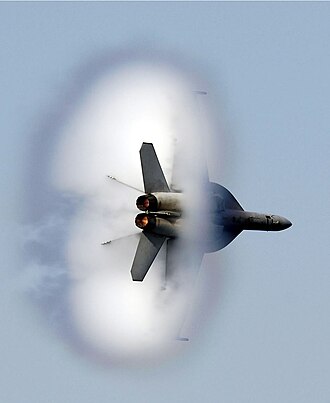
![U.S. Navy F/A-18 approaching the speed of sound. The white cloud forms as a result of the supersonic expansion fans dropping the air temperature below the dew point.[1][2]](/images/9f/c9/9fc9abc2b5ec4523717787a3f8eebfd292e0e1a9219c79d2263204a4ad23bf10.jpg)
Defining Speed Thresholds
To categorize movement through the air, scientists use specific terms based on the Mach number (the ratio of an object's speed to the speed of sound):
- Transonic: Speeds occurring between Mach 0.8 and Mach 1.2, where only parts of an object (such as rotor blade tips) reach supersonic speeds.
- Supersonic: Speeds exceeding Mach 1.
- Hypersonic: Speeds exceeding Mach 5.
Supersonic Phenomena in Nature and Technology
The concept of supersonic movement is not limited to high-tech aviation. A common example is the tip of a bullwhip; the wave motion traveling through the whip allows the tip to reach supersonic speeds, creating the characteristic "crack" known as a sonic boom. Similarly, when an inflated balloon bursts, the contracting pieces of latex move at supersonic speeds, contributing to the loud popping noise.
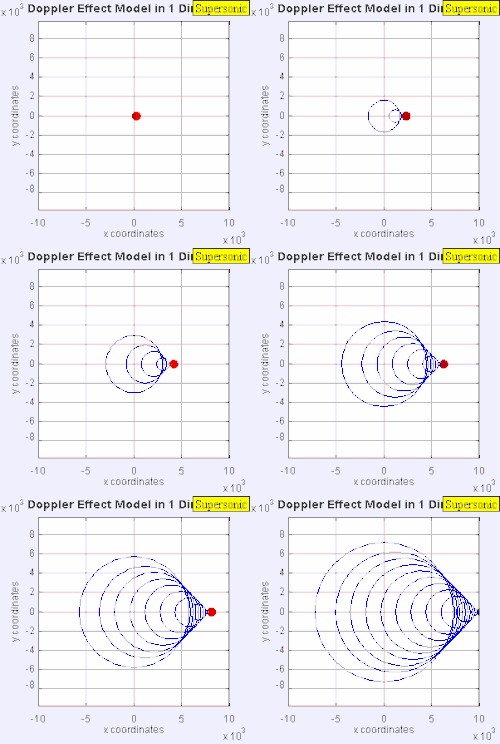
In modern technology, most firearm bullets are supersonic, with rifle projectiles often exceeding Mach 3. Spacecraft also experience supersonic speeds during reentry, though the lower air density at high altitudes mitigates some effects. During ascent, launch vehicles typically avoid supersonic speeds below 30 km (~98,400 feet) to minimize aerodynamic drag.
Supersonic Travel: Land, Sea, and Air
Land Speed Records
While most supersonic travel occurs in the air, land vehicles have also broken the barrier. The ThrustSSC holds the official world land speed record, driven by Andy Green, who achieved an average bi-directional speed of 1,228 km/h (763 mph) in the Black Rock Desert on October 15, 1997. The Bloodhound LSR project attempted to break this record in South Africa with a jet and hybrid rocket-propelled car, aiming for speeds up to 1,600 km/h (1,000 mph), though the project faced delays and was eventually put up for sale.
The Evolution of Supersonic Flight
Modern fighter aircraft are almost exclusively supersonic. While no current passenger aircraft fly at these speeds, history includes iconic examples like the Concorde and the Tupolev Tu-144. Some aircraft are capable of supercruise, which is the ability to maintain sustained supersonic flight without using an afterburner. The Concorde was notable for spending more time in supersonic flight than all other aircraft combined during its decades of service.
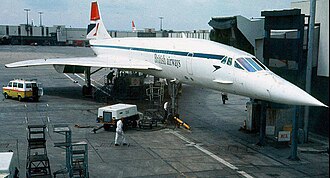
Designing these aircraft requires complex aerodynamics. To minimize drag, engineers use the Supersonic area rule and the Whitcomb area rule to manage shock waves. Ideally, supersonic aircraft follow shapes like the von Karman ogive or the Sears-Haack body—long, slender designs with large delta wings—to maintain stability and efficiency.
Key Facts
- Mach 1 is the threshold for supersonic speed.
- Hypersonic speed is defined as any speed greater than Mach 5.
- The speed of sound decreases with altitude due to lower temperatures (up to 25 km).
- Transonic flight occurs between Mach 0.8 and Mach 1.2.
- The ThrustSSC is the only land vehicle to officially travel at supersonic speeds.
Speed Comparison Summary
| Category/Medium | Speed Threshold (Approximate) | Notes |
|---|---|---|
| Air (Sea Level, 20 °C) | 343.2 m/s (768 mph) | Standard Mach 1 baseline |
| Water (Room Temp) | 1,440 m/s (4,724 ft/s) | Significantly faster than air |
| Transonic Range | Mach 0.8 – Mach 1.2 | Partial supersonic effects |
| Hypersonic | Mach 5+ | Extremely high velocity |
Frequently Asked Questions
What is the difference between supersonic and hypersonic?
Supersonic refers to any speed exceeding the speed of sound (Mach 1), whereas hypersonic refers specifically to speeds exceeding five times the speed of sound (Mach 5).
Why do supersonic aircraft have long, slender shapes?
Long, slender shapes (such as the Sears-Haack body) are used to minimize aerodynamic drag and manage the shock waves created when traveling at high speeds.
What causes a sonic boom?
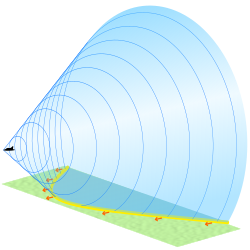
A sonic boom is caused by an object traveling faster than the sound waves it creates, resulting in a sudden change in pressure that is heard as a loud noise.
Does the speed of sound change with altitude?
Yes. Because the speed of sound depends on temperature, and temperature typically decreases with altitude (up to 25 km), the speed of sound also decreases.
What is supercruise?
Supercruise is the ability of an aircraft to maintain sustained supersonic flight without the use of an afterburner.