Sunken Meadow Creek Marsh Habitat Restoration
The delicate balance of coastal ecosystems often depends on the free movement of tides. At Sunken Meadow State Park, a decades-long struggle between human infrastructure and natural hydrology has culminated in a successful effort to restore a vital marsh habitat. What began as a project to control pests and facilitate traffic eventually evolved into a comprehensive ecological recovery mission.
The Impact of the Earthen Berm
In the 1950s, an earthen berm—a raised bank of soil—was constructed across Sunken Meadow Creek. This structure served two primary purposes: allowing vehicular traffic to cross the area and controlling local mosquito populations. However, this barrier came with a significant environmental cost.
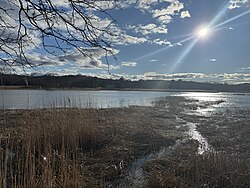
By blocking the natural tidal flow (the rise and fall of sea levels), the berm prevented saltwater from entering the creek. This stagnation led to a buildup of pollution and created an ideal environment for Phragmites australis, an invasive common reed, to thrive and displace native vegetation.
The Path to Restoration
Recognizing the ecological decline, a coalition of organizations began researching a solution in 2008. This group included New York State Parks, the New York State Department of Environmental Conservation, the Long Island Sound Study, Save the Sound, and the National Fish and Wildlife Service. Their goal was to replace the restrictive berm with a foot-bridge to restore water movement.
Official planning began in 2011, and by October 2012, the design for the new bridge was finalized. However, nature accelerated the process unexpectedly.
The Role of Hurricane Sandy
On October 29, 2012, Hurricane Sandy struck the Long Island region with intense winds, rainfall, and storm surges. The force of the storm blew out the earthen berm, effectively restoring tidal flow for the first time in decades. This sudden return of saltwater helped push out invasive species and allowed native plants to be reintroduced naturally.
Ongoing Conservation Efforts
Following the storm, construction of the planned foot-bridge was completed in October 2013. Since then, the area has undergone continuous improvement through targeted restoration projects, including erosion control and the planting of Spartina alterniflora, commonly known as smooth cordgrass.
In 2025, the National Audubon Society was awarded a $1.5 million grant from the National Wildlife and Fish Service. This funding is dedicated to further enhancing the marsh through hydrological repair, elevation enhancement, and the continued removal of invasive plants.
Key Facts
- Initial Obstruction: An earthen berm built in the 1950s blocked tidal flow for over 50 years.
- Catalyst for Change: Hurricane Sandy destroyed the berm in October 2012, initiating immediate tidal restoration.
- Infrastructure: A permanent foot-bridge was completed in October 2013.
- Major Funding: A $1.5 million grant was awarded to the National Audubon Society in 2025.
- Educational Use: The site serves as a living laboratory for the Sunken Meadow Nature Center and the Western Suffolk BOCES Outdoor Learning Lab.
Restoration Summary
| Period/Date | Event/Action | Ecological Impact |
|---|---|---|
| 1950s | Berm Construction | Blocked tides; invasive Phragmites growth |
| 2008–2012 | Planning Phase | Research and design for foot-bridge replacement |
| Oct 2012 | Hurricane Sandy | Berm destroyed; tidal flow restored |
| Oct 2013 | Bridge Completion | Permanent pedestrian access established |
| 2025 | Audubon Society Grant | $1.5M for hydrological and elevation repair |
Frequently Asked Questions
Why was the earthen berm originally built?
The berm was constructed in the 1950s to facilitate vehicular traffic across Sunken Meadow Creek and to manage mosquito populations.
How did Hurricane Sandy help the marsh?
The storm surge and winds from Hurricane Sandy destroyed the berm, which allowed tidal waters to flow back into the creek, flushing out pollution and invasive species while encouraging native plant growth.
What is Spartina alterniflora?
Spartina alterniflora, or smooth cordgrass, is a native plant species used in planting projects to stabilize the marsh and restore the natural habitat.
What will the 2025 grant be used for?
The $1.5 million grant awarded to the National Audubon Society will fund the removal of invasive plants, elevation enhancement, and hydrological repairs to ensure the marsh's long-term health.
How is the restored marsh used for education?
The area serves as an educational hub where students from the Sunken Meadow Nature Center and the Western Suffolk BOCES Outdoor Learning Lab learn about native wildlife and the process of habitat restoration.