Sulidae: The Specialized World of Gannets and Boobies
The family Sulidae comprises a group of medium-to-large coastal seabirds known collectively as sulids. This family includes the gannets and boobies, birds renowned for their spectacular hunting technique: plunge-diving. By dropping from great heights into the ocean to capture fish and marine invertebrates, these birds have evolved highly specialized physical traits that allow them to survive the impact of hitting the water at high speeds.
While older scientific sources often grouped all ten species into a single genus, modern research using DNA sequencing and morphological analysis has divided them into three distinct genera: Sula (true boobies), Morus (gannets), and Papasula (Abbott's booby). Among these, Abbott's booby represents an ancient lineage that diverged from the others millions of years ago.
Key Facts
- Hunting Style: Specialized plunge-divers that can reach depths of 1–2 meters.
- Physical Build: Torpedo-shaped bodies designed to reduce drag during dives.
- Distribution: Primarily tropical and subtropical waters, with gannets also inhabiting temperate regions.
- Nesting: All species breed in colonies and use vascularized feet to incubate eggs.
- Evolution: The lineage dates back to the Early Eocene, approximately 47 to 50 million years ago.
Physical Adaptations for the Deep Dive
Sulids typically measure between 60 and 85 cm in length, with impressive wingspans ranging from 140 to 175 cm. Their wings are long, narrow, and pointed, optimized for efficient flight. To facilitate plunge-diving, they have evolved a "torpedo-shaped" body that is somewhat flat, reducing water resistance. Interestingly, their flight muscles are relatively small; this is an evolutionary trade-off to maintain the small cross-section necessary for diving.
Their anatomy is further refined for a marine existence. The nostrils enter the bill rather than opening directly to the outside, preventing water from entering during a dive. Their eyes are angled forward, providing a wider field of binocular vision than most birds, which is critical for spotting prey from the air. Additionally, they possess a well-developed preen gland that produces waxy secretions used for waterproofing feathers.
Their feet are fully webbed across all four toes. In certain species, these webs are brightly colored and play a central role in courtship rituals.
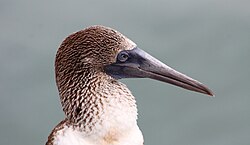
Plumage and Appearance
Sulid plumage generally falls into two categories: all-white (or light grey/brown) with dark wingtips and tails, or dark brown/black upperparts with white underparts. Gannets are specifically noted for the yellowish hue of their heads. Most species also feature black markings on the lores (the area between the eye and the bill).
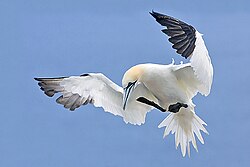
Ecology and Hunting Behavior
While not truly pelagic (meaning they generally stay closer to coastlines than some other seabirds), sulids are often found on remote Pacific islands. They feed exclusively at sea, targeting mid-sized fish and cephalopods. While many hunt communally, some are known to follow fishing boats to scavenge chum or bycatch.
The plunge-dive is their signature move, though they are capable of using their wings and legs to swim underwater if the prey escapes the initial impact. Behavioral patterns also vary by genus: gannets point their bills upward before takeoff, while boobies point them forward. Both point their bills downward upon landing.
Reproduction and Life Cycle
Sulids are colonial breeders. Males establish and defend nest sites through territorial displays and calls to attract females. Once a pair bond is formed, they maintain it through frequent copulation and mutual preening.
Most clutches consist of two eggs, which are unmarked and range in color from white and pale blue to green or pink. Because sulids lack a brood patch (a featherless area of skin on the abdomen), they have evolved a unique method of incubation: their feet become vascularized and hot, allowing them to keep the eggs warm by tucking them under their webs.
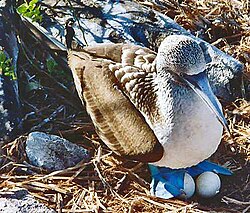
Hatchlings are born naked and develop white down shortly after. They are altricial, meaning they are entirely dependent on their parents for food, which is delivered via regurgitation. Due to limited food supplies, siblicide is common, where the stronger chick kills its sibling. Only the Peruvian booby regularly raises more than one chick to maturity.
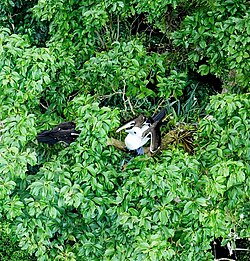
Evolutionary History and Systematics
The evolutionary history of the Sulidae is extensive, with fossils appearing as early as the Eocene. They are closely related to cormorants (Phalacrocoracidae) and darters (Anhingidae), sharing traits such as the lack of external nostrils and the presence of a gular sac. Together, these groups are placed in the order Suliformes.
Genetic studies indicate that Abbott's booby diverged from the other sulids roughly 22 million years ago. The split between the ancestors of gannets and the remaining boobies occurred around 17 million years ago. The modern genera likely stabilized around the Oligocene-Miocene boundary (approximately 23 Mya), likely originating in the western Tethys Sea region of Europe.
| Common Name | Genus | Primary Range |
|---|---|---|
| Northern gannet | Morus | Western Europe, North America |
| Cape gannet | Morus | West to Southwest Africa |
| Australasian gannet | Morus | Australia, New Zealand |
| Abbott's booby | Papasula | Christmas Island |
| Blue-footed booby | Sula | Eastern Pacific (California to Peru) |
| Masked booby | Sula | Tropical oceans (Indian, Atlantic, Pacific) |
| Nazca booby | Sula | Eastern Pacific (Baja to Colombia) |
| Brown booby | Sula | Pantropical Atlantic and Pacific |
| Red-footed booby | Sula | Most tropical oceans |
| Peruvian booby | Sula | Coast of Peru and Chile |
Frequently Asked Questions
How do sulids keep water out of their noses during dives?
Unlike many birds, the nostrils of sulids enter into the bill rather than opening directly to the outside, which prevents water from rushing into the nasal passages during high-speed plunges.
Why do some boobies have brightly colored feet?
Brightly colored webs, most notably in the blue-footed booby, are used in elaborate courtship displays to attract mates.
How do these birds incubate their eggs without a brood patch?
Sulids use their feet for incubation. The webs of their feet become highly vascularized and warm, allowing them to keep the eggs at the necessary temperature by placing them directly under the webs.
What is the difference between a gannet and a booby?
While both are sulids, they differ in morphology, behavior, and DNA. For example, gannets typically have a yellowish hue to their heads and point their bills upward before taking off, whereas boobies point their bills forward.
What is siblicide in sulid colonies?
Siblicide occurs when the stronger of two chicks in a nest kills its sibling. This is a frequent occurrence in most sulid species due to limited food resources, ensuring the survival of at least one healthy offspring.