The Fascinating World of Auks: Exploring the Family Alcidae
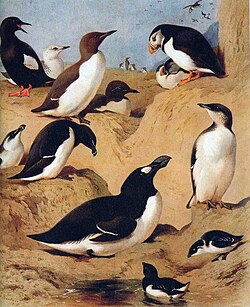
Auks, belonging to the biological family Alcidae, are a specialized group of seabirds found throughout the Northern Hemisphere. This diverse family includes well-known birds such as puffins, murres, guillemots, auklets, and murrelets. While they may remind some observers of penguins due to their striking black-and-white plumage and upright posture, auks are actually a distinct lineage of birds within the order Charadriiformes.
Physical Characteristics and Locomotion
Auks are monomorphic, meaning that males and females of the same species look nearly identical in appearance. They vary significantly in size; for instance, the tiny least auklet weighs only about 85 grams and measures 15 cm, while the much larger thick-billed murre can reach 1 kg and 45 cm in length. Because they have relatively short wings, auks must flap them very rapidly to achieve flight.
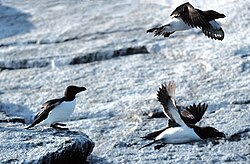
The biology of an auk is a study in evolutionary compromise. They have largely traded mobility on land and efficient flight for superior swimming and diving abilities. Their wings are designed to be the bare minimum required for flight while serving as highly effective tools for underwater movement. This makes them excellent divers that appear to "fly" through the water. However, this specialization often makes their walking on land appear somewhat clumsy.
Feeding and Ecology
Auks are wing-propelled pursuit divers, a term describing birds that use their wings rather than their feet to swim and chase prey through the water. This feeding method is very similar to that of penguins. In their natural habitats, their primary competition for food comes from cormorants, which use their strong feet for propulsion. To avoid direct competition, auks often hunt further offshore than other seabirds.
Dietary preferences vary by species. Strong-swimming murres typically hunt faster, schooling fish, whereas smaller auklets tend to feed on slower-moving krill. Their diving capabilities are impressive; Uria guillemots can reach depths of 100 meters, Cepphus guillemots dive to about 40 meters, and auklets typically dive to depths of 30 meters.
Breeding and Social Behavior
Most auks are pelagic birds, meaning they spend the vast majority of their adult lives on the open sea, only coming ashore to breed. They are also monogamous, often forming lifelong pairs. Most species typically lay a single egg each year and tend to return to the same nesting site annually.
Nesting habits vary across the family. Some species, like the Uria guillemots, form massive colonies on steep cliff edges. Others, such as the Cepphus guillemots, prefer smaller groups on rocky coasts. Many other species, including puffins and auklets, nest in underground burrows.
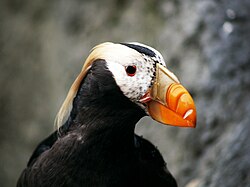
Puffins and auklets are particularly well-adapted for both flying and walking compared to their more specialized diving relatives.
Diversity and Taxonomy
The family Alcidae contains 25 extant (currently living) or recently extinct species divided into 11 genera. While they were once thought to be an ancient, distinct lineage, genetic research suggests their unique traits are the result of intense natural selection. They are now classified within the suborder Lari, making them more closely related to skuas than previously believed.
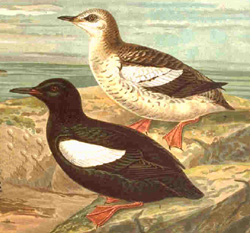
Taxonomically, the family is split into two main subfamilies: Alcinae and Fraterculinae. Within the Alcinae, there are several distinct tribes, including the Synthliboramphini, which consists of specific murrelets. Genetic studies suggest these murrelets are more closely related to the "true auks" than to other murrelet groups.
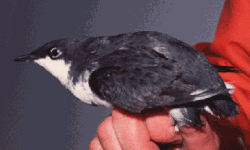
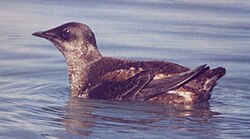
Another group, the Brachyramphini, includes the murrelets that are not part of the Synthliboramphus genus, such as the marbled murrelet.
Evolution and Distribution
The fossil record for auks dates back to the late Eocene, approximately 35 million years ago. While fossils have been found in both California and Maryland, the high diversity of fossils in the Pacific suggests that auks likely evolved there during the Miocene epoch. From the Pacific, they likely spread to the Atlantic by moving south and eventually crossing the Arctic Ocean.
Today, auks are restricted to the cooler waters of the Northern Hemisphere. Their ability to inhabit southern regions is limited by the temperature of the water; as water warms, the speed of their prey (such as small fish) increases, making it harder for the birds to catch them. Consequently, the highest concentration of auk species is found in the Pacific (19–20 species) compared to the Atlantic (6 species).
Key Facts
- Family: Alcidae (includes puffins, murres, and auklets).
- Habitat: Northern Hemisphere, primarily in cool, subarctic waters.
- Diet: Primarily fish and krill, caught via wing-propelled pursuit diving.
- Lifespan Traits: Most species are monogamous and form lifelong pairs.
- Evolution: They exhibit convergent evolution with penguins, meaning they evolved similar traits independently.
- Size Range: From the 85g least auklet to the 1kg thick-billed murre.
Summary of Auk Groups
| Subfamily | Tribe/Group | Common Examples |
|---|---|---|
| Alcinae | Alcini (Typical Auks) | Razorbill, Common Murre, Little Auk |
| Alcinae | Synthliboramphini | Xantus's murrelet, Ancient murrelet |
| Alcinae | Cepphini (True Guillemots) | Black guillemot, Pigeon guillemot |
| Alcinae | Brachyramphini (Murrelets) | Marbled murrelet, Long-billed murrelet |
| Fraterculinae | Aethiini (Auklets) | Cassin's auklet, Parakeet auklet |
| Fraterculinae | Fraterculini (Puffins) | Atlantic puffin, Tufted puffin |
Frequently Asked Questions
Are auks closely related to penguins?
No. While they look similar due to convergent evolution—where unrelated species develop similar traits to adapt to similar environments—they belong to different biological lineages.
Why are some birds called "murres" in America and "guillemots" in Europe?
This is simply a difference in regional English naming conventions. The two species known as murres in North America are referred to as guillemots in Europe.
How do auks catch their food?
Auks are wing-propelled pursuit divers. They use their wings to "fly" through the water to chase and capture prey like fish and krill.
Where do auks spend most of their time?
Auks are pelagic birds, meaning they spend the majority of their adult lives on the open ocean, only coming to land or cliffs to breed.
Why are there more auk species in the Pacific than the Atlantic?
While the fossil record shows more diversity in the Atlantic during the Pliocene, scientists believe the current lower numbers in the Atlantic are due to historical extinctions.