Seabirds: Adaptations, Migration, and Conservation of Marine Birds
Seabirds, also known as marine birds, are specialized avian species adapted to life within the marine environment. While they vary significantly in physiology, behavior, and lifestyle, they often demonstrate convergent evolution—a process where unrelated species evolve similar traits because they face the same environmental challenges and occupy similar feeding niches.
The evolutionary history of these birds stretches back to the Cretaceous period, with modern seabird families emerging later during the Paleogene. Today, they range from highly pelagic species that spend most of their lives on the open ocean to coastal birds that may spend portions of the year away from the sea entirely.
Key Facts
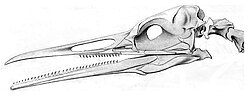
- Evolution: First appeared in the Cretaceous period; modern families emerged in the Paleogene.
- Life History: Generally characterized by longer lifespans, later breeding ages, and fewer offspring compared to other birds.
- Social Structure: Most species nest in colonies, ranging from a few dozen to millions of individuals.
- Migration: Some species undertake the longest migrations of any animal, including trans-equatorial journeys.
- Threats: Major risks include fisheries bycatch, oil spills, climate change, and prey depletion.
Biological Characteristics and Adaptations
Life at sea requires extreme physiological adaptations. Seabirds have evolved various methods to handle the challenges of salt water, thermoregulation, and buoyancy. For example, some species possess specialized glands to secrete excess salt, while others have evolved specific plumage characteristics.
![Cormorants, like this double-crested cormorant, have plumage that is partly wettable. This functional adaptation balances the competing requirement for thermoregulation against that of the need to reduce buoyancy.[25]](/images/7c/11/7c11c31be2f1ddf4b73a7e72a78675db7859b5b10b2f09319f792a90a2d764d1.jpg)
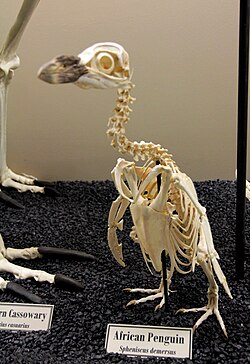
Physical structures are often tailored to their specific movement in the water. Penguins, for instance, possess a sternal keel—a ridge on the breastbone—that supports the powerful muscles needed for diving and swimming.
Feeding Strategies
Seabirds employ diverse tactics to secure food from the ocean:
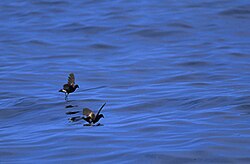
- Surface Feeding: Foraging at the ocean's surface, sometimes including "pattering" on the water.
- Pursuit Diving: Chasing prey beneath the surface.
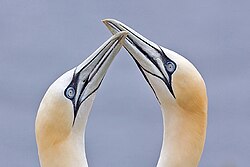
- Plunge Diving: Diving from a height into the water to catch fish.
- Kleptoparasitism: Stealing food from other birds, alongside scavenging and predation.
Life History and Global Migration
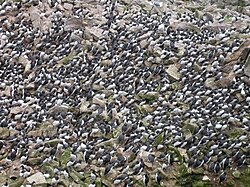
Seabirds invest heavily in their young, often maintaining strong pair bonds throughout the breeding season. Many species are colonial nesters, gathering on offshore rocks, islands, or cliffs to breed.
Migration is a defining feature for many species. The Arctic tern holds the record for the farthest migration of any bird, crossing the equator to spend the Austral summer in Antarctica. Similarly, the sooty shearwater completes an annual round trip of approximately 64,000 kilometers (40,000 mi), traveling between New Zealand/Chile and the North Pacific.
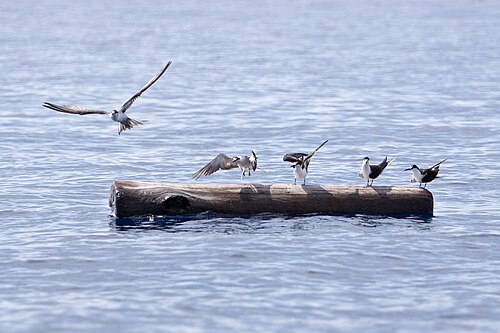
![Raft of coastal seabirds[2] Gulf of St. Lawrence, Quebec, Canada](/images/a5/8f/a58fc690c0a31b4f42dbeb1564a0f30498b1f5cbfec9f6102af96fe0da7ac02b.jpg)
Human Impact and Conservation
Humans and seabirds have a long, intertwined history. Historically, these birds guided fishers to stocks and led sailors to land. However, modern industrial activities have created severe threats.
The Impact of Fisheries
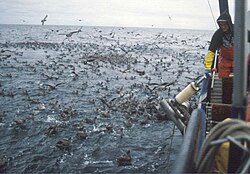
Fisheries cause significant mortality through bycatch—the accidental capture of non-target species. An estimated 160,000 to 330,000 seabirds are caught on longlines annually, with albatrosses, petrels, and shearwaters being the most vulnerable. Pursuit divers, such as guillemots and penguins, are more susceptible to gillnets, where an estimated 400,000 birds perish each year.
Other Environmental Threats
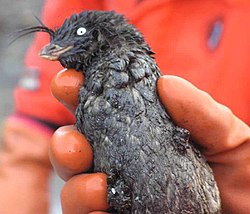
Beyond fishing, seabirds face dangers from oil spills, offshore development, and climate change. Pollution, such as oiling, can be catastrophic for individual birds and entire colonies.
Conservation efforts are currently focused on establishing wildlife refuges and modifying fishing techniques to reduce bycatch and protect vulnerable populations.
Classification of Seabird Families
Seabirds are categorized into several distinct orders based on their evolutionary lineage and physical traits.
| Order | Representative Families | Distribution/Notes |
|---|---|---|
| Sphenisciformes | Penguins (Spheniscidae) | Antarctic and southern waters |
| Procellariiformes | Albatrosses, Petrels, Shearwaters | Pan-oceanic and pelagic |
| Pelecaniformes | Pelicans (Pelecanidae) | Worldwide |
| Suliformes | Gannets, Boobies, Cormorants, Frigatebirds | Worldwide |
| Phaethontiformes | Tropicbirds (Phaethontidae) | Worldwide tropical seas |
| Charadriiformes | Gulls, Terns, Auks, Skuas, Phalaropes | Worldwide |

Frequently Asked Questions
Which seabird has the longest migration?
The Arctic tern performs the longest migration of any bird, traveling from the north to the south to spend the Austral summer in Antarctica, effectively crossing the equator.
What is fisheries bycatch and how does it affect seabirds?
Bycatch occurs when seabirds are accidentally entangled in nets or hooked on fishing lines. Hundreds of thousands of birds, particularly albatrosses and pursuit divers, die annually due to longlines and gillnets.
How do seabirds differ from other birds in their life history?
Seabirds generally live longer, begin breeding at a later age, and produce fewer offspring than many other bird species, though they invest significantly more time in raising their young.
What is convergent evolution in the context of seabirds?
Convergent evolution is when different seabird families develop similar physical or behavioral traits because they occupy similar ecological niches or face the same environmental pressures in the marine environment.
Why do some seabirds nest in colonies?
Many seabirds nest in colonies, which can range from a few dozen to millions of birds, often on remote offshore islands, cliffs, or rocks to protect their young from land-based predators.