Sranan Tongo: The History and Evolution of Suriname's Creole Language
Sranan Tongo (also known as Sranantongo or Surinamese Creole) is a vibrant English-based creole language native to Suriname in South America. Serving as both an unofficial national language and a lingua franca—a common language used between people who do not share a native tongue—it is spoken by approximately 520,000 first-language speakers and 150,000 second-language speakers. Beyond the borders of Suriname, the language thrives within the Surinamese diaspora, particularly in the Netherlands.
The language emerged from a complex history of migration, colonization, and survival, blending European influences with the linguistic heritage of West and Central Africa.
Key Facts
- Origin: Developed as an English-based pidgin among enslaved Africans in Suriname.
- Speaker Base: Roughly 670,000 total speakers (L1 and L2 combined).
- Lexifiers: Primarily English, with significant contributions from Dutch, Portuguese, and Spanish.
- African Influence: Strong roots in Gbe, KiKongo, and Akan languages.
- Official Status: Unofficial national language; standard orthography adopted in 1986.
The Historical Development of Sranan Tongo
Sranan Tongo likely began as a pidgin—a simplified language used for basic communication—when English colonists brought enslaved Africans from various tribes to plantations in the Guiana region. Because these individuals shared no common African language, they developed a hybrid system to communicate with each other and their captors.
A pivotal shift occurred in 1667 following the Treaty of Breda, when the Dutch took control of the territory from the English. While the number of English speakers declined, the Dutch colonists maintained the existing local language as a lingua franca. This led to Dutch becoming a secondary lexifier (a language that provides a large portion of the vocabulary), distinguishing Sranan Tongo from other English-based Afro-Caribbean creoles.
The language continued to evolve as different groups arrived in Suriname. In the early 18th century, a large influx of Akan people from the Gold Coast introduced new Africanisms through a process of relexification. Later, the arrival of indentured workers from India, China, and Java, as well as intermarriage with indigenous peoples, further cemented Sranan Tongo's role as the primary bridge between the country's diverse ethnic groups.
Linguistic Characteristics
While Sranan Tongo contains many English words, it is rarely mutually intelligible with modern English due to centuries of isolation from English speakers. Its unique identity is forged from several linguistic layers:
- African Roots: The grammar, morphology (word structure), and phonology (sound system) are heavily influenced by Gbe (including Fon and Ewe), KiKongo, and Akan. This is especially evident in ritual Winti lexicons and anatomical terms.
- Indigenous Influence: Cariban languages, such as Carib and Arawak, contributed terms related to botany, zoology, and local cuisine.
- European Layers: Beyond English and Dutch, Portuguese influences remain, particularly in the Odos—the traditional proverbs and folklore passed down through oral tradition.
Phonology and the Struggle for Standardization
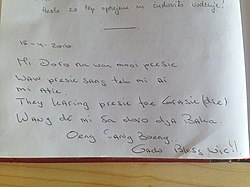
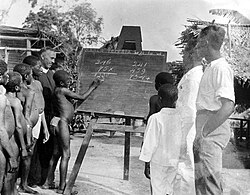
For much of its history, Sranan Tongo was viewed as a low-prestige language, often pejoratively called Taki Taki ("talk talk") or Negerengels ("Negro-English"). Consequently, written texts until the mid-20th century relied on non-standardized Dutch spelling, which did not accurately reflect the language's actual sounds.
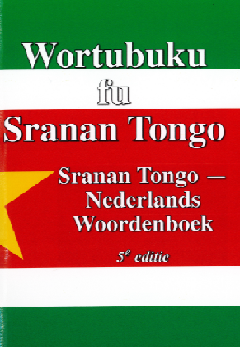
A movement for linguistic emancipation eventually led the Surinamese government to commission a committee of writers and linguists. On July 15, 1986, a standard phonology-based orthography was officially adopted. However, because Dutch remains the primary language of instruction in schools, many speakers continue to use Dutch-style spelling in casual writing.
Modern Use and Literature
In recent decades, Sranan Tongo has gained significant social acceptance. During the 1980s, public figures such as former president Dési Bouterse helped popularize the language by delivering national speeches in Sranan. Today, it is common to see code-switching—the practice of alternating between two languages—between Sranan Tongo and Dutch, especially in digital communication.
The language also has a rich literary history dating back to 1783, with the first publication being a poem by Hendrik Schouten. Notable literary figures include the poet Henri Frans de Ziel ("Trefossa"), who wrote the second verse of Suriname's national anthem in Sranan Tongo. Other influential writers include Michaël Slory and Bea Vianen.
The language has even reached the global stage; in 2021, Jeangu Macrooy performed the song "Birth of a New Age" in Sranan Tongo at the Eurovision Song Contest.
Language Summary
| Feature | Details |
|---|---|
| Language Family | English Creole / Atlantic |
| Primary Region | Suriname, Netherlands |
| Estimated Speakers | ~670,000 |
| Writing System | Latin |
| ISO Codes | srn (639-2, 639-3) |
| Key Influences | English, Dutch, Portuguese, Gbe, Akan, KiKongo |
Frequently Asked Questions
Is Sranan Tongo the same as English?
No. While it is an English-based creole and shares much of its vocabulary with English, it has its own distinct grammar and phonology. Due to a lack of contact with English speakers since the 17th century, it is generally not mutually intelligible with modern English.
Why is Dutch influence so strong in the language?
After the Dutch took over Suriname in 1667, they maintained Sranan Tongo as a lingua franca. Over time, a substantial amount of Dutch vocabulary was integrated, making Dutch a secondary lexifier of the language.
What are Odos?
Odos are Afro-Surinamese proverbs, stories, and folklore. They were passed down through oral tradition during the era of slavery and remain a vital part of Afro-Surinamese cultural identity today.
Is Sranan Tongo taught in schools in Suriname?
No, the formal educational system in Suriname is Dutch-based. Because it is not taught in schools, many native speakers are unfamiliar with the official standard spelling adopted in 1986.
How is Sranan Tongo used today?
It is widely used for casual conversation in Suriname and among the diaspora in the Netherlands. It is frequently mixed with Dutch in daily speech and computer-mediated communication.