Dutch languageNederlandsWest Germanic languagesLow FranconianAfrikaans

Dutch Language: History, Distribution, and Linguistic Structure

Dutch Language: History, Distribution, and Linguistic Structure The Dutch language (Nederlands) is a West Germanic language spoken by approximately 25 million native speakers and 30 milli...

Dutch Language: History, Distribution, and Linguistic Structure

The Dutch language (Nederlands) is a West Germanic language spoken by approximately 25 million native speakers and 30 million total speakers worldwide. As a primary official language in the Netherlands, Belgium, and Suriname, it serves as a vital cultural and administrative bridge across Europe and the Americas.

Dutch belongs to the Indo-European family, specifically the West Germanic branch. It evolved from Low Franconian, a group of dialects that diverged from other Germanic tongues in the early Middle Ages. Today, it is regulated by the Nederlandse Taalunie (Dutch Language Union), ensuring standardization across the different regions where it is spoken.
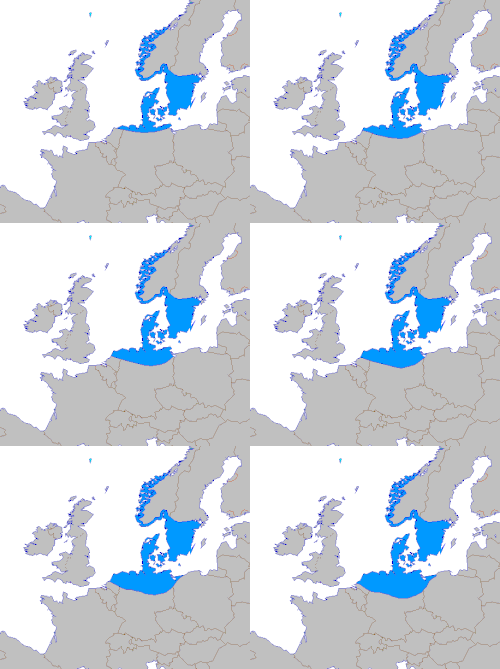
Map of the pre-Roman Iron Age in Northern Europe culture(s) associated with the Proto-Germanic language, ca 500–50 BCE. The area south of Scandinavia is the Jastorf culture.

Key Facts

  • Native Speakers: Approximately 25 million (2021).
  • Official Status: Official in the Netherlands, Belgium, Suriname, and several Caribbean territories (Aruba, Bonaire, Curaçao, Sint Eustatius, Sint Maarten, and Saba).
  • Language Family: Indo-European > Germanic > West Germanic > Low Franconian.
  • Major Daughter Language: Afrikaans, spoken predominantly in South Africa.
  • Writing System: Latin alphabet, including specialized Braille systems (six-dot and eight-dot).

Historical Evolution

The development of Dutch is categorized into four primary stages, reflecting the political and social shifts of Northern Europe.

Frankish (3rd–5th Centuries)

The roots of Dutch lie in the Frankish dialects spoken by the Germanic tribes during the early migration period.

Old Dutch (5th–12th Centuries)

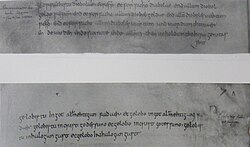
During this era, the language began to distinguish itself from other West Germanic dialects. Early records, such as the Utrecht baptismal vow, provide insight into this formative period.
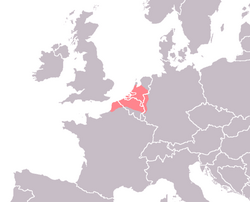
Area in which Old Dutch was spoken
The Utrecht baptismal vow

Middle Dutch (12th–15th Centuries)

Middle Dutch saw a rise in literary production and the standardization of regional dialects as trade and urban centers grew.

Modern Dutch (15th Century–Present)

Modern Dutch emerged with the rise of the Dutch Republic. A landmark in this period was the Statenvertaling (1637), a faithful translation of the Bible that significantly influenced the standardized form of the language.

Title page of the Statenvertaling (1637) reads: Biblia ... Uyt de Oorspronckelijcke talen in onse Neder-landtsche tale getrouwelijck over-geset. (English: From the Original languages into our Dutch language faithfully translated.)[46]

Geographic Distribution and Dialects

While centered in the Low Countries, Dutch has a global footprint due to colonial history and migration.

European Core

The vast majority of speakers are located in the Netherlands (70.8%) and Belgium (27.1%). In Belgium, the language is often referred to as Flemish. Various dialect groups exist, including Central, Flemish, Stadsfries, and West Frisian Dutch.
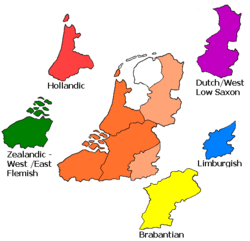
Traditional division of Dutch dialects

Global Reach

Dutch is an official language in Suriname and the Dutch Caribbean. While Indonesia did not adopt Dutch as an official language after independence, the Indonesian language remains heavily influenced by Dutch vocabulary.

In the Dutch East Indies (present day Indonesia and Malacca, Malaysia), Dutch was used by only a limited educated elite.[76]
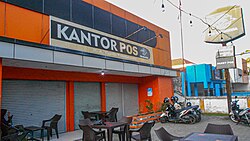
Indonesia did not adopt the Dutch language after independence. However, the Indonesian language is heavily influenced by Dutch. Seen here is kantor pos (from the Dutch postkantoor), meaning post office.
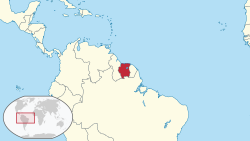
The location of Suriname in South America
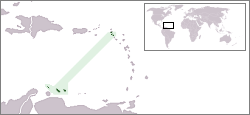
The Dutch Caribbean at both ends of the Lesser Antilles, lining the Caribbean Sea

Africa and the Congo

In Africa, Dutch influenced the development of Afrikaans in South Africa. Historically, Dutch was also used in the Belgian Congo.
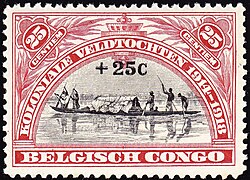
Dutch-language variant of a Belgian Congo postage stamp showing colonial expeditions
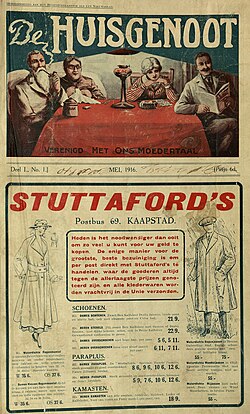
Standard Dutch used in a 1916 ad in South Africa before Afrikaans replaced Dutch for use in media
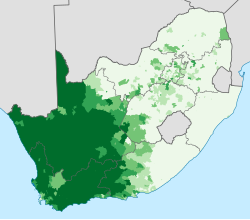
The distribution of Afrikaans across South Africa: proportion of the population speaking Afrikaans at home: 0–20% 20–40% 40–60% 60–80% 80–100%

Linguistic Characteristics

Dutch is known for its unique phonology and a flexible but structured grammar.

Phonology and Writing

The language utilizes a variety of vowels and diphthongs. A notable feature of the writing system is the use of the digraph ⟨ij⟩, which is often treated as a single letter in various contexts.
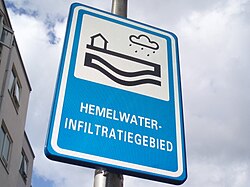
The 27-letter compound hemelwaterinfiltratiegebied (rainwater infiltration area) on a traffic sign in Zwolle, Netherlands
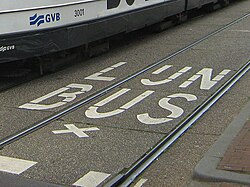
Dutch uses the digraph ⟨ij⟩ as a single letter and it can be seen in several variations. Here, a marking saying lijnbus ("line/route" + "bus"; the tram lane also serves as bus road).

Grammar and Syntax

Dutch verbs are divided into weak and strong classes. Weak verbs typically form their past tense with -de or -te, while strong verbs undergo vowel changes. The language also employs diminutives (such as -je, -pje, or -tje) to denote smallness or affection.

In terms of word order, Dutch follows a standard subject-verb-object pattern in main clauses, but shifts the verb to the end in subordinate clauses.

Summary of Speaker Distribution

Estimated Dutch Speakers by Region (2010-2020)
Country/Region Approximate Speakers Data Year
Netherlands 17,000,000 2020
Belgium 6,500,000 2020
Suriname 400,000 2020
Curaçao 12,000 2011
Aruba 6,000 2010
Caribbean Netherlands 3,000 2018
Sint Maarten 1,500 2011

Frequently Asked Questions

What is the difference between Dutch and Flemish?

Flemish is essentially the variety of Dutch spoken in Northern Belgium (Flanders). While there are differences in pronunciation and some vocabulary, they share the same standardized written form.

How is Afrikaans related to Dutch?

Afrikaans is a daughter language of Dutch. It evolved in South Africa from 17th-century Dutch settlers, simplifying much of the grammar while retaining a core Dutch vocabulary.

What is the role of the Nederlandse Taalunie?

The Nederlandse Taalunie (Dutch Language Union) is the official regulatory body that manages the standardization of the Dutch language across the Netherlands, Belgium, and Suriname.

Is Dutch spoken in Indonesia?

Dutch is not an official language in Indonesia and was previously used only by a limited educated elite. However, the Indonesian language contains many loanwords from Dutch.

What are Dutch diminutives?

Diminutives are suffixes added to nouns to indicate that something is small or to express endearment. Common suffixes include -je (e.g., neefje), -pje (e.g., boompje), and -tje (e.g., baby'tje).

References

  1. Afrikaans is a daughter language of Dutch; see Booij 1999, p. 2, Jansen, Schreuder & Neijt 2007, p. 5, Mennen, Levelt & Gerrits 2006, p. 1, Booij 2003, p. 4, Hiskens, Auer & Kerswill 2005, p. 19, Heeringa & de Wet 2007, pp. 1, 3, 5. Afrikaans was historically called Cape Dutch; see Deumert & Vandenbussche 2003, p. 16, Conradie 2005, p. 208, Sebba 1997, p. 160, Langer & Davies 2005, p. 144, Deumert 2002, p. 3, Berdichevsky 2004, p. 130. Afrikaans is rooted in 17th-century dialects of Dutch; see Holm 1989, p. 338, Geerts & Clyne 1992, p. 71, Mesthrie 1995, p. 214, Niesler, Louw & Roux 2005, p. 459. Afrikaans is variously described as a creole, a partially creolised language, or a deviant variety of Dutch and has a vastly simplified grammar compared to Dutch; see Sebba 2007, p. 116.
  2. It has the widest geographical and racial distribution of all official languages of South Africa; see Webb 2003, pp. 7, 8, Berdichevsky 2004, p. 131. It has by far the largest geographical distribution; see Alant 2004, p. 45.It is widely spoken and understood as a second or third language; see Deumert & Vandenbussche 2003, p. 16, Kamwangamalu 2004, p. 207, Myers-Scotton 2006, p. 389, Simpson 2008, p. 324, Palmer 2001, p. 141, Webb 2002, p. 74, Herriman & Burnaby 1996, p. 18, Page & Sonnenburg 2003, p. 7, Brook Napier 2007, pp. 69, 71.An estimated 40 percent of South Africans have at least a basic level of communication in Afrikaans; see Webb 2003, p. 7 McLean & McCormick 1996, p. 333. Afrikaans is a lingua franca of Namibia; see Deumert 2004, p. 1, Adegbija 1994, p. 26, Batibo 2005, p. 79, Donaldson 1993, p. xiii, Deumert & Vandenbussche 2003, p. 16, Baker & Prys Jones 1998, p. 364, Domínguez & López 1995, p. 399, Page & Sonnenburg 2003, p. 8, CIA 2010.While the number of total speakers of Afrikaans is unknown, estimates range between 15 and 23 million. Afrikaans has 16.3 million speakers; see de Swaan 2001, p. 216. Afrikaans has a total of 16 million speakers; see Machan 2009, p. 174. About 9 million people speak Afrikaans as a second or third language; see Alant 2004, p. 45, Proost 2006, p. 402. Afrikaans has over 5 million native speakers and 15 million second language speakers; see Réguer 2004, p. 20. Afrikaans has about 6 million native and 16 million second language speakers; see Domínguez & López 1995, p. 340. In South Africa, over 23 million people speak Afrikaans to some degree, of which a third are first-language speakers; see Page & Sonnenburg 2003, p. 7. L2 "Black Afrikaans" is spoken, with different degrees of fluency, by an estimated 15 million; see Stell 2008, p. 1.Dutch and Afrikaans share mutual intelligibility; see Gooskens 2007, p. 453, Holm 1989, p. 338, Baker & Prys Jones 1998, p. 302, Egil Breivik & Håkon Jahr 1987, p. 232. For written mutual intelligibility; see Sebba 2007, p. 116, Sebba 1997, p. 161.It is easier for Dutch speakers to understand Afrikaans than the other way around; see Gooskens 2007, p. 454.
  3. 410,000 in the United States, 159,000 in Canada, 47,000 in Australia; see Simpson 2009, p. 307. Between 200,000 and 400,000 in US alone; see McGoldrick, Giordano & Garcia-Preto 2005, p. 536.
  4. In France, a historical dialect called French Flemish is spoken. There are about 80,000 Dutch speakers in France; see Simpson 2009, p. 307. In French Flanders, only a remnant of 20,000 Flemish-speakers remain; see Berdichevsky 2004, p. 90. French Flemish is spoken in the north-west of France by an estimated population of 20,000 daily speakers and 40,000 occasional speakers; see European Commission 2010.A dialect continuum exists between Dutch and German through the Kleverlandish, Lower Saxon and Limburgish dialects.In 1941, 400,000 Indonesians spoke Dutch, and Dutch exerted a major influence on Indonesian; see Sneddon 2003, p. 161. In 1941, about 0.5% of the inland population had a reasonable knowledge of Dutch; see Maier 2005, p. 12. At the beginning of World War II, about one million Asians had an active command of Dutch, while an additional half million had a passive knowledge; see Jones 2008, p. xxxi. Many older Indonesians speak Dutch as a second language; see Thomson 2003, p. 80. Some of the ethnic Chinese in Indonesia speak Dutch amongst each other; see Tan 2008, pp. 62–64, Erdentuğ & Colombijn 2002, p. 104. Dutch is spoken by "smaller groups of speakers" in Indonesia; see Bussmann 2002, p. 83. Some younger Indonesians learn Dutch as a foreign language because their parents and grandparents may speak it and because in some circles, Dutch is regarded as the language of the elite; see Vos 2001, p. 91. At present, only educated people of the oldest generation, in addition to specialists who require knowledge of the language, can speak Dutch fluently; see Ammon et al. 2006, p. 2017. Around 6.4% of present-day Indonesian vocabulary can be traced back to Dutch words, see Tadmor 2009, p. 698.
  5. Dutch and English are the closest relatives of German; see Abraham 2006, p. 124. Dutch is the closest relative of German; see Czepluch & Abraham 2004, p. 13. Dutch and English are closely related; see Ingram 1989, p. 494, Todd 2004, p. 37, Kager 1989, p. 105, Hogg 2002, p. 134, De Bot, Lowie & Verspoor 2005, pp. 130, 166, Weissenborn & Höhle 2001, p. 209, Crisma & Longobarde 2009, p. 250. Dutch and English are very closely related languages; see Fitzpatrick 2007, p. 188. Dutch is, after Frisian, the closest relative of English; see Mallory & Adams 2006, p. 23, Classe 2000, p. 390, Hogg 2002, p. 3, Denning, Kessler & Leben 2007, p. 22. English is most closely related to Dutch; see Lightfoot 1999, p. 22, and more so than to German; see Sonnenschein 2008, p. 100, Kennedy Wyld 2009, p. 190.