Boers: The History and Legacy of the South African Frontier Farmers
The Boers (from the Dutch and Afrikaans word for "farmer") are the descendants of proto-Afrikaans-speaking Free Burghers who settled the eastern Cape frontier of Southern Africa between the 17th and 19th centuries. Emerging from a blend of European settlers, their history is defined by a persistent drive for independence, a deep connection to the land, and a long-standing conflict with colonial powers.
Originally established as a refreshment station for the Dutch East India Company (VOC) in 1652, the Dutch Cape Colony served as the cradle for this distinct cultural group. Over time, these settlers evolved from company employees into independent farmers, creating a society rooted in Protestant Christianity and the Afrikaans language.
Key Facts
- Etymology: The name "Boer" means "farmer" in Dutch and Afrikaans.
- Ancestry: Primarily Dutch, with significant contributions from French Huguenots, Germans, and Flemish settlers.
- Language: Afrikaans.
- Religion: Protestant Christianity, specifically the Dutch Reformed Church.
- Population: Approximately 1.5 million descendants.
- Major Events: The Great Trek (1835–1840) and the Anglo-Boer Wars.
Origins and European Influence
The foundation of the Boer population began with the Free Burghers—settlers granted freedom from the VOC to farm the land. This population was significantly bolstered between 1688 and 1689 by the arrival of nearly two hundred French Huguenots. These political refugees, fleeing religious persecution in France after the revocation of the Edict of Nantes, settled in areas such as Franschhoek, Paarl, Stellenbosch, and Drakenstein.
While the Huguenots deeply influenced the colony's character, the VOC mandated that only Dutch be taught in schools starting in 1701. By the mid-18th century, the Huguenots had largely assimilated, and the French language faded in favor of the evolving Dutch dialect that would become Afrikaans.
The Rise of the Trekboers
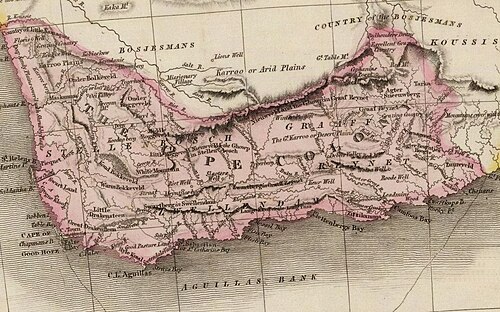
As the colony expanded eastward toward Algoa Bay, many farmers sought to escape the restrictive and often oppressive control of the VOC government. These semi-nomadic pioneers became known as Trekboers. To maintain control over these emigrants, the VOC established magistracies at Swellendam (1745) and Graaff Reinet (1786).
Tensions peaked in 1795 when heavily taxed burghers, feeling unprotected against local Bantu peoples, expelled VOC officials and established independent governments in Graaff Reinet and Swellendam.
British Rule and Frontier Conflict
The geopolitical landscape shifted in 1806 when the United Kingdom incorporated the Cape Colony into the British Empire. By 1814, the Netherlands formally ceded the colony to the British crown. This transition brought new frictions; while the colony prospered, Boer farmers grew dissatisfied with British administration.
Conflict was further exacerbated by the Cape Frontier Wars (1779–1879), a series of nine wars fought primarily between the settlers and the Xhosa people. These conflicts were driven by disputes over land and cattle, as well as vacillating government policies regarding boundaries. Eventually, the Xhosa were defeated, and the territories were brought under British control.
The Great Trek and the Boer Republics
Between 1835 and the early 1840s, a movement known as the Great Trek saw approximately 12,000 to 14,000 Boers emigrate from the Cape Colony. Driven by a desire to escape British rule, these Voortrekkers moved into the interior, crossing the Orange River into Natal and the Zoutspansberg region of the Transvaal.
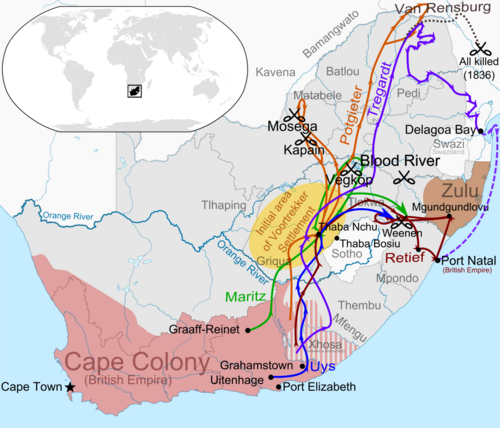
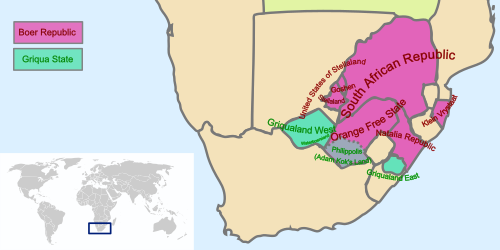
This migration led to the establishment of various independent Boer states. The most prominent were the South African Republic (Transvaal) and the Orange Free State. These republics were characterized by a desire for self-governance and a strict adherence to their Protestant faith.
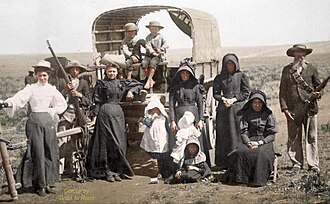
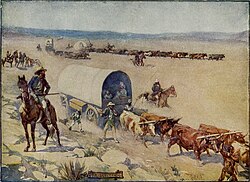
Life for these settlers revolved around the covered wagon, which served as both transport and home as they navigated the vast South African plains.
The Anglo-Boer Wars
The independence of the Boer republics was short-lived. Following the British annexation of the Transvaal in 1877, resistance led by figures like Paul Kruger eventually expelled the British. However, this set the stage for the Second Boer War at the turn of the century. The Boers fought a grueling campaign to maintain the independence of the Transvaal and the Orange Free State, ultimately capitulating in 1902 under the Treaty of Vereeniging.
Summary of Boer Republics
| Republic | Dates | Primary Region |
|---|---|---|
| Republic of Swellendam | 1795 | Western Cape |
| Republic of Graaff-Reinet | 1795–1796 | Eastern Cape |
| Natalia Republic | 1839–1902 | Eastern Cape |
| South African Republic | 1852–1902 | Gauteng, Limpopo |
| Orange Free State | 1854–1902 | Free State |
Frequently Asked Questions
What is the difference between a Boer and an Afrikaner?
While the terms are often used interchangeably, "Boer" specifically refers to the farmers and descendants of the frontier settlers, whereas "Afrikaner" is a broader ethnic term encompassing all descendants of Dutch, French, and German settlers in Southern Africa who speak Afrikaans.
Why did the Boers leave the Cape Colony during the Great Trek?
The Boers were primarily motivated by a desire to escape British colonial rule, which they found oppressive, and to seek land where they could establish their own independent governments and cultural norms.
What role did the French Huguenots play in Boer history?
The Huguenots provided a significant population boost and cultural influence in the late 17th century. Although they eventually assimilated and lost their language, they contributed to the genetic and social fabric of the Boer community.
What was the significance of the Treaty of Vereeniging?
Signed on May 31, 1902, the Treaty of Vereeniging formally ended the Second Anglo-Boer War, resulting in the Boer republics becoming British colonies.
What is the primary religion of the Boers?
The Boers are traditionally Protestant Christians, with the majority belonging to the Dutch Reformed Church (Nederduitsch Hervormde Kerk).