South German Gulden: The History and Evolution of Southern Germany's Currency
Between 1754 and 1873, the South German gulden (German: Süddeutsche Gulden) served as the primary currency for several states in Southern Germany, including Bavaria, Baden, Württemberg, Frankfurt, and Hohenzollern. This currency system was a complex evolution of medieval standards, reflecting the shifting political and economic landscape of the region before the unification of the German Empire.
The gulden was structured with a non-decimal division: one gulden was divided into 60 kreuzer, and each kreuzer was further subdivided into either 4 pfennig or 8 heller.
Key Facts
- Period of Use: 1754 to 1873.
- Primary States: Bavaria, Baden, Württemberg, Frankfurt, and Hohenzollern.
- Denomination: 1 Gulden = 60 Kreuzer.
- Silver Standard: Based on the Cologne Mark of fine silver.
- Replacement: Replaced by the decimal Goldmark in 1873.
Origins and Early Standards
The South German gulden evolved from the florin used during the Late Middle Ages and Early Modern period within the Holy Roman Empire. Following the 1524 Reichsmünzordnung (Imperial Mint Ordinance), the currency emerged as the Guldengroschen. Over the following centuries, the gulden was defined as a fraction of the Reichsthaler, a silver specie coin.
By 1690, the currency in Southern Germany and the Austrian Empire followed the Leipzig standard. Under this system, one gulden was worth 1/18 of a Cologne Mark of fine silver (approximately 12.992 grams) or half of a Reichsthaler specie coin.
The Divergence from Austria
In the 1730s, a drop in the gold-silver price ratio from 15 to 14.5 led many states to reissue the gulden in gold. This created a rift between Southern Germany and Austria. Southern Germany valued the Carolin d'or (a gold coin containing 7.51g of fine gold) at 11 gulden, whereas Austria valued it at 9 gulden. Consequently, the South German gulden was worth approximately 0.6827g of fine gold or 9.9g of fine silver.
Because of this discrepancy, Southern German states could not adopt the Austrian currency convention of 1754. While Austria set its gulden at 11.6928g of fine silver, Southern Germany adopted a lower value of 9.744g of silver per gulden (1/24 of a Cologne Mark).
Currency Depreciation and the Kronenthaler
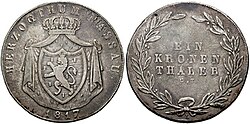
The Conventionsthaler, which contained 23.3856g of fine silver and was valued at 2.4 gulden, eventually gave way to the Kronenthaler between 1807 and 1837. The Kronenthaler contained more silver (25.71g) but was valued at 2.7 gulden, effectively reducing the silver value per gulden to 9.524g. This period was marked by competitive currency depreciation among the various South German states.
Stabilization and the Union Coin
The monetary instability was addressed by the Munich Coin Treaty of 1837. This treaty redefined the gulden at 9.545g of silver (2/49 of a Cologne mark), establishing a fixed exchange rate of 1.75 gulden to 1 Prussian Thaler. This era saw the introduction of new denominations, including 1/2, 1, and 2 gulden coins, as well as the Vereinsmünze (Union Coin), valued at 3.5 South German gulden or 2 Prussian thalers.
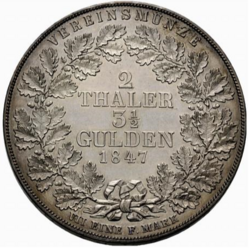
In 1857, the Vienna Monetary Treaty introduced the Vereinsthaler. Although it contained slightly less silver than the Prussian Thaler, it maintained the value of 1.75 gulden. The existing 3.5 gulden Union Coin was redenominated as 2 Vereinsthaler.
Transition to the Goldmark
Following the unification of Germany in 1871, the new German Empire sought to standardize its currency. In 1873, the Goldmark was introduced as a decimal currency. One Mark (ℳ) was divided into 100 Pfennig (₰). The exchange rate was set such that one Mark equaled 35 kreutzer, or 7/12 of a gulden.
The South German gulden was phased out over the next three years, and by January 1, 1876, it was officially abolished. The Goldmark remained the sole legal tender until August 4, 1914, when the gold link was severed at the start of World War I, leading to the introduction of the Papiermark.
Silver Content Comparison
The following table outlines the changing silver standards of the South German gulden compared to the Austrian florin.
| Standard / Year | South German Gulden (g silver) | Austrian Florin (g silver) |
|---|---|---|
| 1690: Reichsthaler = 2G | 12.992 | - |
| 1741: Gold Carolin | 0.68g gold | 0.83g gold |
| 1753: Conventionsthaler | 9.744 | 11.693 |
| 1820s: Kronenthaler | 9.524 | 11.693 |
| 1837: Prussian Thaler | 9.545 | 11.693 |
| 1857: Vereinsthaler | 9.524 | 11.111 |
Frequently Asked Questions
What was the South German gulden?
It was the currency used by Southern German states, including Bavaria and Baden, from 1754 to 1873, before being replaced by the Goldmark.
How was the gulden divided?
One South German gulden was divided into 60 kreuzer, and each kreuzer was worth either 4 pfennig or 8 heller.
Why did the South German gulden differ from the Austrian gulden?
The two diverged in the 1730s due to different valuations of the gold Carolin d'or, leading Southern Germany to adopt a lower silver standard (9.744g) than Austria (11.6928g) in 1754.
What was the purpose of the Munich Coin Treaty of 1837?
The treaty stabilized the currency by redefining the gulden at 9.545g of silver and establishing a clear exchange rate with the Prussian Thaler.
When was the South German gulden officially abolished?
The gulden and kreuzer were officially abolished on January 1, 1876, after the transition to the decimal Goldmark began in 1873.