Bremen Thaler: The Unique Gold Standard of a Hanseatic City
Before the unification of German currency, the financial landscape of the region was a complex tapestry of varying standards and metallic values. Among these, the Thaler served as the primary currency for the Free Hanseatic City of Bremen. While most of Northern Germany shifted its monetary foundations multiple times, Bremen maintained a distinct and stubborn adherence to a gold-linked standard that set it apart from its neighbors for over a century.
The Evolution of the North German Thaler
To understand Bremen's unique position, one must first look at the broader North German context. Following the 1690 Leipzig currency standard, most North German states defined the Reichsthaler (Imperial Thaler) as 1/12th of a Cologne Mark of fine silver, which equaled 19.488 grams.
However, the economic balance shifted in the mid-18th century as the gold-silver price ratio dropped. In France, for example, this ratio fell to 14.5 after 1726. This volatility led many states to move away from pure silver and reissue their currencies as Thaler Gold, a cheaper alternative to the silver-heavy Reichsthaler.
By the 1730s, the gold florin (2.5036 g) was valued at 2 thalers. This meant a single Thaler Gold was worth 1.2518 g of gold or 18.15 g of silver. The situation evolved further in 1741 when Frederick the Great introduced the Friedrich d'or pistole, a coin containing 6 grams of fine gold valued at 5 thalers. This further reduced the value of the Thaler Gold to 1.2 g of gold or 17.4 g of silver.
Bremen's Defiance of the Conventionsthaler
In 1754, most of Northern Germany abandoned the unofficial Thaler Gold standard in favor of the Conventionsthaler. This new standard restored a silver footing, setting the value at 13 1/3 thalers to the Cologne Mark, or 17.5392 grams of silver.
Bremen, however, took a different path. Initially, in 1740, the city attempted to lower its thaler standard to 2/3rd of the Reichsthaler specie coin (2/27 of a Cologne mark of silver), but it struggled to actually issue currency to this specific standard. Because French and North German gold pistoles were stable in quality and widely available, Bremen simply accepted the gold standard: 5 Thaler Gold to one 6.0-gram pistole.
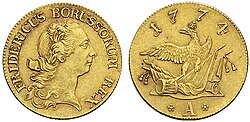
Bremen maintained this gold-linked valuation long after every other state had transitioned to the Conventionsthaler, holding the line until the German Reunification in 1871 and the eventual currency overhaul in 1873.
The Transition to the Gold Mark
As the 19th century progressed, Bremen continued to calibrate its currency against gold. In 1863, the city valued the German gold krone—which contained 10 grams of fine gold—at 8.4 Thalers. This established an equivalence of 1 4/21 grams of fine gold per Thaler.
The era of the Thaler finally ended in 1873 when Germany adopted the gold mark (ℳ). Because the mark was also fixed to gold (1 gram = 2.79ℳ), a precise conversion was established: 1 Thaler was equal to 3 + 9/28 mark.
Key Facts
- Currency Duration: The Thaler was used in Bremen until 1873.
- Subdivisions: One Thaler was divided into 72 Grote, and each Grote was divided into 5 Schwaren.
- Gold Link: Bremen maintained a ratio of 5 thalers to one 6-gram Friedrich d'or pistole.
- Unique Status: Bremen was the only state to keep the Thaler Gold standard after others adopted the Conventionsthaler in 1754.
- Final Conversion: 1 Thaler = 3 + 9/28 gold marks.
| Standard/Coin | Composition/Value | Key Characteristic |
|---|---|---|
| Reichsthaler (1690) | 19.488 g fine silver | 1/12th of a Cologne Mark |
| Friedrich d'or | 6.0 g fine gold | Worth 5 Thalers in Bremen |
| Conventionsthaler | 17.5392 g fine silver | Adopted by most states after 1754 |
| Gold Krone (1863) | 10 g fine gold | Valued at 8.4 Bremen Thalers |
| Gold Mark (1873) | 1 g = 2.79ℳ | Replacement for the Thaler |
Frequently Asked Questions
What was the subdivision of the Bremen Thaler?
The Bremen Thaler was divided into 72 Grote, and each Grote was further divided into 5 Schwaren.
Why did Bremen keep the gold standard while other states switched to the Conventionsthaler?
Bremen found that French and North German gold pistoles were easily available and possessed a stable quality and value, leading them to maintain the 5 thalers to one 6-gram pistole ratio.
What was the Friedrich d'or pistole?
Introduced by Frederick the Great in 1741, it was a coin containing 6 grams of fine gold and was valued at 5 thalers.
How was the Thaler converted to the gold mark in 1873?
The conversion was calculated exactly as 1 Thaler = 3 + 9/28 mark (ℳ).
What was the Cologne Mark?
The Cologne Mark was a unit of weight used to define the silver content of the Reichsthaler; for instance, the 1690 standard defined the Reichsthaler as 1/12th of a Cologne Mark of fine silver.