South American Linguistic Areas
South America is home to an extraordinary diversity of indigenous languages. Rather than being grouped solely by genetic relationship (family trees), many of these languages are studied as linguistic areas. A linguistic area occurs when unrelated or distantly related languages develop shared traits due to prolonged contact and geographical proximity.
From the high peaks of the Andes to the dense basins of the Amazon, these shared characteristics—ranging from word order to specific consonant sounds—reveal the deep history of human interaction across the continent.
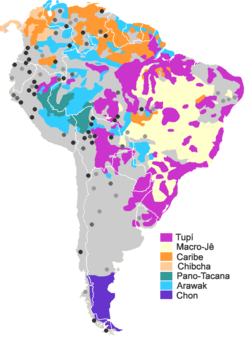
Key Facts
- Word Order Diversity: South American areas vary significantly, with the Andean and Colombian-Central American areas favoring SOV (Subject-Object-Verb), while the Venezuelan-Antillean and Chaco areas favor VO or SVO.
- Andean Stability: The Andes region shows strong statistical evidence as a linguistic area, characterized by elaborate suffixing and specific palatal and uvular consonants.
- Amazonian Debate: While traditionally viewed as a single area, recent quantitative research suggests Amazonia may not be a linguistic area sensu strictu, but rather a collection of smaller macroregions.
- Morphological Complexity: Many regions, particularly in the Amazon and the Andes, utilize highly complex suffixing or noun-classifier systems.
Northern and Central Regions
Colombian–Central American Area
This area includes the Chibchan, Misumalpan, Mangue, and Subtiaba families, and sometimes incorporates Lencan, Jicaquean, Chocoan, and Betoi. It is primarily defined by an SOV word order and the use of postpositions, which distinguishes it from the neighboring Mesoamerican Linguistic Area.
Key traits include voicing opposition in stops and fricatives, a Genitive-Noun order, and "morpholexical economy," where lexical compounds are used instead of independent roots. For example, in Guatuso, specific compounding elements are used to categorize liquid substances or flat surfaces.
Venezuelan–Antillean Area
Consisting of Arawakan, Cariban, Guamo, Otomaco, Yaruro, and Warao, this area stands in contrast to the Colombian-Central American region by utilizing VO word order. Shared traits include the absence of voicing opposition in obstruents and the use of prepositions.
The Andean Linguistic Area
The Andean area is one of the most well-defined linguistic regions, encompassing Quechuan, Aymaran, Callahuaya, and Chipaya. It is characterized by SOV word order and extensive suffixing morphology.
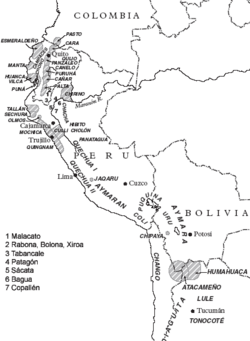
Phonological and Morphosyntactic Traits
Phonologically, the region is noted for glottalized and aspirated stops, uvular stops, and a limited vowel system (typically /i, a, u/). Morphosyntactically, the area utilizes an accusative case, genitive case, and passive constructions.
Statistical studies highlight that the Andes and Western South America share certain argument marking strategies, such as the use of both case and indexation, though the Andes uniquely maintains a strict Subject-Object-Verb constituent order.
Ecuadorian–Colombian Subarea
A specific subarea within the Andean region includes languages like Páez, Guambiano, and Ecuadorian Quechua. This group is distinguished by the presence of the glottal stop /ʔ/ and voiceless bilabial fricative /ɸ/, and the absence of uvular stops.
The Amazon Basin
The Amazonian region is vast, involving families such as Arawakan, Cariban, Tupian, and Panoan. Traditionally, researchers identified traits like objects preceding subjects (VOS, OVS, OSV), verb agreement with both subject and object, and the use of nominalizations for relative clauses.
Noun-Classifier Systems
Amazonian languages frequently employ noun-classifier systems, categorized into three types:
- Numeral: Separate words obligatory in expressions of quantity.
- Concordial: Affixes or clitics expressing class agreement.
- Verb incorporation: Lexical items incorporated into the verb stem to signal a noun's class.
The Validity Debate
Recent quantitative research has challenged the notion of a single "Amazonian" linguistic area. Studies by Joshua Birchall suggest that no single feature shows a consistent areal distribution across the entire macroregion. Instead, evidence points toward three distinct macroregions: the Andes, Western South America, and Eastern South America.
Specialized Regional Areas
Vaupés and Caquetá–Putumayo
The Vaupés area (including Eastern Tukanoan and Arawakan) is known for evidentiality, serial verb constructions, and nominal classification. Meanwhile, the Caquetá–Putumayo area (Boran, Witotoan) is characterized by a first-person plural inclusive/exclusive contrast and a resistance to lexical borrowing.
Orinoco–Amazon and Southern Guiana
The Orinoco–Amazon area features ergative alignment and discourse redundancy. In Southern Guiana, languages like Mawayana have borrowed grammatical features from Cariban languages, such as the "frustrative" marker on verbs and nominal tense marking.
Upper Xingu and Mamoré–Guaporé
The Upper Xingu is considered an "incipient" linguistic area due to the relatively recent arrival of various language families. The Mamoré–Guaporé area in Bolivia and Brazil is remarkably diverse, including over 50 languages from 17 families, characterized by a high incidence of prefixes and a lack of nominal number.
Southern Regions
The Chaco and South Cone
The Gran Chaco area (including Matacoan and Guaicurúan) is defined by SVO word order and active-stative alignment. The South Cone area (Mapudungun, Chon) utilizes SVO order and complex morphological devices to signal the visual location of subjects or objects relative to the speaker.
Fuegian Languages
In Tierra del Fuego, languages such as Chonan and Yahgan share traits related to reduplication, compounding, and an object-initial (OV) word order.
Summary of Major Linguistic Areas
| Linguistic Area | Primary Word Order | Key Distinguishing Feature | Example Families/Languages |
|---|---|---|---|
| Colombian–Central American | SOV | Postpositions; Morpholexical economy | Chibchan, Misumalpan |
| Venezuelan–Antillean | VO | Prepositions; No voicing opposition | Arawakan, Cariban |
| Andean | SOV | Elaborate suffixing; Uvular stops | Quechuan, Aymaran |
| Amazonian (Traditional) | VOS/OVS/OSV | Noun-classifier systems; Ergativity | Tupian, Panoan |
| Gran Chaco | SVO | Active-stative alignment | Matacoan, Guaicurúan |
| South Cone | SVO | Morphological location signaling | Mapudungun, Chon |
Frequently Asked Questions
What is a linguistic area?
A linguistic area is a geographical region where several languages, even those from different families, share similar grammatical, phonological, or lexical traits because their speakers have interacted over a long period.
Why is the Amazonian linguistic area controversial?
Recent quantitative studies suggest that there is no single set of features shared across all Amazonian languages. Researchers now argue that the region is better described as several smaller macroregions rather than one unified linguistic area.
How does the Andean area differ from the Colombian-Central American area?
While both utilize SOV word order, they differ in phonology and specific morphosyntactic traits. The Andean area is characterized by elaborate suffixing and specific sounds like uvular stops, whereas the Colombian-Central American area is noted for its "morpholexical economy" and postpositions.
What are noun-classifier systems in Amazonian languages?
These are systems used to categorize nouns. They can appear as separate words for counting (numeral), as affixes for agreement (concordial), or by incorporating the noun's class directly into the verb stem (verb incorporation).
What is active-stative alignment?
Found in the Gran Chaco area, active-stative alignment is a grammatical system where the marking of the subject depends on whether the subject is an active agent or a passive undergoer of the action.