Aymara Language: History, Linguistics, and Cultural Perspectives
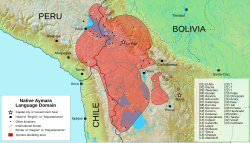
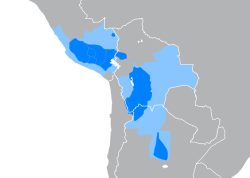
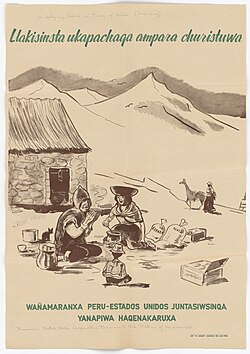
The Aymara language, known natively as Aymar aru, is a vital indigenous tongue of the Andean highlands. Spoken by approximately 1.7 million people between 2007 and 2014, it serves as a cornerstone of cultural identity for the Aymara people across Bolivia, Peru, Chile, and Argentina. While it holds official status in Bolivia and Peru, it is recognized as a minority language in Chile and Argentina.
From its complex phonology to a unique conceptualization of time, Aymara offers a fascinating glimpse into the cognitive and historical landscape of South America.
Key Facts
- Native Speakers: Approximately 1.7 million (2007–2014).
- Primary Regions: Bolivia, Peru, Chile, and Argentina.
- Official Status: Official in Bolivia and Peru; recognized minority in Chile and Argentina.
- Language Family: Aymaran.
- Writing System: Primarily Latin script, with a 2015 adaptation using Korean Hangeul.
Etymology and Historical Evolution
The origin of the term "Aymara" is a subject of academic debate. Some suggest it stems from a group in the Apurímac region, while others, such as Rodolfo Cerrón-Palomino, propose it is derived from the Quechuaized toponym ayma-ra-y, meaning "place of communal property." Historical records show the term was used to describe the people as early as 1567 in reports by Garci Diez de San Miguel.
Interestingly, the language was historically referred to as "the language of the Colla." The Colla were likely an Aymara nation during the Spanish conquest, though some scholars argue the Colla were actually Puquina speakers who ruled Tiwanaku and later adopted Aymara languages. The transition to using "Aymara" as the primary name for the language took over a century to become standard practice.
Geographical Distribution
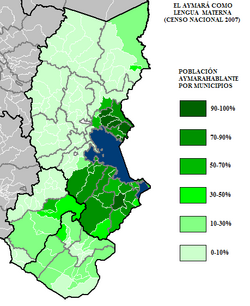
Aymara is concentrated in the high-altitude regions of the Andes. In Peru, its distribution is particularly notable within the southern departments of Puno, Moquegua, and Tacna.
Linguistic Structure and Phonology
Aymara is characterized by a sophisticated sound system. Its consonants include a variety of plosives, fricatives, and approximants, with a notable distinction between voiceless, aspirated, and ejective sounds.
Consonant Inventory
The language utilizes a wide range of articulation points, including bilabial, dental/alveolar, palatal, velar, uvular, and glottal sounds. A distinguishing feature is the use of ejectives (sounds produced with a closed glottis) and aspirated consonants.
Orthography and Writing Systems
Writing Aymara has evolved through various attempts to standardize the script. Early colonial efforts were heavily influenced by Spanish, most notably the system developed by Bertonio. In 1954, the Scientific Alphabet was approved, followed by several other iterations including the Alfabeto Funcional Trilingüe in 1944.
The current standard is the Alfabeto Unificado (Unified Alphabet), sanctioned in Bolivia in 1984 and Peru in 1985. This system consists of 3 vowels and 26 consonants, using an umlaut to indicate vowel length. In a modern twist, a full writing system using the Korean script Hangeul was developed for Aymara in 2015.
Morphology and Grammar
Aymara employs a complex system of suffixes to modify meaning. These are categorized into several types:
- Nominal Suffixes: These include kinship markers (-la, -lla, -chi, -ta), size indicators (-chʼa), and the plural marker -naka.
- Derivational Suffixes: Used to create new words, such as diminutive suffixes.
- Inflectional Suffixes: Including the attributive suffix -ni and possessive paradigms.
A Unique Perception of Time
One of the most striking aspects of Aymara is its conceptual metaphor regarding time. Unlike English speakers, who generally view the future as being "in front" of them, Aymara speakers represent the past as being in front and the future as being behind.
This is based on the logic that the past is known and can be "seen" (hence it is in front), while the future is unknown and cannot be seen (hence it is behind). This rare linguistic phenomenon is reflected in both their speech and physical gestures.
Aymara Language Summary
| Feature | Details |
|---|---|
| ISO 639-1 Code | ay |
| ISO 639-3 Code | aym (Inclusive) |
| Language Family | Aymaran |
| Official Status | Official in Bolivia and Peru |
| Estimated Speakers | 1.7 Million (2007-2014) |
| Primary Script | Latin (Alfabeto Unificado) |
Frequently Asked Questions
Where is Aymara primarily spoken?
Aymara is spoken mainly in the Andean regions of Bolivia and Peru, with smaller populations of speakers in Chile and Argentina.
How does Aymara view the future and the past?
In Aymara culture and language, the past is conceptualized as being in front of the speaker because it is known, while the future is viewed as being behind them because it is unseen.
What is the current official writing system for Aymara?
The most widely accepted system is the Alfabeto Unificado, which was officially sanctioned in Bolivia in 1984 and Peru in 1985.
Is Aymara related to Quechua?
While they share a geographical region and some structural similarities due to long-term interaction, Aymara belongs to the Aymaran language family, distinct from the Quechuan family.
Can Aymara be written in scripts other than Latin?
Yes, while the Latin script is standard, a writing system using the Korean script Hangeul was developed for the language in 2015.