Ludovico Bertonio and the Documentation of the Aymara Language
Ludovico Bertonio (1552–1625) was a pivotal figure in the early linguistic documentation of South America. An Italian Jesuit missionary, Bertonio dedicated a significant portion of his life to studying and codifying the Aymara language, spoken primarily in the Andean regions of southern Peru and Bolivia.
Bertonio joined the Society of Jesus (the Jesuits) in 1575. Six years later, he was dispatched to Peru, where he began his extensive work among the Aymara people. His efforts were not merely religious but academic, as he sought to create structured tools for communication and instruction in a native tongue.
Key Facts
- Identity: Italian Jesuit missionary active in South America.
- Primary Focus: The Aymara language of southern Peru and Bolivia.
- Major Contribution: Authored several foundational grammars and vocabularies of Aymara.
- Printing Hub: Utilized the Jesuit printing press at the mission of Juli in southwestern Peru.
- Lifespan: Born in Rocca Contrada (1552) and died in Lima (August 3, 1625).
The Linguistic Works of Bertonio
Bertonio's scholarly output began with foundational texts designed to introduce learners to the complexities of the Aymara tongue. His earliest publications, released in 1603, included the Arte breve de la lengua aymara para introducir el Arte grande de la misma lengua and the Arte y grammatica muy copiosa de la lengua aymara.
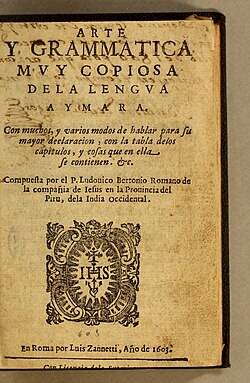
The establishment of a printing press by the Jesuits at the mission of Juli in southwestern Peru allowed Bertonio to produce a surge of literature. In 1612 alone, he published four significant works. These texts ranged from comprehensive dictionaries to religious guides translated into both Aymara and Romance languages (the vernacular languages derived from Latin).
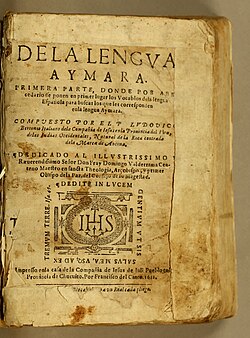
Chronology of Major Publications
The following table summarizes the key texts produced by Bertonio during his tenure in South America.
| Year | Title | Description |
|---|---|---|
| 1603 | Arte y Grammatica muy copiosa de la Lengua Aymara | Comprehensive grammar of the Aymara language. |
| 1603 | Arte Breve de la Lengua Aymara... | A brief introduction to the larger grammar. |
| 1612 | Vocabulario de la Lengua Aymara | A detailed vocabulary/dictionary of the language. |
| 1612 | Arte de la Lengua Aymara... | Grammar including a collection of phrases and Romance translations. |
| 1612 | Libro de la Vida y Milagros de Nuestro Señor Iesu Christo | Bilingual text (Aymara and Romance) on the life of Christ. |
| 1612 | Confessionario muy copioso | Bilingual confessional guide including instructions on the Seven Sacraments. |
Historical Legacy and Debate
Because original copies of Bertonio's publications are rare, modern scholars rely on facsimiles. Julius Platzmann notably published facsimiles of the 1603 Arte y grammatica and the vocabularies to preserve these records for future study.
Bertonio's influence also sparked historical debate regarding the nomenclature of the language. The Peruvian historian Clemente Markham asserted that Bertonio actually invented the name "Aymara." However, this claim was rejected by the Bolivian geographer Manuel Vicente Ballivian in a published pamphlet.
Frequently Asked Questions
Who was Ludovico Bertonio?
Ludovico Bertonio was an Italian Jesuit missionary who lived from 1552 to 1625 and is best known for his extensive linguistic work with the Aymara people in Peru and Bolivia.
Where were Bertonio's books printed?
Many of his works were printed at the Jesuit mission of Juli, located in southwestern Peru, after the Jesuits established a printing press there.
What was the purpose of the "Arte Breve"?
The Arte breve de la lengua aymara was designed as a concise introductory text to prepare students for the more comprehensive Arte grande.
Did Bertonio invent the word "Aymara"?
While the historian Clemente Markham claimed that Bertonio invented the name, this assertion was disputed and rejected by the geographer Manuel Vicente Ballivian.
In which languages did Bertonio write his religious texts?
His religious works, such as the Libro de la Vida y Milagros and the Confessionario, were written bilingually in Aymara and either Romance or Spanish.